Top Mobile App Development Company In The USA: Scale Your Business from MVP to Enterprise
“Trusted by Businesses Across the USA — Fast Apps, Higher Rankings, More Paying Customers.”
“Trusted by Businesses Across the USA — Fast Apps, Higher Rankings, More Paying Customers.”
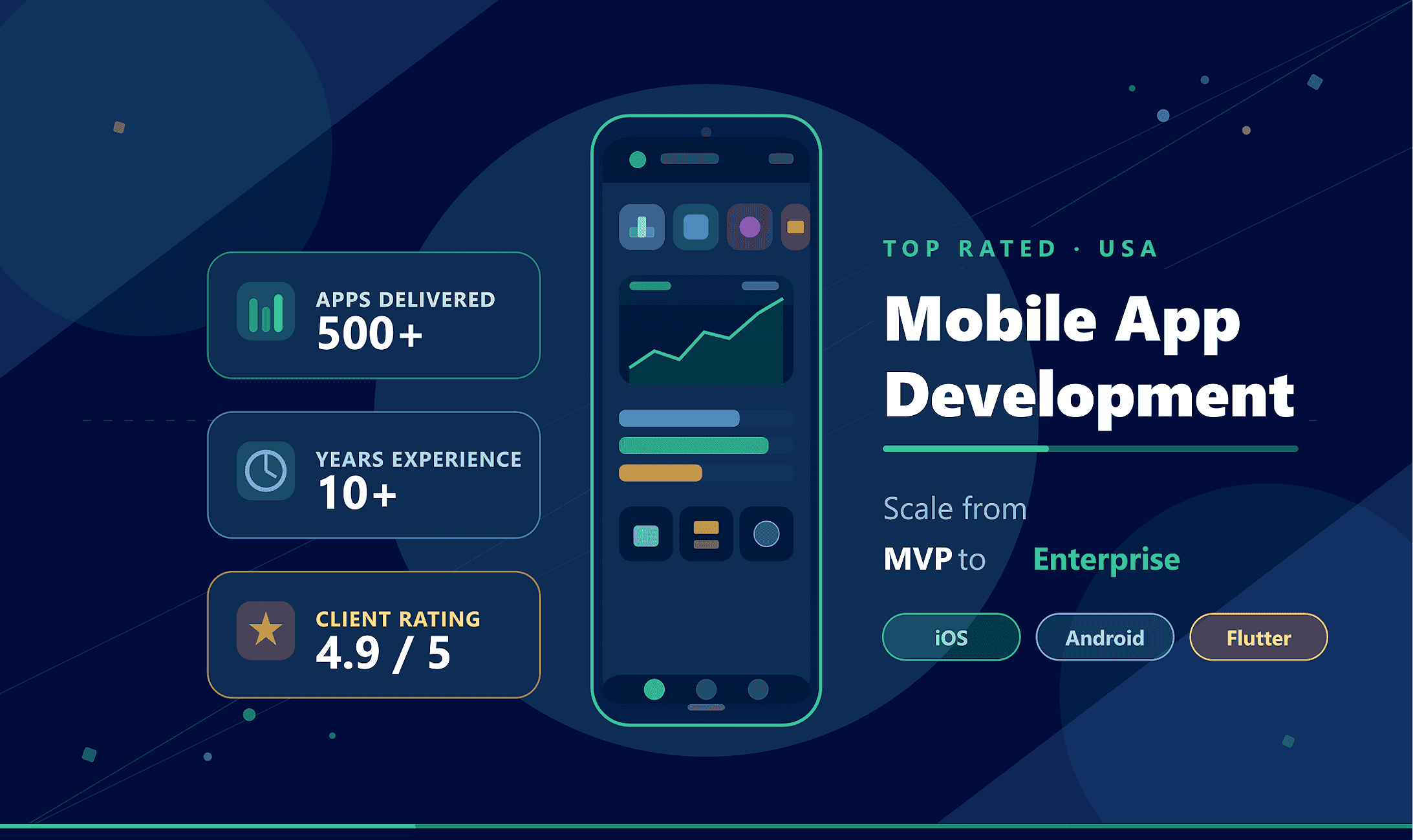
U.S. consumers spend over $52.3 billion on mobile apps every year — and the average person spends 4+ hours a day on their device. If your business doesn’t have a high-performing mobile app, you’re not just missing a channel. You’re handing revenue to competitors who do.
But here is the real problem most businesses face. Finding a mobile app development company in the USA that actually delivers is harder than it sounds. They need to come in on time, on budget, and still be around after launch.
This guide walks you through exactly what to look for, what to avoid, and how to evaluate any app development partner before signing a contract. If you are comparing agencies right now, bookmark this page. The checklist in section 6 alone will save you from the most expensive hiring mistakes in mobile development.
What You’ll Learn In This Guide:
Ready to get a transparent estimate?
Book a free 30-minute discovery call with our U.S.-based team. We will review your goals, give you a platform recommendation, and send a fixed-scope cost estimate within 48 hours. No pitch decks. No obligation.
📌
Highlights
-
✔Mobile is mission-critical. $52.3B in annual consumer spend and 4+ hours of daily usage isn’t a trend — it’s the market reality.
-
✔The platform investment is real (~$8.3B). Build on a scalable architecture, or you’ll pay for it later.
-
✔Startup agility meets enterprise rigor. We deliver real business impact, not just code.
-
✔End-to-end coverage. Design, engineering, compliance, launch, and beyond.
-
✔Speed to market matters. We move fast — and we build for the long game.
Why Mobile Has Become The Primary Revenue Channel For U.S. Businesses
The numbers don’t lie — apps have become core revenue infrastructure for modern brands.
U.S. consumers spend over $52.3 billion annually on mobile applications. Average daily device usage now exceeds four hours. This isn’t casual scrolling. It’s your customer’s primary window into every brand they interact with — including yours. Mobile has become the front door for acquisition, engagement, and direct commerce.
What The $52.3B In Annual App Spend Means For Your Business
The app platform market is worth nearly $8.3 billion. This shows how seriously companies are investing in frameworks, tooling, and developer ecosystems. But there’s a catch: with hundreds of thousands of apps competing for attention in the app stores, showing up isn’t enough. Quality and discoverability are what separate apps that generate revenue from apps that collect dust.
How 4+ Hours Of Daily Usage Changes Your Product Strategy
Four-plus hours a day. That’s your window. Every minute is an opportunity. If your app does not have onboarding, personalization, and performance built in from the start, you are leaving money on the table.
Your customers live in apps. Retailers close sales through mobile checkout. Subscription businesses retain users through app-first experiences. Service providers drive lifetime value through push notifications and smart personalization.
The question is no longer whether to invest in cross-platform apps — it’s whether your mobile app is doing the heavy lifting it should be.
A well-tuned push flow can lift repeat purchases. A frictionless checkout cuts cart abandonment. The right architecture, in the hands of an experienced team, turns daily usage into measurable KPIs.
Why Businesses Choose A Mobile App Development Company In The USA
Speed kills — and so does a bad feedback cycle. Choosing the right development firm starts with one question: Do they work the way your team works?
Working with a U.S.-based team means shared time zones, shared context, and decisions that happen the same day instead of the next morning. Whether your project needs web development support alongside your mobile build, our full-stack teams cover both under one roof. No translation delays. No async lag on critical questions. Just fast, clear communication between people who understand the same market you’re selling into.
We work in the same business hours as your team. That means real-time collaboration, tighter feedback loops, and fewer missed handoffs. The result: faster releases, fewer costly revisions, and a product team that’s actually aligned with your business goals.
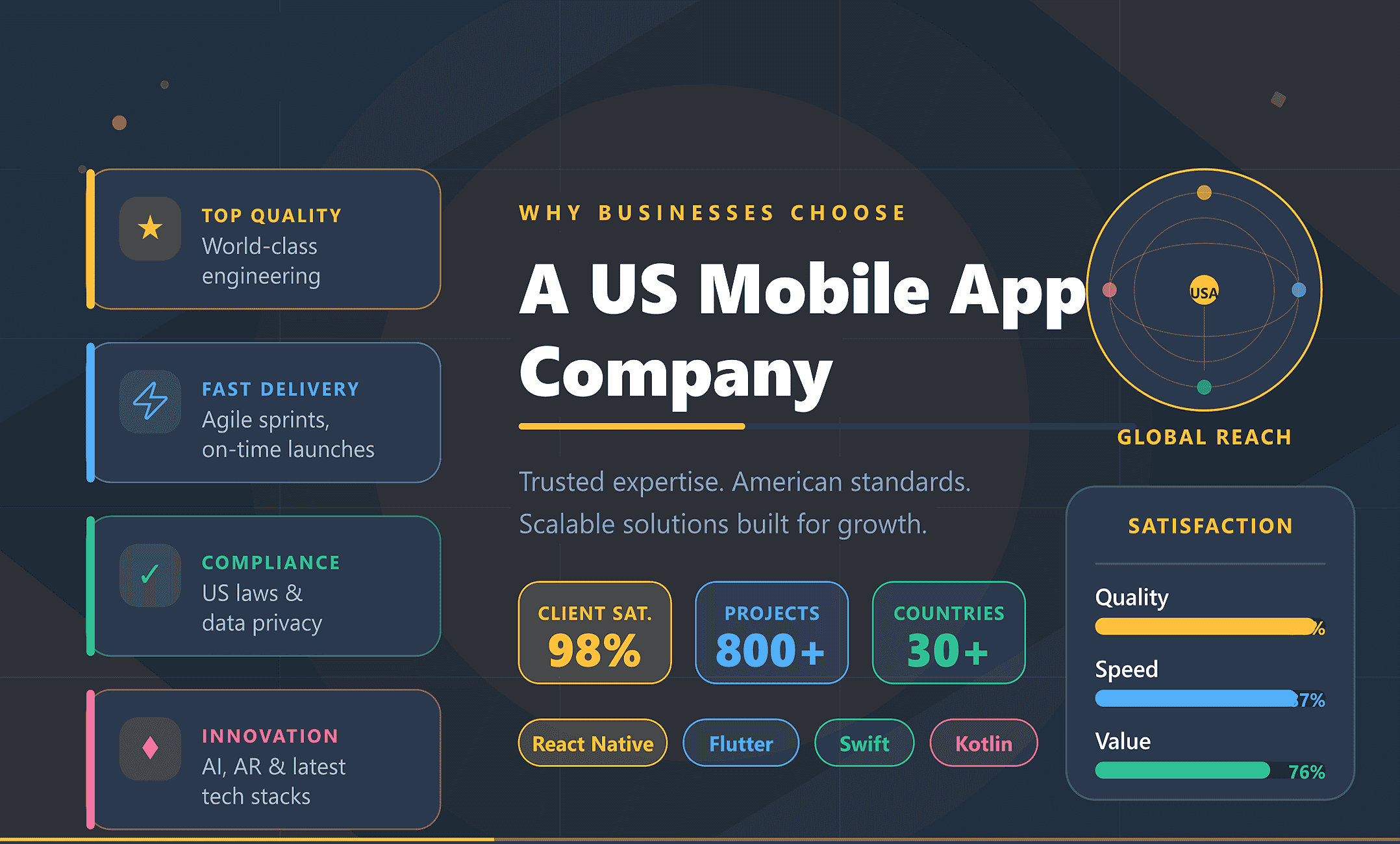
Security isn’t an afterthought here, either. Every project follows ISO 27001-aligned controls, encryption standards, and secure coding practices. Your users’ data deserves nothing less. Your compliance team will thank you, too.
- Same-day collaboration: Work directly with U.S.-based product teams without delays caused by timezone differences.
- Cross-industry expertise: Experience across healthcare, finance, and other sectors with compliance-aware development built into the process.
- Reliable post-launch support: Clear ownership, ongoing optimization, and client outcomes that can be independently verified.
- Dedicated project leadership: Every engagement includes a U.S.-based account manager and a named technical lead.
- Structured communication: Daily standups during overlap hours, weekly sprint reviews, and monthly roadmap planning sessions.
- Long-term maintenance: Support SLAs and post-launch service plans keep your application secure, stable, and up to date.
Trusted by product teams: “Webo 360 Solutions gave us the communication and reliability we needed to hit a tight launch window. The US-based support was excellent.” — Product Lead, B2B SaaS Company.
How To Go From Idea To MVP Without Burning Your Runway
Startups must move quickly to capture market opportunity. We help founders in Silicon Valley, NYC, and Austin launch viable products fast. We do this by combining product strategy, rapid engineering, and transparent pricing. Every mobile app developer on our team is aligned to your business goals — not just the technical spec.
For early-stage teams, time-to-market and validated learning matter more than polished feature sets. If you’re looking to develop a mobile app that captures real market demand, the fastest path is a disciplined MVP — not a full build. That is where our fast-track approach delivers real value.
React Native and Flutter let us cut delivery timelines without sacrificing user experience. Cross-platform tooling lets you test core product assumptions on iOS and Android from a single codebase. This cuts development effort and speeds up investor-ready demos.
Cost transparency is central to our startup offering. We offer clear, fixed-scope MVP quotes and iterative, milestone-based engagements. This helps you manage the runway and show traction to investors. Our process focuses on validated feature delivery. We build the smallest set of features that prove user demand, measure real usage, and then iterate toward growth.
What A Well-Scoped MVP Actually Includes
A well-scoped MVP focuses your first build on what actually matters. It reduces risk, sharpens your pitch for investors, and gives you real user data to work with instead of assumptions. A disciplined product development approach at this stage prevents the rework that kills timelines later.
We lean on React Native and Flutter for most MVPs. These cross-platform frameworks let us ship to iOS and Android at the same time without doubling the engineering work. This compresses your time-to-market without sacrificing UX quality.
MVP + Growth Roadmap (Phases)
- Discovery (1–3 weeks): Stakeholder interviews, hypothesis validation, and KPI definition to align product strategy with business goals.
- Prototype (2–4 weeks): Clickable designs and rapid user testing to validate critical workflows before development begins.
- MVP Build (8–12 weeks): Focused feature development, rigorous QA, and launch to real users for market validation.
- Scale & Grow: Data-driven roadmap expansion focused on retention, monetization, and sustainable product growth.
Common Startup Pain Points We Solve:
- Speed: Deliver investor-ready MVPs in months rather than quarters.
- Cost transparency: Fixed-scope options and milestone-based billing provide predictable investment planning.
- Validated delivery: Product instrumentation and measurable KPIs help demonstrate progress toward product-market fit.
How Long Does MVP Development Actually Take?
Timing matters. Trends open and close. The startups that win are the ones who ship early, learn fast, and iterate before the window moves.
Our US-based teams are aligned with major startup hubs, including Silicon Valley, New York, and Austin. We build with transparent milestones and clear budgets, so founders always know where they stand. No surprises. No scope creep. Investor-ready progress at every stage.
We’ve launched marketplaces that tested pricing mechanics fast. We’ve helped consumer apps use A/B-tested onboarding to drive meaningful activation lift. Every time, cross-platform development saves weeks of engineering time and lets teams learn faster.
Ready to scope your MVP? We’ll give you a fixed-price estimate and delivery timeline within 48 hours — no obligation.
Example Snapshot:
A Silicon Valley marketplace founder shipped an MVP in 10 weeks using React Native. Built on a single React Native codebase, the app launched simultaneously on iOS and Android. In the first month, they achieved 3x week-over-week user growth. D7 retention hit 42% — above the category benchmark — and those metrics became the centerpiece of a successful seed funding round.
Which Technologies Should Your Mobile App Be Built On?
The tech stack you choose isn’t just an engineering decision. It’s a business decision.
Pick the wrong foundation, and you’ll pay for it every time you try to scale. Pick the right one and your infrastructure becomes a competitive advantage — not a liability. Every software development decision you make at this stage compounds over time — for better or worse.
We build cloud-native backends. They scale elastically, respond fast, and run predictably. Cloud-first architecture and secure API design work together. They protect user data and simplify integrations. This also keeps compliance manageable for regulated industries.
AI and machine learning have crossed the line from experimental to essential. Personalization, smart recommendations, and automated workflows now drive conversion and retention. The real question is: where in your product does reducing friction with AI move the revenue needle?
Flutter and React Native give product teams faster deployment without sacrificing quality. Most startups and growth-stage companies ship faster and spend less by sharing a codebase across iOS and Android. Users get a native-feel experience and won’t notice the difference.
The right choice depends on your product. Consumer apps chasing reach and speed? Cross-platform is often the right call. Performance-critical or hardware-heavy? Native Android and iOS development is the better path. Enterprise backends requiring long-term stability and deep integrations?
The same applies when a web app needs to share logic and APIs with your mobile product — architecture decisions made here affect both. That’s where robust Java app development earns its keep.
What Enterprise-Grade Mobile App Development Actually Requires
Enterprise mobile apps need to be secure, maintainable, and able to connect with complex back-office systems. We design enterprise-grade mobile apps that connect to legacy CRM and ERP platforms. They enforce strict security controls and scale with your business. For enterprises managing both mobile and web touchpoints, we ensure consistent architecture and security across every layer. We often build Java backends to deliver reliable APIs and enterprise integration patterns.
Our teams in Boston and Seattle focus on regulated industries like healthcare and finance. In these sectors, HIPAA and PCI compliance, data residency, and auditability are non-negotiable. We encrypt data at rest and in transit, enforce role-based access control, and monitor continuously. These are designed to meet enterprise security requirements.
Building a scalable solution means more than writing code. It requires architecture that supports growth, observability, and maintainability. We build our systems using modular microservices and secure API gateways. For legacy systems, we use message-driven integration. CI/CD pipelines keep delivery reliable at scale.
For Example:
Our enterprise teams follow Java best practices to build high-throughput APIs that are easy to support long term.
Architecture Snapshot
Here is the enterprise architecture we typically recommend. Start with a Java-based backend serving secure REST or GraphQL APIs behind an API gateway. Use OAuth2 or OpenID Connect for identity and access management. Encrypted data stores and backups protect your data.
Kafka or RabbitMQ handles asynchronous messaging for decoupled legacy integration. Prometheus and the ELK stack provide monitoring and logging for operational visibility. This pattern supports integration with CRM/ERP systems while maintaining performance and compliance.
We build systems that grow with you. Fast under load. Resilient under failure. Secure by design. When mobile becomes a core revenue channel, downtime and security gaps stop being engineering problems. They become business problems.
Ensuring Long-Term Scalability
Our Java backends power the high-performance APIs that enterprise products depend on. Java gives you strong concurrency handling, mature monitoring tooling, and long-term stability. These are things large-scale operations actually require — not just features that look good in a pitch deck.
Our cloud architects and compliance leads design deployments built to meet enterprise SLAs. For healthcare clients, that means HIPAA alignment built into the architecture. For payment flows, this means PCI-conscious data paths and tokenization from day one. Not retrofitted compliance scrambles before launch.
Enterprise Architecture Snapshot
- Core services: Java-based microservices with Kubernetes orchestration, API gateways, and scalable service architecture.
- Data flow: Secure APIs, message queues, and analytics pipelines with role-based access controls and encryption both in transit and at rest.
- Security controls: Tokenization, audit logging, automated vulnerability scanning, and scheduled penetration testing to strengthen compliance and risk management.
- Monitoring & scaling: Centralized logging, APM tooling, auto-scaling policies, and multi-region failover to support high availability and operational resilience.
Mini Case Study — Enterprise Integration
A large healthcare provider needed a modern mobile front-end layered over legacy EMR and billing systems. They came to us to get it done without compromising HIPAA controls or disrupting core operations.
We built a Java-based API layer with controlled endpoints and added middleware adapters for their legacy ERP. We then deployed a cloud-native architecture with strict encryption and role-based access controls. The result was clean, audited data flows and a successful compliance review. A phased rollout modernized the user experience without touching the systems the business depended on.
- Legacy system integration: CRM and ERP connectivity with real-time data synchronization and minimal operational disruption.
- Secure API architecture: Tokenization, audit trails, and security-first API design built to support regulatory and compliance requirements.
- Ongoing support & maintenance: Continuous monitoring, performance optimization, and security updates to keep systems reliable over the long term.
HIPAA, PCI, And Mobile App Compliance: What You Need Before You Launch
Compliance added at the end isn’t compliance — it’s a liability.
Every mobile app that handles sensitive data needs security and legal controls woven into the product lifecycle from day one. Not as an afterthought. Not as a launch-week checkbox. From the first design decision.
Meeting HIPAA Healthcare Requirements
If your app touches protected health information, HIPAA isn’t optional. Every healthcare project includes strict security measures. We build in:
- Role-based access controls: Restrict access to sensitive systems and data based on user roles and permissions.
- Strong encryption: Protect data both at rest and in transit using industry-standard encryption protocols.
- Immutable audit trails: Maintain tamper-resistant activity logs for compliance, traceability, and security monitoring.
We also apply least-privilege identity management.
We also produce the documentation that regulators and partners need. This includes policies, risk assessments, remediation plans, and runbooks. Everything is ready for audit day — not drafted in a panic the week before.
Maintaining PCI Compliance For Financial Data
Card payment flows require PCI DSS compliance, full stop. We design payment handling with secure gateways, tokenization, and tightly scoped card data zones. This shrinks the compliance surface as much as possible. Regular vulnerability scans and penetration tests catch risks before they become incidents.
Compliance Checklist For Product Owners
When To Call Us
- Incident response & remediation: You’ve identified a breach, failed an audit, or uncovered a critical vulnerability and need immediate corrective action.
- Pre-launch compliance readiness: You’re preparing to collect PHI, payment information, or other sensitive data and need compliant systems from day one.
- Legacy system modernization: You’re migrating or integrating existing platforms into a compliant mobile or cloud-based backend environment.
- Ongoing compliance management: You require recurring assessments, policy updates, monitoring, and maintenance to support long-term regulatory compliance.
Mobile App Development Company In The USA: Our Unique Value Proposition
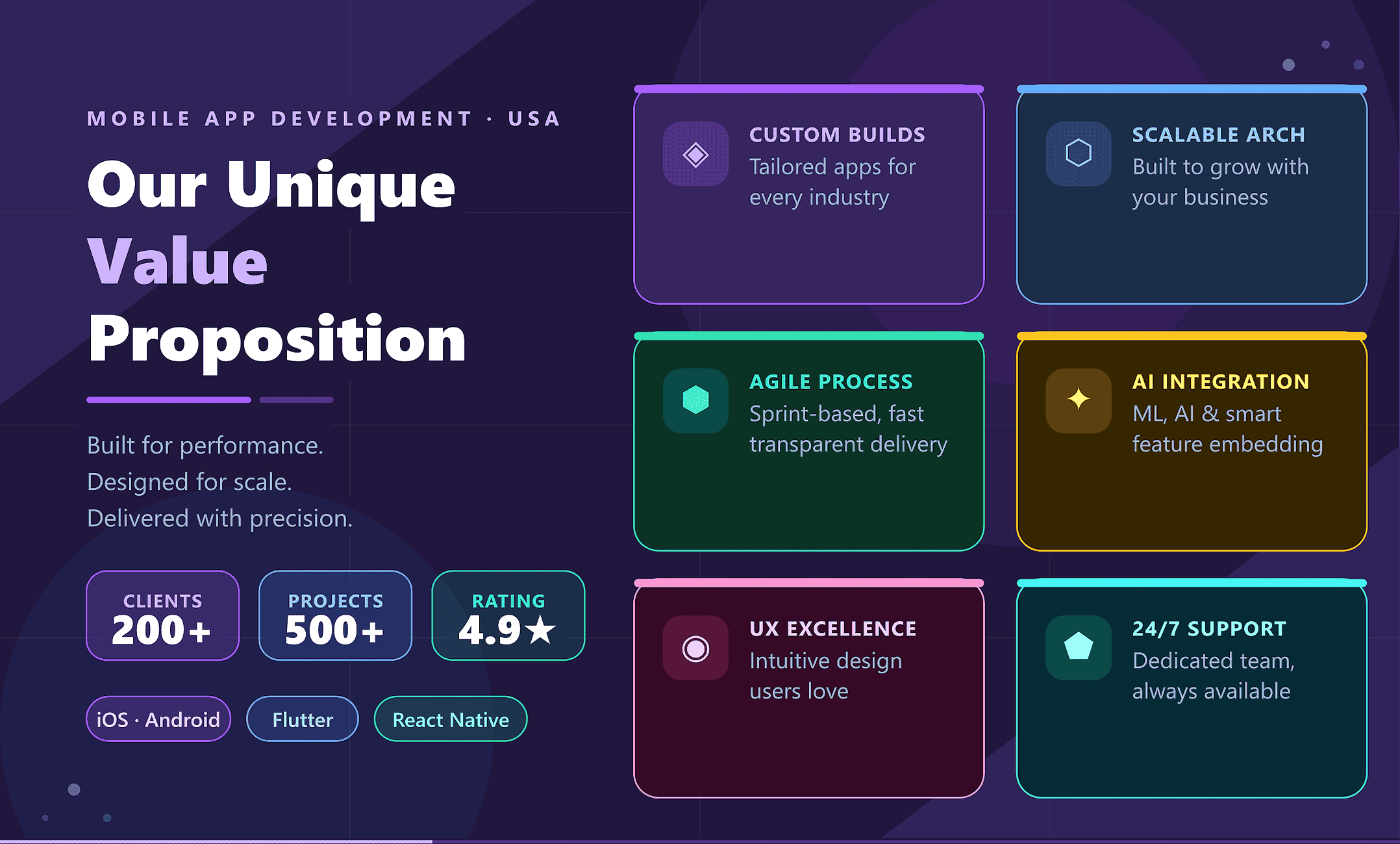
Local market knowledge matters. As a US-focused mobile app development company, we combine regional insight with technical excellence to build apps that resonate with American users. We also ensure every app meets domestic regulatory and business requirements. That market alignment shortens feedback cycles and improves product-market fit.
Our value proposition pairs engineering rigor with a client-centered delivery model. We deliver custom, end-to-end mobile app development services that USA clients depend on. This covers everything from concept and UX to backend APIs and post-launch support.
Whether your product needs mobile app development, web development, or both, we cover the full stack. Our teams follow proven processes that emphasize quality, security, and measurable outcomes.
Choosing a local partner provides tangible advantages:
- Accountability: Transparent delivery processes, U.S.-based contracts, and direct access to project leadership throughout the engagement.
- Collaboration: Shared time zones and cultural alignment support faster decision-making and more efficient product iterations.
- Personalized experience: Dedicated teams that operate as long-term partners, supporting your growth and digital transformation goals.
- Expertise: Extensive experience across iOS, Android, and web application development, including enterprise integrations and industry-specific solutions.
Advanced Technologies Driving Innovation
Innovation powers competitive advantage. We integrate advanced technologies across mobile and web services development to solve specific business problems. Every tool we choose improves your product metrics.
AI & Machine Learning
Personalization, recommendation engines, and predictive analytics increase engagement and conversion. Our AI work focuses on practical models that lift key metrics like click-through rates and retention. At the same time, we keep inference efficient on mobile and backend services.
Augmented Reality (AR)
We use AR features to create immersive product experiences. These tools boost user acquisition and time-on-app for retail, real estate, and training. We design AR flows that prioritize discoverability and performance across devices.
Blockchain
We build custom blockchain integrations for apps. These are perfect if you need tamper-evident records or decentralized trust. Our solutions enhance security and auditability while keeping user friction low.
Cloud-Native Architectures
Cloud-native patterns (microservices, containerization, managed services) provide the scalability and observability enterprises need. These architectures reduce time-to-market for new features and improve operational resilience.
Low-Code & Cross-Platform Tools
We use Flutter and React Native to speed up product delivery. This allows your team to iterate rapidly and cut development costs without losing UX quality.
We apply technology decisions pragmatically, choosing the right tool for the right problem. Our senior engineers publish architecture notes and whitepapers on technical tradeoffs. These patterns help product teams make informed choices.
How Much Does Mobile App Development Cost In The USA?
Knowing what it costs to build a mobile product is essential for planning and prioritization. App pricing depends on scope, integrations, platform, and ongoing support. There is no single number — but transparent estimates help you make informed tradeoffs.
For a scoped MVP with typical features, iOS development averages around $27,000 and Android around $23,000. Typical features include authentication, core workflows, a basic backend, and analytics.
These figures are ballpark MVP costs. Complex requirements push estimates higher. These include enterprise integrations, advanced security, and real-time features.
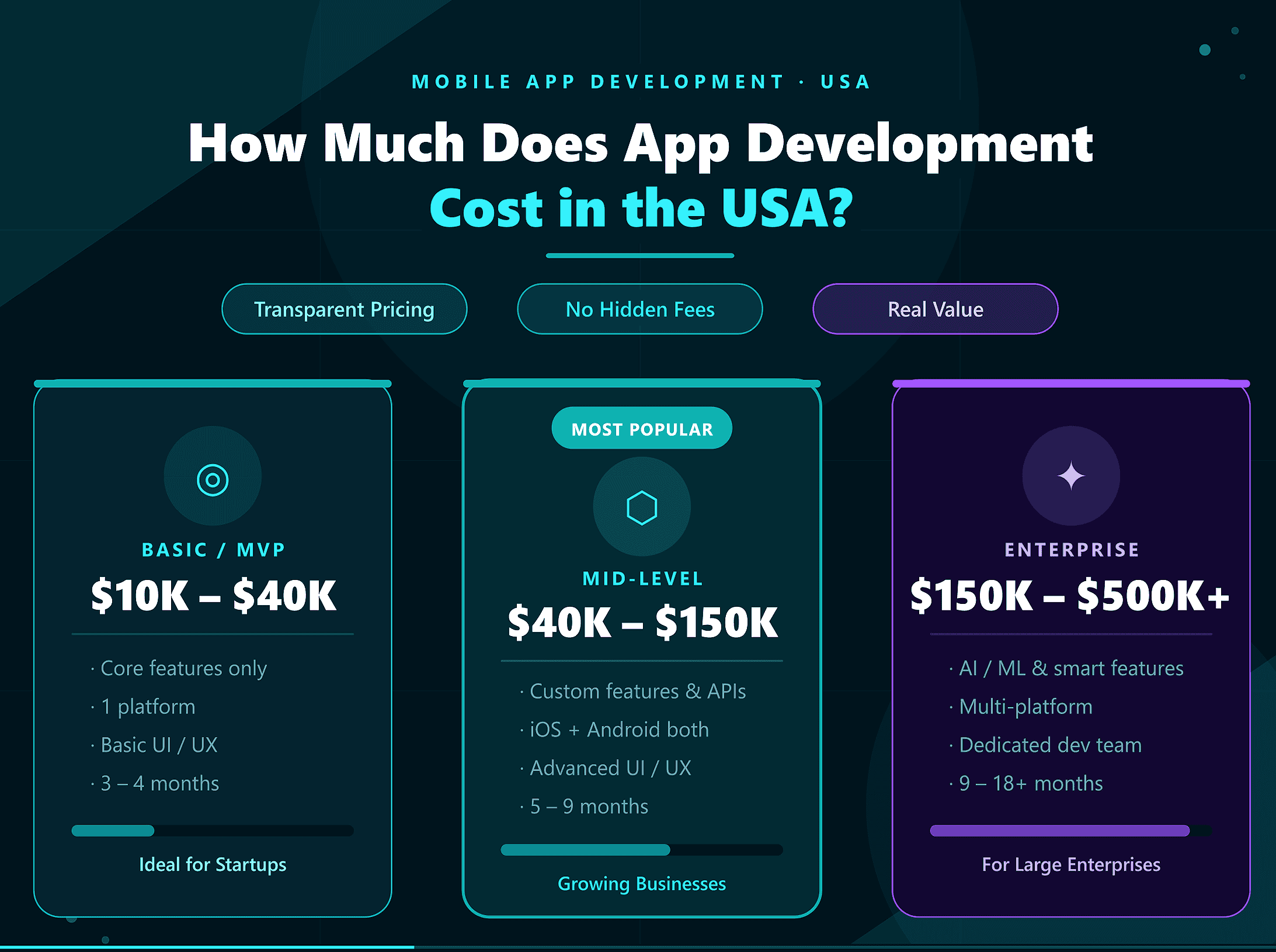
Typical cost drivers to clarify during scoping include:
- Feature complexity: Requirements such as payment processing, offline synchronization, real-time messaging, and advanced workflows significantly influence effort and cost.
- Backend integrations: CRM, ERP, legacy system connections, and third-party APIs add development and testing complexity.
- Compliance & security: Requirements such as HIPAA, PCI, data residency, and audit controls may require additional engineering and validation.
- Design & UX requirements: Custom animations, accessibility standards, multi-brand experiences, and advanced UI systems increase project scope.
- Post-launch support: Ongoing monitoring, platform updates, OS compatibility, and feature enhancements contribute to long-term investment.
We offer two common engagement models to suit different needs:
- Fixed-Price MVP: A defined scope, clear deliverables, and predictable costs make this model ideal for startups and early-stage teams managing budgets and timelines.
- Time & Materials (T&M): Flexible sprint-based or hourly engagement suited for enterprise initiatives, legacy integrations, and evolving product requirements, with full transparency into progress and resource allocation.
When you scope a project with us, we map features to cost and prioritize high-impact work to maximize early ROI. Clear roadmaps and transparent estimates reduce surprises. They also help you plan funding milestones with confidence.
How UX Design Directly Impacts Your App’s Retention And Revenue
Bad UX doesn’t just frustrate users. It kills conversion, tanks retention, and sends people straight to your competitors.
Great design does the opposite. It makes complex workflows feel effortless. It makes users want to come back. And it starts long before a single screen is built — which is why we treat design and development as one continuous process, not two separate handoffs.
We begin every engagement with user research — mapping real behaviors, actual pain points, and the core journeys that matter. Not assumptions. Not gut instinct. Real data that makes every design decision defensible and every feature worth shipping.
Wireframes and rapid prototypes validate navigation before engineering begins. Usability tests catch the problems that look fine in a design review but fall apart in someone’s hands. Early-stage testing prevents the late-stage rework that blows timelines and budgets.
From there, we build clean, modern interfaces. We balance beautiful aesthetics with great performance and accessibility. Reaching your broadest possible audience means neither experience nor speed can be sacrificed.
An exceptional user experience is one of the fastest ways to increase adoption, retention, and lifetime value for your product. Our design practice focuses on measurable UX outcomes that directly impact business metrics. These include fewer drop-offs, higher conversion rates, and stronger engagement.
Our UX process is structured to reduce risk and validate assumptions quickly:
- Discovery: Stakeholder interviews, competitive analysis, and user research define target personas, priorities, and measurable success metrics.
- Wireframes & flows: Low-fidelity layouts that clarify information architecture and map key user journeys.
- Prototyping: Interactive prototypes that validate core experiences through early stakeholder and user feedback.
- Usability testing: Moderated and unmoderated testing sessions identify friction points and validate design decisions with real users.
- Iterate & handoff: Final UI components, accessibility validation, and developer-ready assets delivered with design system guidance.
UX Deliverables
- Personas & journey maps: Detailed user profiles and end-to-end experience mapping.
- Information architecture & wireframes: Structured navigation models and page layouts.
- Clickable prototypes & test reports: Interactive experiences supported by usability findings and recommendations.
- Design systems & accessibility assets: Reusable UI components, visual guidelines, and compliance checklists.
- Optimization roadmaps: Post-launch A/B testing plans and continuous improvement recommendations.
Done correctly, UX improvements produce measurable outcomes such as faster task completion, higher onboarding success rates, and stronger long-term retention.
- Research-driven decisions: User insights based on real behavior rather than assumptions.
- Rapid validation: Prototype testing confirms ideas before significant engineering investment.
- Continuous improvement: Ongoing iteration guided by analytics, KPIs, and user feedback.
At every stage, you receive clear deliverables that help align stakeholders, reduce risk, and accelerate product development.
This process ensures your final product balances great design with technical feasibility. It also maximizes your overall business value.
Examples of Impact:
Our design work typically reduces onboarding drop-off and speeds up task completion. It also increases your overall feature adoption. We track and report on all of these metrics during post-launch optimization.
Mobile App Development By Industry: Healthcare, Finance, Logistics, And More
One-size-fits-all apps rarely deliver the outcomes businesses need. We build custom mobile apps tailored to the regulatory, operational, and UX requirements of your industry. The goal is a custom app solution that solves real problems and drives measurable value for your specific industry.
Healthcare
We build healthcare mobile apps that meet strict compliance requirements. These include HIPAA controls, auditability, and secure data handling. Typical solutions include patient engagement portals, telehealth interfaces, and clinical workflow tools. These integrate with EHRs while preserving privacy and uptime.
Finance
We build fintech and financial service apps with a focus on security. Our systems feature secure transactions, clear audit trails, and PCI-aligned payment flows. Authentication is robust and supports MFA and biometrics. We design architectures that balance performance, regulatory compliance, and fraud protection.
Logistics & Supply Chain
We build mobile solutions for tracking, route optimization, and warehouse workflows. These tools integrate directly with your ERP systems to reduce manual data entry. They also improve operational visibility and accelerate fulfillment times.
Education & Enterprise Productivity
We build scalable applications for everything from learning platforms to field services. These range from mobile-first tools to full web development platforms with offline and cross-device support. We ensure your apps include offline capabilities, role-based access, and clear analytics. These help measure engagement and outcomes.
Across these industries, we focus on resilient architecture and seamless CRM and ERP integrations. We also apply industry-specific UX best practices to every project. Our developers and architects deliver enterprise integrations with care. We design our systems to minimize disruption and maximize your operational efficiency.
How To Connect A Modern Mobile App To Your Legacy CRM OR ERP
Legacy systems hold your most valuable data and your most critical business logic. They’re also, almost always, the biggest bottleneck standing between you and a modern mobile product.
The answer isn’t ripping them out. That’s expensive, risky, and often unnecessary. The answer is an API-first integration strategy. It unlocks the data trapped in those systems and delivers it to a modern mobile front-end. Your core operations stay untouched.
We build custom middleware and API layers to connect legacy CRM, ERP, and database systems with modern mobile experiences. Controlled endpoints. Standardized data contracts. No fragile point-to-point integrations that break every time someone updates a schema.
How the data flows:
Legacy database → middleware adapters (ETL/transform) → secure API gateway → business microservices → mobile application. Legacy systems stay intact. Mobile gets what it needs. Everyone keeps moving.
- Enterprise-grade API security: Secure APIs with rate limiting, tokenization, and audit logging designed to meet modern enterprise security standards.
- Staged migration strategy: Controlled rollout processes keep mission-critical systems operational while minimizing disruption and downtime.
- Middleware & adapter architecture: Protect existing technology investments while enabling new functionality, integrations, and advanced reporting capabilities.
Legacy Migration Readiness Checklist
- Inventory critical systems: Identify key endpoints, dependencies, and data ownership across the organization.
- Validate data governance: Review schemas, retention requirements, and sensitive data classifications.
- Assess integration options: Confirm available database access, APIs, message queues, and other connectivity points.
- Map compliance requirements: Document encryption, masking, audit logging, and regulatory obligations throughout data flows.
- Define rollback procedures: Establish staged cutover plans and recovery processes before implementation begins.
The Role Of Cloud Integration In App Performance
Your backend is either an asset or a bottleneck. There’s rarely a middle ground.
A properly architected cloud backend makes your app feel instant. It delivers real-time sync, consistent performance, and the headroom to scale without firefighting. A poorly architected backend means slow load times and outages during traffic spikes. It also means engineering teams spending their days on infrastructure instead of product.
We design cloud-native solutions built for how modern mobile products actually behave. This means handling unpredictable traffic, global users, and zero tolerance for downtime. This applies equally to a native mobile product and a high-traffic web app running shared backend infrastructure.
Hybrid multi-cloud strategies let products route traffic intelligently. They also allow you to store records where compliance requires and recover from failures fast. They also prevent lock-in to a single vendor’s pricing model.
- Real-time synchronization: Instant updates across devices and sessions using event streams and publish/subscribe architectures—eliminating polling delays and stale data.
- Elastic scaling: Auto-scaling infrastructure and managed cloud services handle traffic spikes without requiring changes to core application logic.
- Hybrid architecture: A balanced mix of public cloud, private cloud, and edge computing resources optimized for cost, performance, security, and compliance requirements.
How The Architecture Flows
Static assets are served through an edge CDN. Requests pass through an API gateway with WAF protection. Authenticated containerized microservices handle the core logic. Message queues manage async work.
Managed databases and analytics pipelines handle storage and reporting. This pattern minimizes latency, contains blast radius, and supports A/B tests and feature flags. You can ship changes safely without a full release.
Cloud Readiness Checklist
Building Trust Through Transparent Communication
Most project failures aren’t technical. They’re communication failures that snowballed.
Missed updates, unclear status, and stale information can wreck a project. These communication gaps turn a manageable problem into a blown timeline and a damaged relationship. Frequent, honest communication doesn’t just feel good. It materially reduces project risk.
We keep every client current on where the project stands, what’s at risk, and what’s coming next. Progress reviews tie directly to business goals, not just engineering velocity metrics that mean little to product owners. We track delivery health through velocity, burndown, cycle time, and release signals. These numbers go into a shared dashboard, so your team sees the same data we do.
Sprint demos surface real feedback early. Issues get caught when they’re cheap to fix — not two sprints later when the scope has grown around them.
We use industry-standard project management tools to keep teams aligned. Our process includes shared backlogs, release dashboards, and clear decision logs. This gives you 24/7 visibility into status and risks — not just whatever ended up in the last email thread. Our delivery team holds regular office hours for questions, demos, and ad-hoc reviews.
Transparency isn’t a soft value for us. It’s what earns repeat engagements.
Native vs. Cross-Platform Mobile Development: Which Is Right For Your Product?
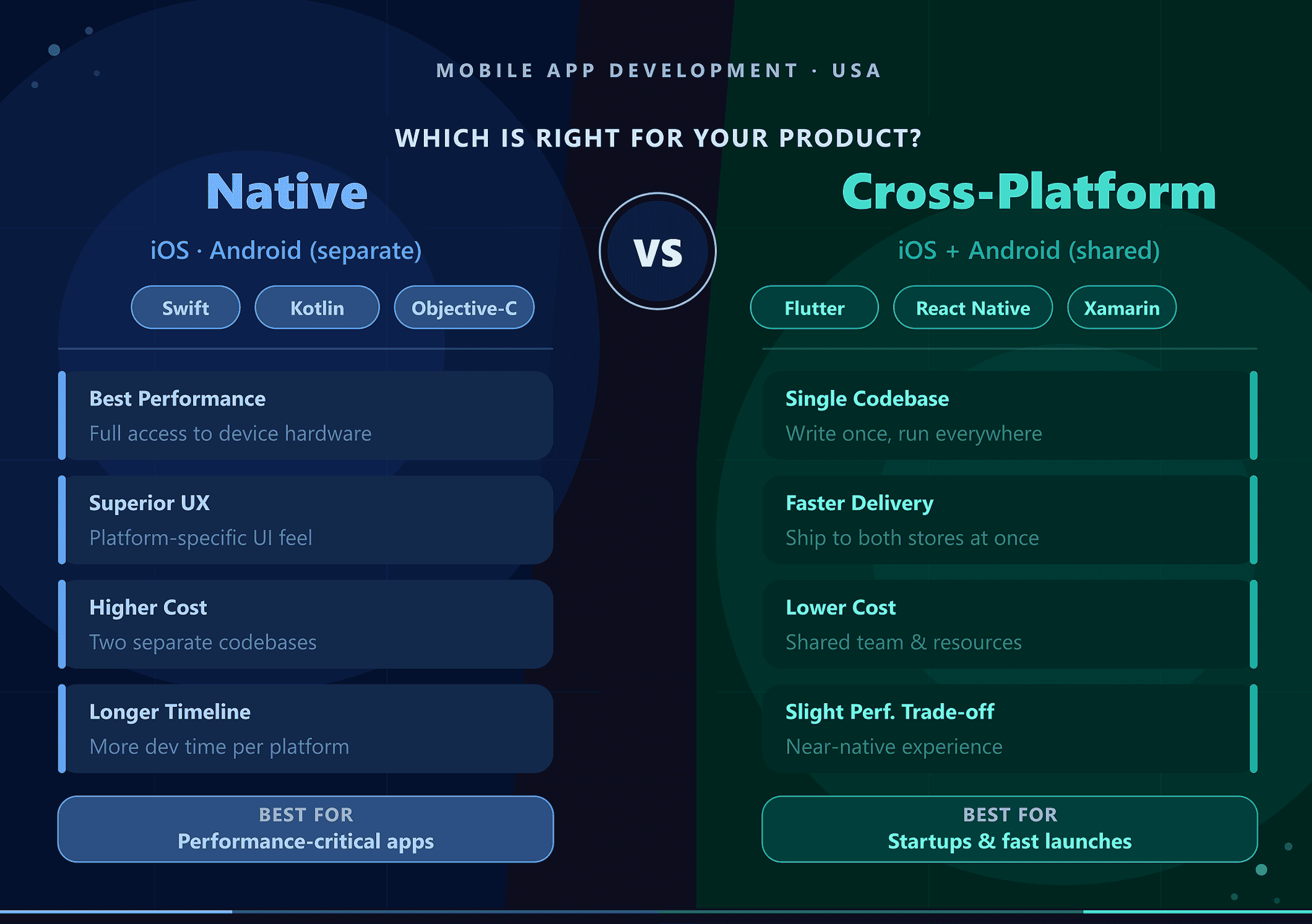
A great mobile experience on iOS and Android can be built with either native or cross-platform approaches. The right choice depends on your product goals, budget, timeline, and long-term support requirements.
When To Choose Native
Native development using Swift or Objective-C for iOS and Kotlin or Java for Android is the right choice when:
- High-performance experiences: Applications with AR, real-time gaming, advanced graphics, or complex animations that demand maximum GPU performance.
- Deep hardware integration: Projects requiring direct access to cameras, Bluetooth, NFC, biometrics, sensors, and other device-level capabilities.
- Platform-specific features: Support for capabilities such as iOS Live Activities, Android widgets, and other operating-system-specific experiences.
- Regulated environments: Enterprise applications requiring strict compliance, auditability, and highly controlled native architectures.
- Dedicated platform teams: Organizations with separate iOS and Android engineering teams responsible for long-term ownership of each codebase.
In these situations, native development delivers the performance, flexibility, and platform integration needed to justify the additional investment.
When Cross-Platform Makes More Sense
Cross-platform frameworks such as React Native and Flutter are often the better choice when:
- Dual-platform launch is required: Reach iOS and Android users simultaneously while controlling development costs and timelines.
- MVPs and business applications: Ideal for consumer apps, internal tools, and early-stage products where speed and broad reach matter most.
- Faster time-to-market: A shared codebase can reduce development timelines by 30–40% compared to separate native applications.
- Consistent user experience: Shared business logic and UI components ensure similar functionality across devices with minimal platform-specific variation.
- Lower maintenance overhead: Managing a single codebase simplifies updates, testing, and long-term product support.
Modern cross-platform frameworks provide near-native performance for most startup and enterprise applications while reducing costs and accelerating delivery.
Decision checklist — which route fits your product?
Not sure which fits your product? Not sure which approach gives you the best app for your users and your budget?
We run a one-hour platform strategy workshop. We review your goals, budget, and compliance requirements and give you a clear recommendation with reasoning.
6 Questions To Ask Before Hiring A Mobile App Development Company In The USA
Choosing the wrong mobile app development firm is one of the most expensive mistakes a U.S. business can make. A failed or delayed app drains budget, delays market entry, and erodes internal confidence in mobile as a channel. Before you sign a contract, ask every development agency these six questions — and evaluate their answers critically.
If you’ve been working through a list of the top mobile app development companies in the USA, these six questions are what separate the ones worth hiring from the ones worth avoiding.
1. Do They Offer Genuine Pricing Transparency?
Vague estimates are a red flag. A credible mobile app development company in the USA should offer a fixed-scope MVP quote with line-item deliverables. They should also be able to provide a time-and-materials model with milestone billing. Ask for a sample project breakdown before committing. If they can’t show you how they price, they can’t help you manage your budget.
2. Can They Show Domain-Specific Case Studies With Real Metrics?
Generic portfolios are not enough. Ask for case studies relevant to your industry, such as healthcare, fintech, logistics, or enterprise SaaS. Look for measurable outcomes like time-to-MVP, retention improvements, compliance achievements, or integration results. Anonymized data is acceptable; vague testimonials are not.
3. What Does Post-Launch Support Actually Include?
Many development agencies disappear after launch. iOS and Android release new OS versions annually — your app must be updated to stay functional and compliant. Ask specifically if post-launch support is included or billed separately. Do they cover OS upgrades, third-party SDK updates, and bug fixes? What are the SLA response times for critical issues?
4. How Do They Handle Legacy Integrations And Compliance?
Enterprise apps rarely live in isolation. Your product may need to connect to a CRM, ERP, payment gateway, or EHR system. If so, your technology partner needs proven experience with those exact integration patterns. For regulated industries, ask about their HIPAA, PCI, or SOC 2 experience. Also, request documentation of their secure software development lifecycle practices.
5. Do They Provide Measurable KPIs And Verifiable References?
Any agency can claim results. Ask for client references you can actually contact. Also, ask for published architecture notes or whitepapers. They should also provide a clear framework for how they define and track success metrics, such as:
- DAU/MAU and retention cohorts: Measure user engagement, stickiness, and long-term retention trends across different user segments.
- Conversion rates: Track how effectively users complete key actions such as registrations, purchases, subscriptions, or lead submissions.
- Crash-free session rates: Monitor application stability and reliability by measuring the percentage of sessions completed without errors or crashes.
6. What Is Their Platform Recommendation Process?
A trustworthy partner does not push one technology stack for every project. Ask how they evaluate and choose the right tech stack for your product. Specifically, have them explain their criteria for selecting:
- Native development: iOS (Swift) or Android (Kotlin) applications built for maximum performance, deep device integration, and platform-specific experiences.
- Cross-platform frameworks: Flutter or React Native solutions that accelerate delivery and reduce maintenance by sharing a single codebase across platforms.
- Backend technologies: Java and other server-side platforms that power APIs, business logic, integrations, security controls, and scalable cloud infrastructure.
Their reasoning process tells you whether they are thinking about your product — or their own convenience.
Use this checklist in every vendor conversation. The agency that answers all six with clarity, evidence, and specifics is the best mobile app development partner for your project.
Proven Delivery: Real Results Across Startup And Enterprise Projects
We’ve shipped products across Silicon Valley, NYC, Austin, Boston, and Seattle. Here’s what that looks like in practice.
We work where the fastest-moving tech ecosystems operate — and we’ve built the kind of track record that holds up when clients compare notes.
Marketplace MVP — Cross-Platform, 10-Week Delivery
A two-founder startup needed an investor-ready MVP to validate demand before committing to a full build. We scoped a fixed-price engagement and built on React Native to ship iOS and Android at the same time. We instrumented the product with retention metrics from day one.
Result: MVP live in 10 weeks. 3x week-over-week user growth in month one. The retention curve from that first month became the centerpiece of their seed funding pitch — and they closed the round.
A tight feature scope, no scope creep, and analytics built in from the start rather than added later.
Enterprise Healthcare Integration — HIPAA-Compliant, Zero Operational Disruption
A regional healthcare provider needed a modern mobile front-end layered over legacy EMR and billing systems. The core infrastructure had to stay untouched. And it all had to pass a HIPAA audit.
We built a Java-based API layer with controlled endpoints and added middleware adapters for their legacy ERP. We then deployed a cloud-native architecture with encryption and role-based access controls throughout.
Result: 40% reduction in patient onboarding time. Clean audit trails. Successful compliance review. The legacy systems stayed untouched — the user experience transformed completely.
Compliance was built into the architecture from day one, not added in the week before launch.
Consumer Fintech App — PCI-Compliant, 4.7-Star Launch
A NYC fintech startup needed a secure payment and budgeting app to compete in the crowded US consumer finance market. Requirements included biometric authentication, real-time transaction syncing, and a PCI-compliant backend. All of it had to ship within 14 weeks.
Result: Zero critical findings in a third-party penetration test at launch. 4.7-star rating on both the App Store and Google Play within 60 days.
Tokenized payment flows and a tightly scoped card data zone were designed before a single screen was built.
B2B SaaS Mobile Dashboard — 38% DAU Lift in 90 Days
An Austin SaaS company needed a mobile companion for their enterprise platform. This included dashboards, report submission, and push alerts for field teams. It also needed offline capability for low-connectivity environments.
Result: Built in React Native with CRM integration and role-based access. Delivered in 11 weeks. Field team daily active usage of the core platform increased 38% within 90 days of the mobile launch.
Offline sync and role-based access were designed upfront, not bolted on after user complaints.
See results from your industry. We’ve shipped compliant, scalable mobile products for healthcare providers, fintech startups, logistics operators, and retail brands. Each engagement came with full architecture documentation and a measurable post-launch outcome. Ask us for the one most relevant to your use case.
⚠ All case studies represent real engagements. Client names are anonymized by mutual agreement. Architecture diagrams and compliance documentation are available to share during a scoping conversation.
Data-Driven App Optimization
Post-launch analytics and continuous optimization are essential for long-term growth. Together, they turn a shipped application into a highly valuable business asset. We instrument apps to collect signals that inform product decisions and improve user engagement over time.
We continuously track and optimize key performance metrics to ensure product growth. Our team monitors essential KPIs like DAU/MAU, retention cohorts, and conversion funnels. We also measure activation rates, overall churn, and feature adoption.
We also monitor crash rates, API latency, and crash-free sessions. We combine event-based analytics, session recordings, and A/B testing. This helps us identify high-impact opportunities and verify improvements.
Typical optimization workflow:
- Instrumentation: Define events and KPIs, implement analytics SDKs, and configure backend tracking for reliable data collection.
- Baseline analysis: Establish current performance, engagement, and conversion benchmarks across key user cohorts.
- Hypothesis & testing: Prioritize experiments and A/B tests to validate product improvements and business assumptions.
- Rollout & monitoring: Release updates gradually using feature flags while monitoring performance, stability, and user impact.
- Iterate & scale: Promote successful experiments to production and continuously plan the next optimization opportunities.
We also prioritize data privacy and compliance (GDPR/CCPA) when designing analytics and reporting. Our delivered reports include a sample dashboard that highlights your key metrics. We also provide recommended experiments and a prioritized roadmap for feature optimization.
5 Mobile App Development Trends Shaping U.S. Businesses
The mobile landscape is evolving quickly. Here are the five trends shaping mobile app development in the USA right now — each framed as a question you should ask your app development partner.
1) AI & ML For Personalization
We use advanced AI and machine learning models to maximize your product metrics. Our team implements smart integrations to:
- Personalize experiences: Deliver tailored content, recommendations, and user journeys based on individual behaviors, preferences, and intent signals.
- Automate complex workflows: Streamline repetitive processes, reduce manual effort, and improve operational efficiency through intelligent automation.
- Surface predictive insights: Identify trends, anticipate user needs, and uncover opportunities that increase engagement, retention, and business performance.
2) Cross-Platform & Low-Code Growth
We help you choose the ideal framework to accelerate your time-to-market. Our team explicitly recommends when to leverage React Native, Flutter, or low-code platforms. This strategic choice ensures you scale quickly without compromising quality or long-term maintainability.
3) Subscription-First Monetization
Our development strategy fully supports subscription and service-first revenue models. We seamlessly build free trials, tiered subscriptions, and in-app services. We also integrate the analytics you need to measure lifetime value (LTV), retention, and churn.
4) Edge Computing & Privacy-First Design
We balance on-device processing and latency reduction with user privacy. Our engineering team builds local-first architectures that minimize data collection and support CCPA and GDPR compliance requirements. This approach delivers fast, private experiences without sacrificing performance.
5) Super Apps & Platform Consolidation
Platform consolidation is accelerating — fewer, broader apps that bundle multiple services into one experience. Your roadmap needs to account for this shift and the integration complexity that comes with it. We help you plan for it before it becomes a problem.
The right framework choice is a product development decision as much as an engineering one.
Staying competitive means asking these questions early. Choose a partner who can turn trends into practical product decisions and sound architecture.
Why U.S. Businesses Choose Webo 360 Solutions
Webo 360 Solutions is a US-based mobile app development partner. We combine enterprise-grade engineering with startup agility. Our software development process is built around outcomes — not just deliverables. We specialize in custom mobile app development for Android and iOS. Our teams across Silicon Valley, NYC, Austin, Boston, and Seattle build secure, scalable software.
We specialize in delivering high-performance applications for healthcare, finance, retail, and logistics. Java backends are available for projects that need them.
What Sets Webo 360 Solutions Apart
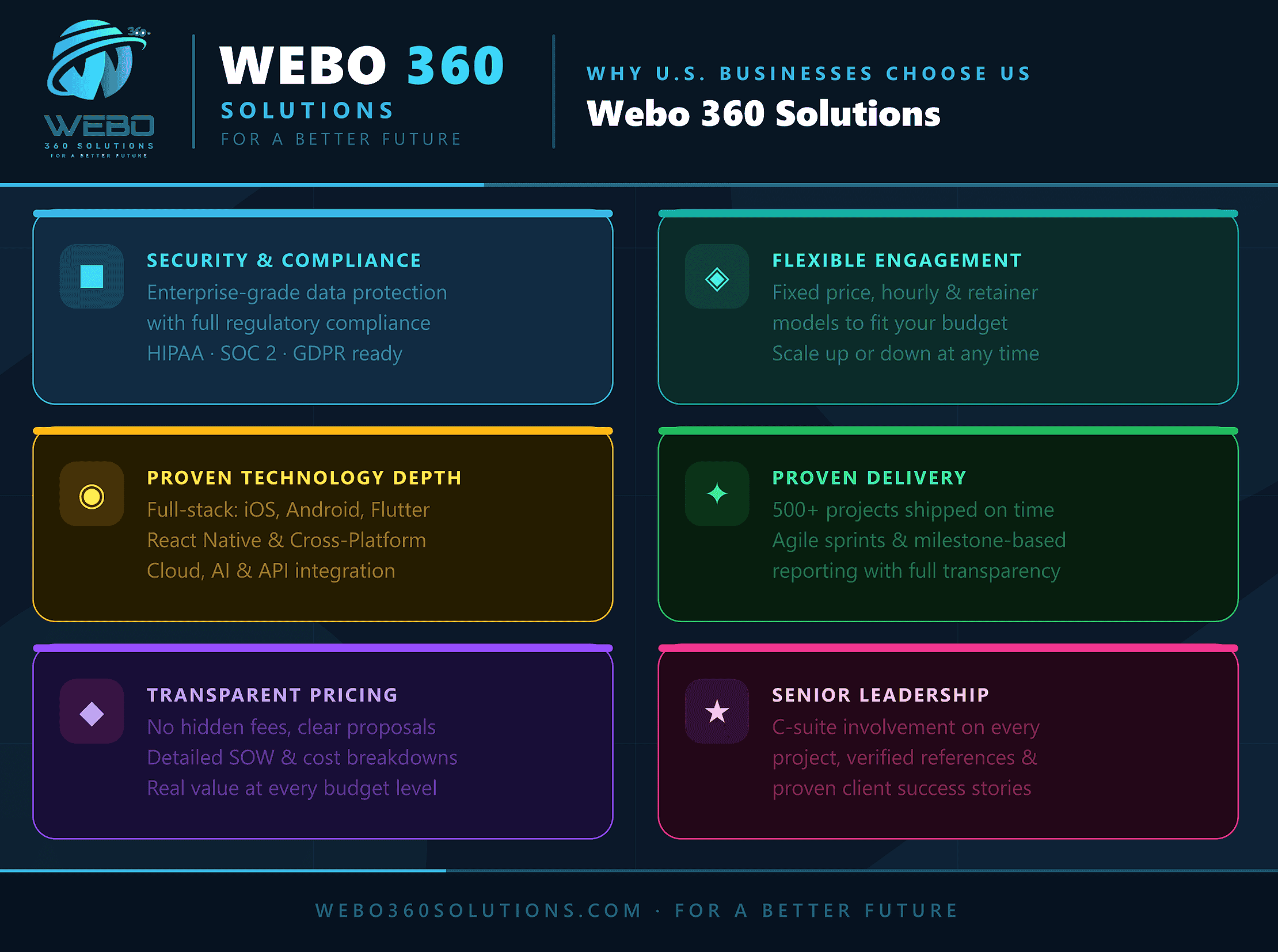
Credibility & Certifications: Webo 360 Solutions has over 8+ years of experience. We build secure mobile products tailored for healthcare, finance, retail, and enterprise organizations. Our teams follow SOC 2-aligned development processes and bring deep expertise in scalable architecture, cloud-native platforms, and enterprise Java development. See our Boston and Seattle case studies for examples of compliance-focused architecture, complex integrations, and measurable business outcomes.
-
✔Security and compliance: We build HIPAA and PCI-aware architecture with secure engineering practices. Our documentation holds up under audit.
-
✔Flexible engagement: Full product teams, talent on demand, and engagement models that match your pace and budget.
-
✔Proven technology depth: We deliver native and cross-platform mobile apps alongside cloud-native backends. By combining this with our deep Java expertise, we build resilient services tailored for the enterprise.
-
✔Proven delivery: We have delivered projects across startups and enterprises with measurable outcomes. For scoped engagements, the average time-to-MVP is three to four months. Anonymized client metrics are available on request.
-
✔Transparent pricing: We offer fixed-scope MVPs and clear milestone billing. This helps startups and businesses control runway and hit funding milestones.
-
✔Senior leadership & references: We believe in total transparency throughout your project. Our team provides dedicated, named technical leads and publishes clear architecture notes. We are also happy to share direct client references upon request. All are available on request to validate delivery quality.
Product-market fit, measurable engagement lifts, and reliable post-launch support. Whether you need a rapid MVP, a complex enterprise integration, or long-term maintenance, we tailor every app solution to match your exact objectives, timeline, and budget.
What Our Clients Say
Webo 360 Solutions delivered PCI-compliant payment flows and measurably reduced checkout drop-off. Their team handled complex integrations with our legacy payment infrastructure seamlessly. Throughout the project, we had full visibility into every milestone.
Series B Fintech Company (New York, NY)
We launched a fully instrumented MVP in under 12 weeks. The milestone-based delivery process gave our investors exactly the traction data they needed — and we closed our seed round shortly after launch.
B2C Marketplace Startup (Austin, TX)
Their Java expertise and compliance-first architecture made our EMR integration straightforward. We passed our HIPAA audit on the first review — no remediation required.
Regional Healthcare Network (500+ beds, Midwest)
After launch, our 30-day retention improved significantly and conversion on the mobile checkout flow jumped meaningfully. Their post-launch support has kept the app stable through two major OS updates.
D2C Retail Brand (50,000+ monthly active users)
Results That Matter
- Rapid MVP delivery: Accelerate product-market validation with investor-ready prototypes and production-grade MVPs delivered on predictable timelines.
- Enterprise integrations: Connect legacy CRM, ERP, and business systems through staged rollouts, minimal operational disruption, and clearly defined SLAs.
- Security-first development: Healthcare and finance solutions built with compliance documentation, audit readiness, and enterprise-grade security controls from day one.
- Long-term product support: Ongoing mobile application monitoring, performance optimization, maintenance planning, and strategic feature roadmaps that evolve with your business goals.
Conclusion
That’s what Webo 360 Solutions is built to do.
U.S.-based teams. Real-time collaboration. Whether you need mobile and web under one roof or a focused native app, we build it right the first time. Security and compliance are designed into every project from day one. Product-first engineering doesn’t stop at launch — it continues through optimization, support, and long-term growth.
Whether you’re a founder shipping your first product or an enterprise untangling years of legacy infrastructure, we bring the process, the people, and the post-launch commitment needed to make it work. The best time to get the architecture right is before you need to fix it.
Book Your Free Strategy Session — Get a Roadmap in 48 Hours or request an MVP roadmap workshop. You’ll walk away with a clear recommendation for your product, timeline, and budget. No pitch decks. No vague next steps. Just a practical assessment of what to build, how to build it, and what it will take to scale.
Frequently Asked Questions
What services do you offer in mobile application development?
- Strategy & Design: Mapping clear product roadmaps and intuitive UX/UI designs for mobile and web development.
- Mobile Engineering: Building native and cross-platform apps for iOS and Android.
- Backend Infrastructure: Engineering secure APIs and robust backend systems using Java.
- Launch & Maintenance: Providing rigorous QA testing, advanced security protocols, and proactive post-launch support.
How long does it take to develop an MVP?
What industries do you specialize in?
- Healthcare & Finance: Building highly secure platforms that meet strict regulatory and compliance standards.
- Retail & Logistics: Engineering high-converting digital architectures and seamless supply chain integrations.
- Education: Developing scalable, user-centric platforms built for modern learning environments.
Which technologies and frameworks do you specialize in?
For web app projects, we apply the same performance and security standards as our native mobile builds.
How do you ensure the quality and security of applications?
- Proactive Architecture: Conducting early threat modeling and continuous SAST/DAST code scanning.
- Automated Deployment: Combining automated and manual QA testing with gated CI/CD pipeline checks.
- Continuous Validation: Our team runs regular penetration testing on your platform. We identify and patch security vulnerabilities early in the development cycle. This proactive testing ensures your software is fully protected before its official launch. We align with SOC-style controls and provide documentation for compliance audits.
Can you support integrations with legacy systems like CRM and ERP?
What is your approach to UX and user engagement?
Our design and development process runs in parallel — so what gets designed is always buildable, and what gets built always reflects the design intent.
Do you support startups with rapid prototyping and MVPs?
How do you handle post-launch support and scaling?
We ensure your system runs smoothly and handles traffic spikes effortlessly at scale. This proactive care ensures your product scales smoothly as your user base grows, rather than just performing well on release day.
How do you price projects, and what procurement questions should we ask?
How do you measure project success and ROI?
How do you compare to offshore development models?
What is your onboarding process for new clients?
How do you support analytics and data-driven product decisions?
What makes you a reliable partner for long-term digital transformation?
How do I get started?
Ready to build something that lasts?
The best time to get the architecture right is before you need to fix it. Whether you’re mapping a new product, evaluating a rebuild, or just figuring out where to start — let’s talk now.