The Future Of Artificial Intelligence: How AI Will Shape The Future Of Business And Everyday Life Over The Next 10 Years
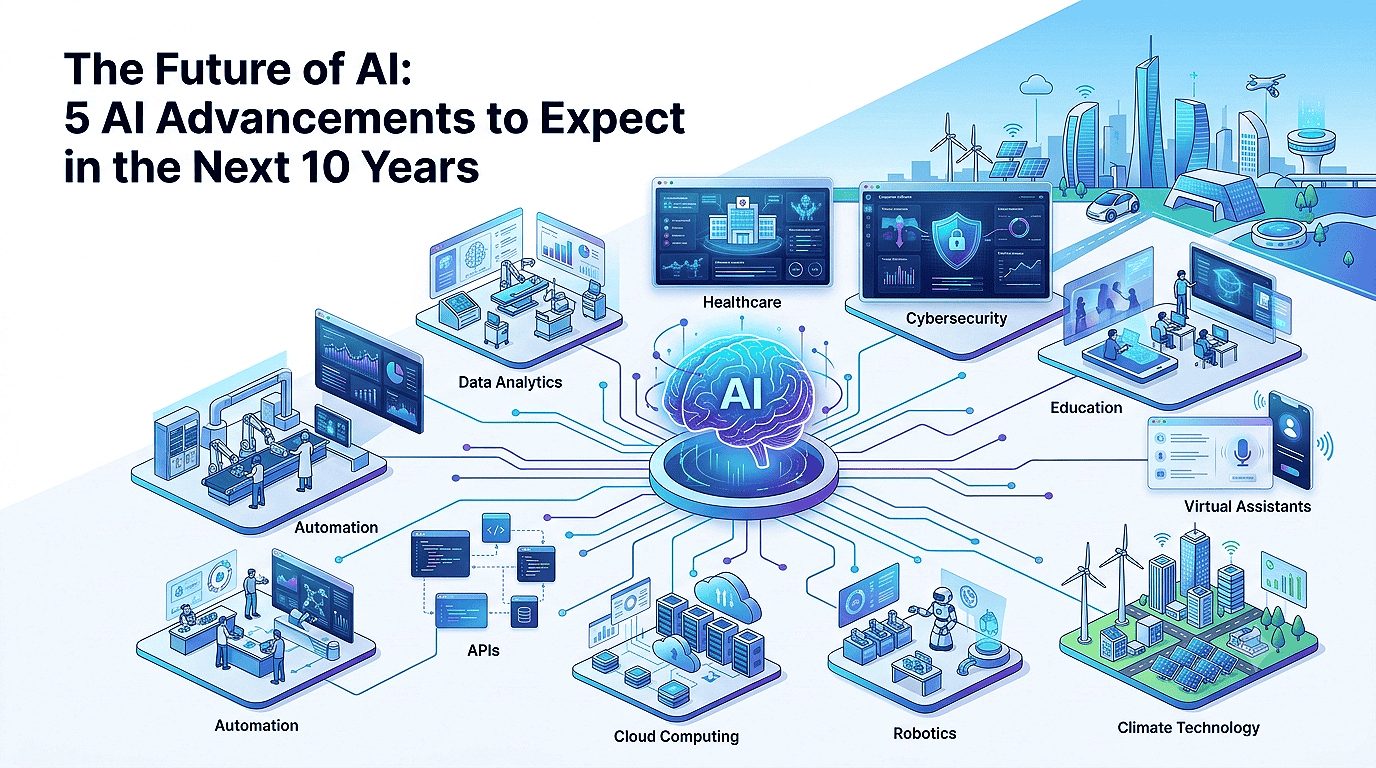
The future of AI is a shift from tools you operate to systems that operate for you. The year is 2026, and AI no longer waits for your instructions. It acts. The AI-powered future belongs to autonomous agent software that plans, decides, and finishes work while you focus on bigger problems. This shift has a name: Agentic AI, and it is already changing how companies run.
The adoption data explains the urgency. Stanford’s 2026 AI Index reports that 88% of organizations now use AI in at least one business function, up from 78% a year earlier.
Generative AI runs in at least one business function at 70% of organizations. The estimated consumer value of Intelligent business solutions in the United States reached $172 billion a year by early 2026, up from $112 billion twelve months before.
Three years ago, you typed a prompt and read an answer. Today, an AI agent books the meeting, drafts the contract, and flags a threat before you notice it. Every business leader needs to understand this moment.
Early adopters gain a real edge. AI in cybersecurity now spots attacks in seconds. AI in education personalizes learning for millions of students at once. These systems run quietly in the background of daily work.
The companies that prepare now will lead their markets. The ones that wait will spend years catching up. AI has become a competitive advantage, not a science project.
This article covers the five advancements set to define the next decade: AI in cybersecurity, AI in education, personalized healthcare, AI virtual assistants, and AI for climate change. Each one is moving out of pilots and into production right now.
Methodology & Disclosure
This 2026 analysis draws on hands-on implementation work, published industry research, technical documentation from leading AI labs, and the adoption patterns we see across live client deployments. We did not build it on forecasts alone.
Our view combines real project experience with current movement in machine learning systems, generative AI, automation, robotics, cybersecurity, healthcare technology, and enterprise software.
AI moves fast. Models, regulations, pricing, and adoption curves shift within months, and some claims here will age.
Treat everything below as strategic guidance, not a guarantee. It reflects the best information available at the time of publication.
📌Key Takeaways
-
✔The AI’s future centers on autonomous agents that plan, act, and complete tasks with little direction.
-
✔AI in cybersecurity now detects threats at machine speed, with 94% of security teams already using it somewhere in operations.
-
✔AI in education personalizes instruction at scale, and four in five US students already use AI for schoolwork.
-
✔Personalized healthcare uses predictive diagnostics, AI-assisted drug discovery, and continuous monitoring to improve outcomes.
-
✔AI virtual assistants have become digital coworkers that run a full process, not simple chatbots.
-
✔AI for climate change optimizes energy use and forecasting, though its own energy footprint demands careful planning.
-
✔Companies that invest in integration, automation, and governance now will hold a durable advantage.
Businesses that invest in AI integration, automation, and governance today will be better positioned to increase performance, reduce operational costs, and gain a long-term competitive advantage.
Working with an experienced intelligent system development partner ensures secure implementation, seamless integration, regulatory compliance, and scalable AI solutions.
What Is The Future Of Artificial Intelligence?
The future of intelligent technology is a move from tools you operate to systems that operate for you. You used to sit at the keyboard and guide every step. Now the work happens in the background, connected to your email, your data, and your software.
This is a big change. Older AI needed a human to prompt it, review it, and prompt it again. Agentic systems chain those steps together and complete whole tasks on their own.
The growth numbers explain the rush. Stanford’s 2026 AI Index found that organizational adoption reached 88% of surveyed companies. Employee use is just as steep. Globally, 58% of employees reported using AI on a semi-regular or regular basis in 2025.
The value is real, not hype. In the United States alone, the estimated value of generative AI tools to consumers reached $172 billion annually by early 2026. Every business is investing because the future of intelligent systems now touches revenue, cost, and speed at the same time. Sitting still is an expensive option.
AI By The Numbers
Advanced intelligence systems are no longer an emerging technology—it’s becoming a core driver of business growth, business performance, and innovation worldwide. The latest research highlights just how quickly AI adoption is accelerating across industries.
These figures illustrate why the future of intelligent systems is no longer a distant prediction—it is already reshaping how organizations operate, make decisions, and compete.
From AI in cybersecurity and AI in education to personalized healthcare AI and virtual assistants AI, businesses that invest early are better positioned to improve efficiency, deliver better customer experiences, and unlock long-term growth.
📊 Quick Insight: AI adoption has moved beyond experimentation. Organizations are now measuring success through productivity gains, cost savings, stronger cybersecurity, personalized customer experiences, and faster decision-making. Companies that delay AI adoption risk falling behind competitors already benefiting from intelligent automation.
Top AI Trends Driving The Evolution Of AI
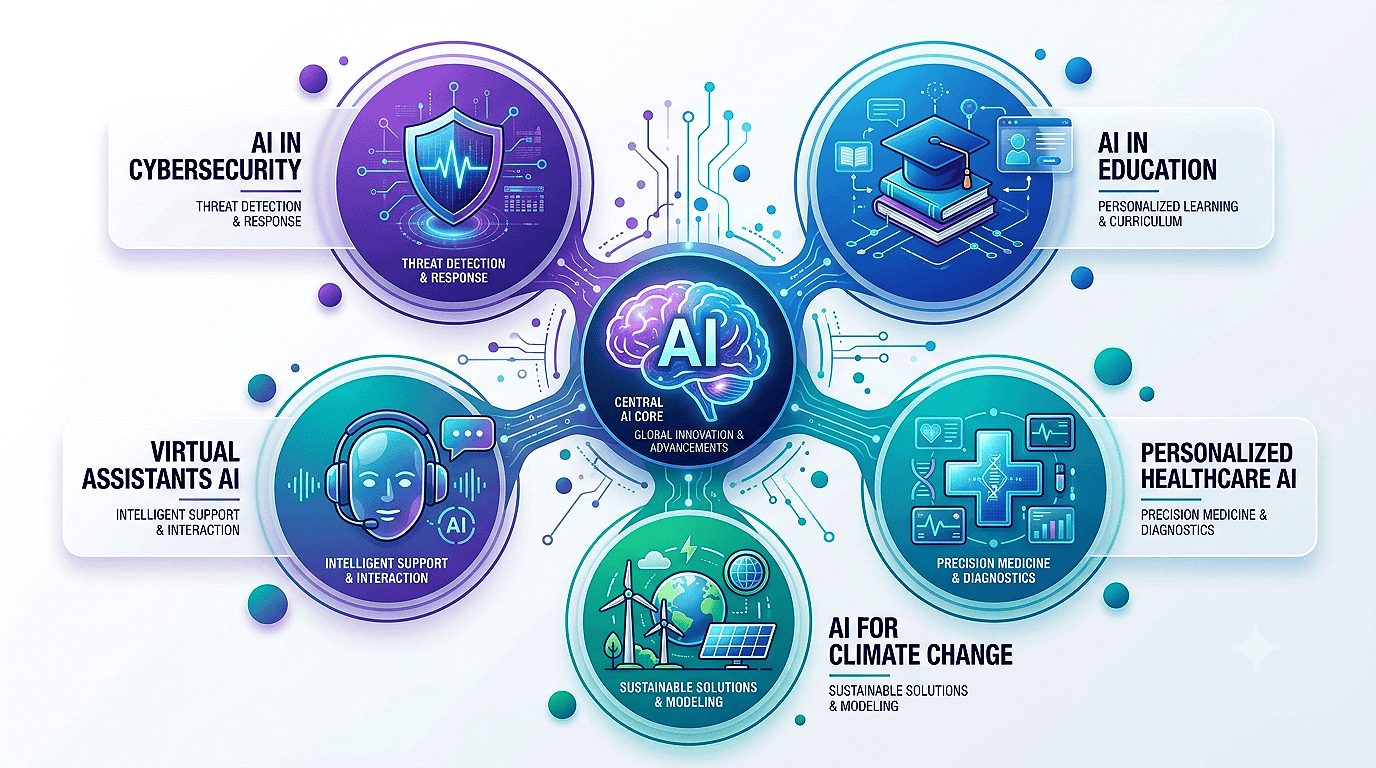
Four capabilities sit under every advancement below.
Generative AI turned text, image, code, and video creation into a daily habit for knowledge workers. Tools like ChatGPT, Claude, and Gemini set the pace, and the quality gap between human and machine output keeps shrinking.
Autonomous agents take a goal, break it into steps, and act across your software without step-by-step direction. Stanford notes that agent deployment still sits in the single digits across most business functions, which tells you how much room remains to grow.
AI automation now handles invoices, scheduling, data entry, and reporting on its own, which frees teams for judgment and strategy.
Edge AI runs models directly on phones, cameras, and sensors, so decisions arrive in milliseconds and data stays local, fast, and private.
Generative AI
Text, images, code, and video now flow from a single request. Tools like ChatGPT, Claude, and Gemini turned generative AI into a daily habit for knowledge workers. The quality gap between human and machine output keeps shrinking.
Autonomous AI Agents
This is the headline act of 2026. Agents take a goal, break it into steps, and act across your tools without hand-holding. They research, decide, and execute while you review the outcome, not every keystroke.
AI Automation
Repetitive work is fading fast. AI now handles invoices, scheduling, data entry, and reporting on its own. Your team spends its hours on judgment and strategy instead.
AI + Robotics
Software intelligence is moving into the physical world. Warehouses, factories, and hospitals run robots that see, adjust, and learn on the job. The line between digital and physical work is thinning.
Edge AI
Not every decision can wait for the cloud. Edge AI runs models directly on phones, cameras, and sensors, so responses arrive in milliseconds. This keeps data local, fast, and private.
“Need to integrate AI into your existing software? Your systems already hold the data. The advantage comes from connecting intelligent agents to it.”
AI In Education
Learning is getting personal at scale. AI tutors adjust to each student’s pace, strengths, and gaps in real time. A struggling learner gets extra practice while an advanced one moves ahead, in the same class.
Smart platforms track engagement and surface what students miss. AI grading returns feedback in minutes instead of weeks, which frees teachers to teach. AI agents now draft lesson plans and assessments in minutes, with personalization built in from the start.
The role of AI has changed in 2026. It moved from a side experiment to a core part of training design, delivery, and assessment. AI agents now plan lessons and draft assessments in minutes, with adaptive personalization built in from the start.
Student behavior confirms the demand. Stanford’s 2026 AI Index reports that four in five US university students now use generative AI for coursework. The audience is already here, and the platforms that meet it will lead.
Comparing The Top AI Advancements Shaping The Future Of AI
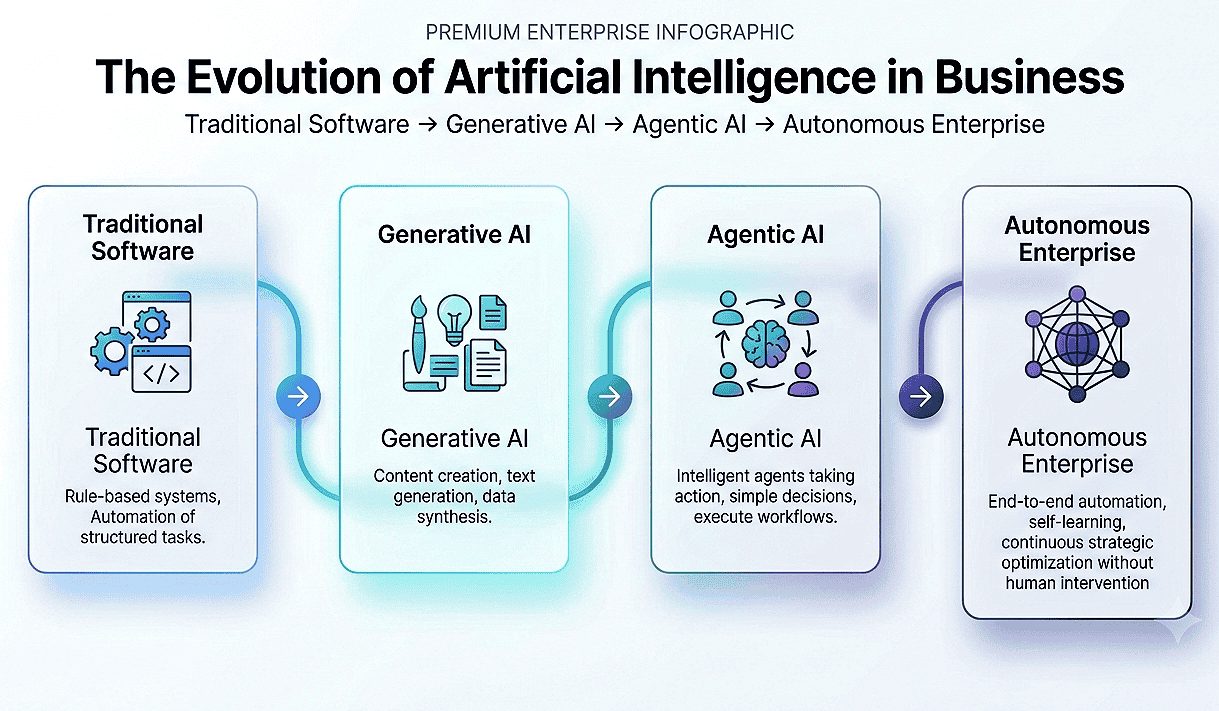
Deciding where to invest in AI starts with understanding what each technology is designed to solve. Every advancement brings different strengths, levels of maturity, and business value. Comparing their practical use cases, potential impact, and current adoption helps organizations focus investment on the AI capabilities that best support long-term growth and competitive advantage.
Each of these technologies contributes to the AI-powered future in different ways. Many organizations achieve the greatest value by combining multiple AI capabilities rather than relying on a single solution.
For example, a healthcare provider may integrate personalized healthcare AI with Edge AI for real-time patient monitoring, while an enterprise may combine virtual assistant AI, AI automation, and autonomous agents to streamline customer support and internal operations.
💡 Expert Tip: The most successful organizations rarely rely on a single AI-powered technology. They combine Generative AI, autonomous AI agents, work management, and industry-specific AI solutions to build scalable, intelligent business operations that deliver long-term competitive advantages.
Personalized Healthcare
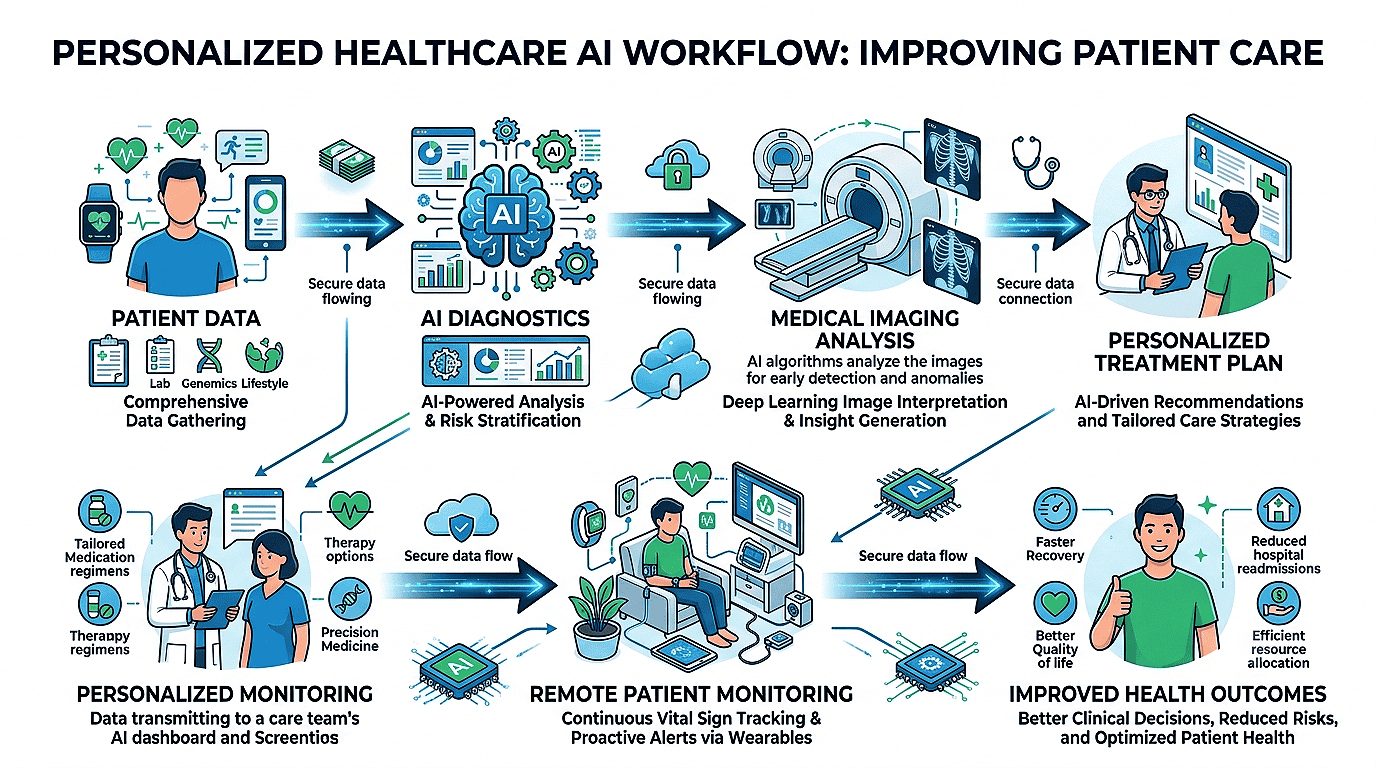
Healthcare is where AI saves both time and lives. AI diagnostics read symptoms and history to catch problems early. Imaging tools spot patterns in scans that a tired eye can miss. Drug discovery that once took years now moves in months. Wearables track glucose, heart rate, and sleep, then feed that data to systems that flag risk before a crisis hits.
Remote Patient Monitoring and Preventive Care
AI platforms are making healthcare more proactive through continuous remote patient monitoring. AI-powered wearable devices and connected health platforms can analyze vital signs, detect unusual health patterns, and notify healthcare providers before conditions become critical.
By identifying potential risks earlier, personalized healthcare AI supports preventive care, reduces hospital readmissions, and enables clinicians to deliver more timely and individualized treatment.
The documentation gains are large. Stanford’s 2026 AI Index reports that some hospital systems cut physician note-writing time by up to 83% using ambient AI scribes. Independent trials show a wide range of results, so the effect varies by setting, but the direction stays consistent: less paperwork, more patient time, less burnout.
Outcomes are improving too. In a Cleveland Clinic-led trial of 150 patients published in NEJM Catalyst, 71% of the AI-supported group lowered their A1C below the 6.5% threshold on metformin alone, compared with 2.4% under standard care. They reached healthy blood sugar levels over one year while cutting other medications, including insulin and GLP-1 drugs.
“Planning a compliant AI build for a regulated industry? Our team designs secure, patient-ready systems that meet HIPAA and audit requirements. Talk to our healthcare AI team.”
AI in Cybersecurity
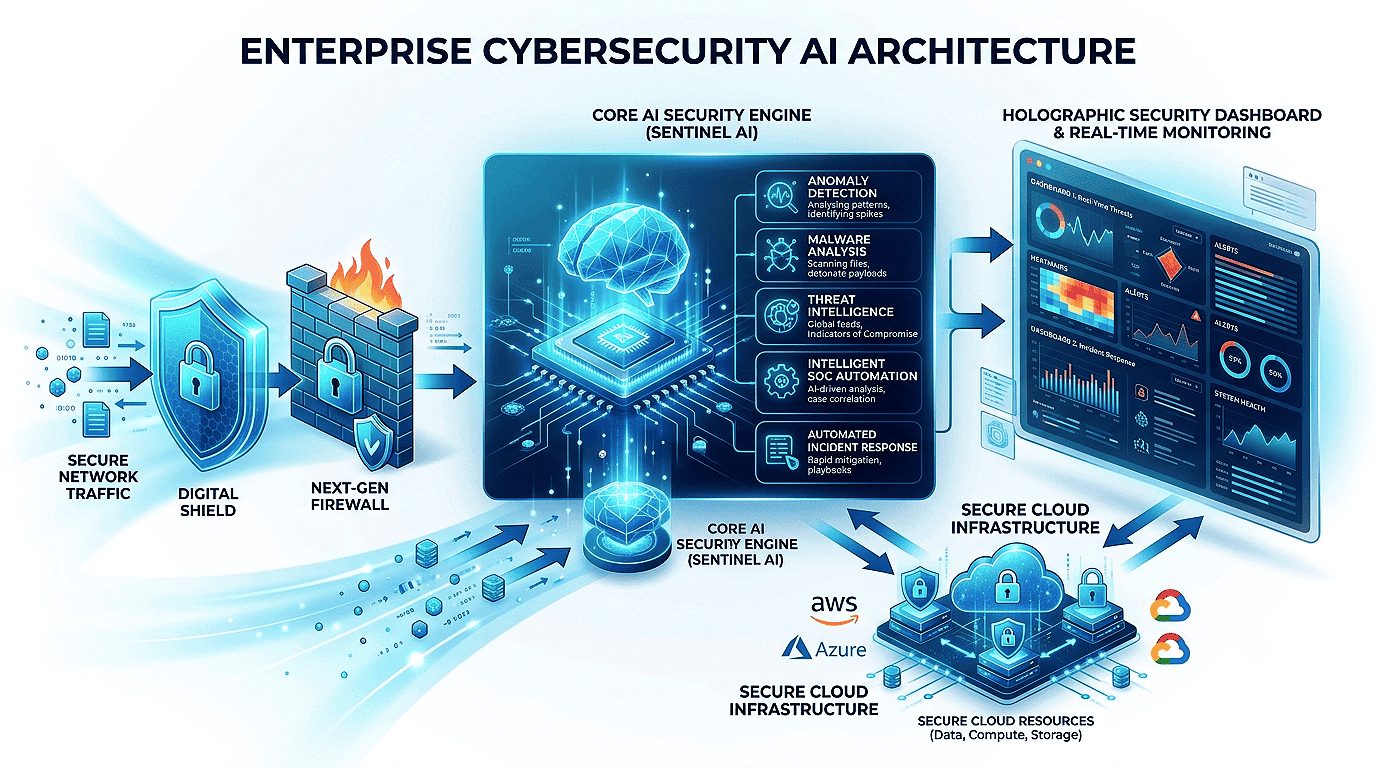
Attackers now move at machine speed, so your defense has to match it. AI reads millions of signals a second and flags the one that matters. Human teams alone cannot hold that pace, and the strongest ones no longer try.
Threat detection is the first payoff. AI learns what normal activity looks like on your network, then flags the odd login, the strange transfer, the pattern a tired analyst would miss. Malware detection has moved past signature lists to behavior analysis, so it catches strains never seen before. Fraud prevention scores each transaction in real time and blocks bad ones before money moves.
Malware detection has moved past old signature lists. Modern systems study how a file behaves, so they catch brand-new strains that have never been seen before. Fraud prevention works the same way, scoring each transaction in real time and blocking the bad ones before money moves.
Intelligent Security Operations with AI
Modern Security Operations Centers (SOCs) generate thousands of security alerts every day, making it difficult for analysts to identify genuine threats quickly. AI helps security teams by automatically prioritizing alerts based on risk, filtering out false positives, correlating related events, and recommending the most effective response actions.
By automating repetitive investigation tasks, AI enables cybersecurity professionals to focus on high-priority incidents, reduce response times, and strengthen an organization’s overall security posture.
The adoption numbers are striking. The 2026 AI SOC Leadership Report found that 94% of security leaders now utilize AI somewhere in the security operations center, with alert triage and investigation as the leading use case. Detection and automated triage sit right at the front of that shift.
The threat is just as real. Darktrace’s State of AI Cybersecurity 2026, a survey of more than 1,500 leaders, found that 73% of organizations already report a significant impact from AI-powered attacks, including tailored phishing and adaptive malware. Attackers bought the same tools you did. The advantage now favors whoever deploys them faster.
AI-Powered Cyber Threats and Adaptive Defense
As AI technology becomes more accessible, cybercriminals are also using AI to launch faster and more sophisticated attacks. AI can automate phishing campaigns, generate convincing social engineering content, identify software vulnerabilities, and adapt malware to evade traditional security tools.
In response, organizations are increasingly adopting AI-powered security platforms that continuously analyze network activity, detect emerging threats in real time, and automate incident response. The future of AI in cybersecurity will depend on adaptive defense systems that learn from evolving attack patterns and help organizations stay ahead of increasingly intelligent cyber threats.
AI Virtual Assistants
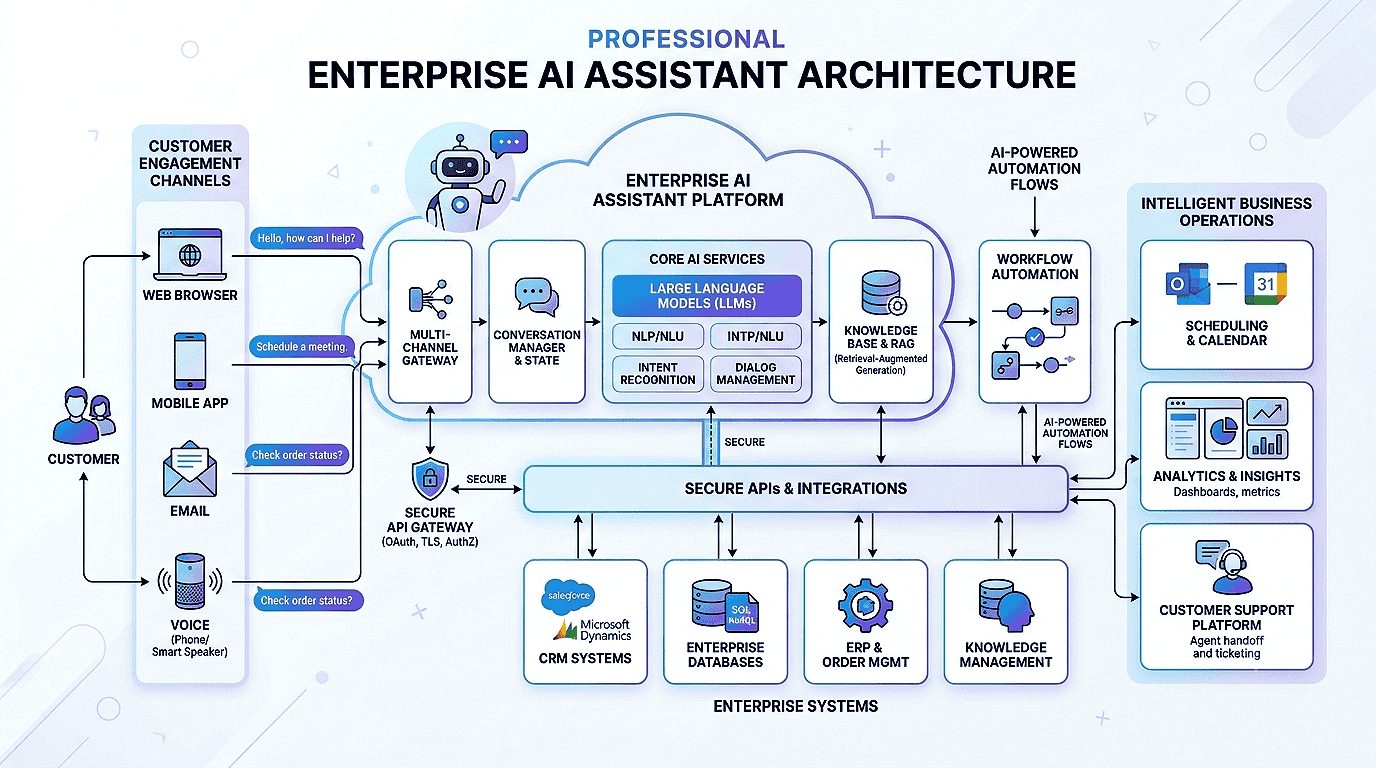
Phone assistants have changed completely. AI virtual assistants started as simple chatbots and became digital coworkers that finish real tasks.
From Simple Commands to Intelligent AI Assistants
Virtual assistants have evolved far beyond answering basic questions or setting reminders. Powered by large language models, natural language processing, and contextual reasoning, today’s AI assistants can understand complex requests, maintain conversations, summarize information, automate repetitive tasks, and assist with business decision-making.
This evolution is transforming AI assistants into intelligent digital collaborators that improve productivity across customer service, sales, operations, and internal business workflows.
Today’s agentic assistants run full processes on their own. They book the travel, update the CRM, chase the invoice, and report back when the job is done. You set the goal, and the assistant handles the steps.
For your business, the payoff is direct. You get support that runs around the clock, lead qualification that works while you focus elsewhere, and sales follow-up that moves deals without manual effort. One system covers work that used to need a full team.
The reach is already massive. When people search their symptoms, an AI assistant answers first 92% of the time, per a 2026 health-search analysis. That is where most patients now form their first impression, before any human weighs in.
These assistants also handle harder work than before. Research shows multi-agent systems improved diagnostic accuracy by 7% to over 60 percentage points compared to single-agent baselines. Assistants have moved from answering trivia to executing complex, high-stakes tasks.
“Ready to build your own AI assistant? Whether you need an AI chatbot, a voice assistant, or full customer support automation, our specialists can map it to your business goals.”
AI for Climate Change
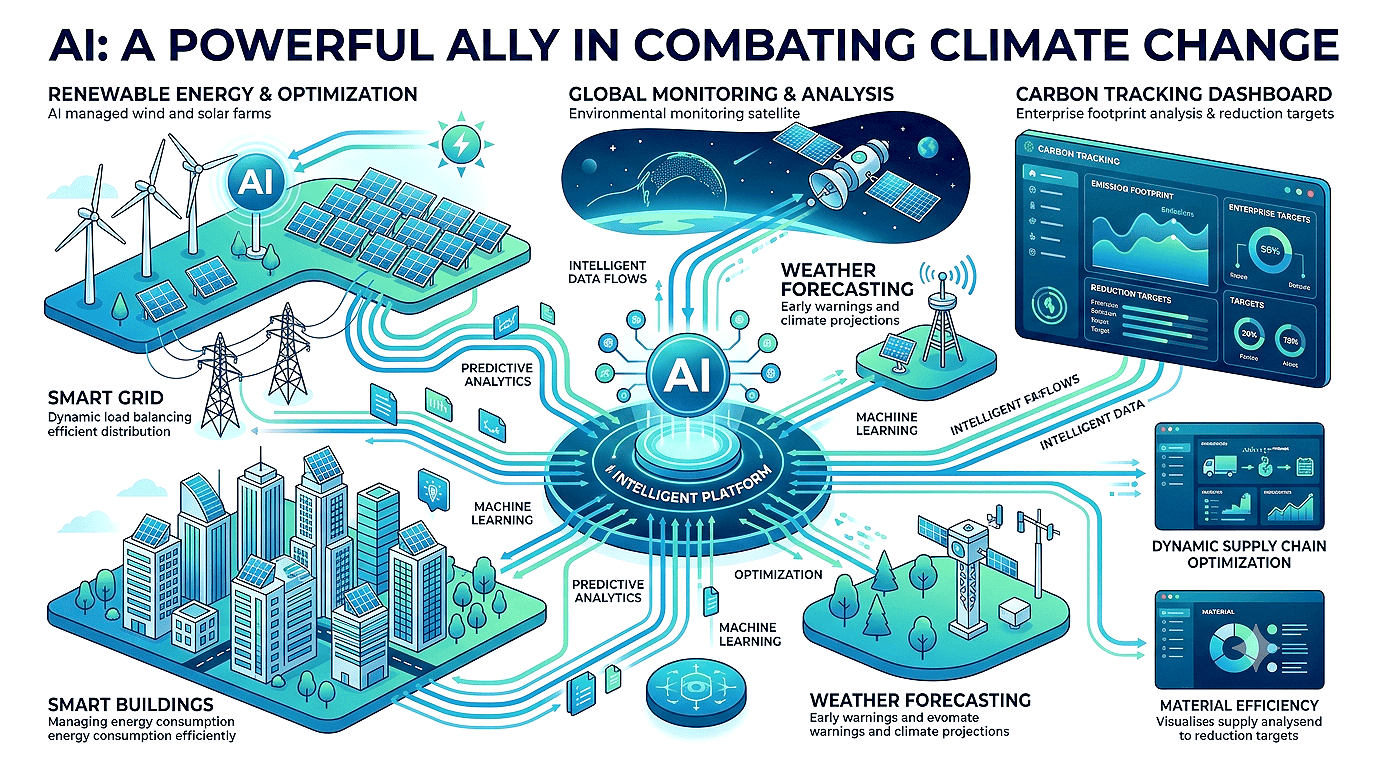
Energy Optimization Across Industries
AI applications are helping organizations reduce emissions by optimizing how energy is generated, distributed, and consumed. AI analyzes data from buildings, factories, transportation networks, and industrial equipment to identify inefficiencies, reduce unnecessary energy use, and improve operational performance.
It also enables real-time carbon tracking, giving organizations better visibility into their environmental impact while supporting long-term sustainability goals.
Smart grids balance supply and demand on the fly, routing clean power where it is needed most. Weather prediction tools now forecast storms and droughts with sharper accuracy, which helps farmers, cities, and insurers plan. Environmental monitoring uses satellites and sensors to track deforestation, pollution, and wildlife at a scale no human team could match.
The technology carries a real cost, and honest planning means facing it. The International Energy Agency projects in its Energy and AI report that data centers could consume about 945 terawatt-hours of electricity a year by 2030, roughly the total consumption of Japan today, with AI as the main driver.
These facilities also draw heavily on water for cooling. The lesson is direct: build on clean energy and efficient cooling, or the fix adds to the problem.
How AI Will Change Your Business
The business case is no longer theoretical, and organizations that adopt AI early are gaining a measurable competitive advantage.
- Lower operating costs: AI automates repetitive tasks at a fraction of the cost of manual processes while maintaining consistent quality.
- Smarter automation: Routine activities such as data entry, scheduling, and reporting run automatically, allowing employees to focus on higher-value work.
- Higher productivity: Teams working alongside AI complete more work in less time without sacrificing accuracy.
- Better decision-making: AI uncovers patterns across large datasets, enabling leaders to make evidence-based decisions with greater confidence.
- Predictive forecasting: AI models anticipate demand, customer churn, and business risks before they affect operations.
- Improved customer experience: AI delivers personalized interactions, faster responses, and around-the-clock support that improves customer satisfaction.
Building AI Responsibly: Challenges and Ethical Concerns
AI brings real risks, and careful leaders plan for them early. Ignoring them invites lawsuits, fines, and lost trust.
Data privacy comes first. AI runs on data, much of it personal, so you need clear consent and strong protection. Algorithmic bias comes next: a model trained on skewed data makes skewed calls in hiring, lending, or care, so test regularly with diverse data.
Regulation is tightening, with the EU AI Act and similar rules setting hard requirements, so transparency about how your systems reach conclusions is no longer optional. People must stay in control of high-stakes decisions, with the ability to review and reverse any call. Strong security ties it all together, since a system holding sensitive data is a prime target.
Responsible Intelligent technology solutions mean facing them from day one.
Data privacy sits at the top. AI runs on data, and much of it is personal. You have to collect, store, and use that data with clear consent and strong protection.
Algorithmic bias is the next concern. A system trained on skewed data makes skewed decisions, which can quietly harm hiring, lending, or care. Regular testing and diverse data help catch these problems before they spread.
AI regulation is tightening fast. The EU AI Act and similar rules now set hard requirements, and compliance is not optional. Transparency matters too, because customers and regulators want to know how your AI reaches its conclusions.
People must stay in control. AI should support human judgment on high-stakes calls, not replace it, and a person should always be able to review and reverse a decision. Strong security ties it all together, since an AI system holding sensitive data is a prime target for attackers.
Expert Insight: AI Success Depends on Responsible Implementation
Artificial intelligence is advancing at an incredible pace, but long-term success depends on more than adopting the latest models. Organizations that combine innovation with responsible governance, high-quality data, and human oversight will achieve the greatest business value.
“AI is one of the most profound technologies we are working on. It is more profound than fire or electricity.” — Sundar Pichai, CEO of Google
This perspective reflects what many organizations are discovering today. AI alone does not create a competitive advantage. Success comes from integrating AI strategically, protecting sensitive data, maintaining regulatory compliance, and ensuring people remain involved in high-impact decisions. Businesses that invest in responsible AI today will be better prepared to scale confidently as AI technologies continue to advance.
Business Insight: Organizations that treat AI as a long-term business strategy—not just another software purchase—are more likely to achieve measurable improvements in business efficiency, customer experience, operational efficiency, and innovation.
Why Webo 360 Solutions Is Your Strategic Partner for the Future of Artificial Intelligence
AI’s potential future is full of promise, but the path to it is technical and steep. APIs, custom LLM integrations, and agentic business flow demand deep expertise that most busy leaders do not have the time to build in-house. That is the gap we close.
At Webo 360 Solutions, we turn complex AI technologies into simple, revenue-generating tools. We work across the platforms that matter, including OpenAI, Gemini, Claude, and custom machine learning systems, and we translate them into tools your team can actually use. You get the power without the complexity.
Our strength is in the fit. We do not just switch AI on and walk away. We design a tailored AI strategy for your goals, build secure data pipelines you can trust, and create custom automation that matches how your business already runs.
We think in partnership, not transactions. Our job is to future-proof your operation, so the technology keeps paying off long after launch. For enterprises in the US and around the world, we bring a standard of rigor, security, and reliability that scales with you.
How Businesses Can Prepare for What Comes Next
Preparing for the upcoming era is a process, not a purchase. The companies that move deliberately win, while those that rush or wait fall behind. Follow these steps.
Turn the Future of AI Into a Competitive Advantage
Artificial intelligence is no longer just an innovation initiative—it’s becoming a core business strategy. Whether you’re exploring AI for the first time or scaling enterprise-wide automation, success depends on choosing the right technologies, integrating them securely, and aligning every implementation with measurable business outcomes.
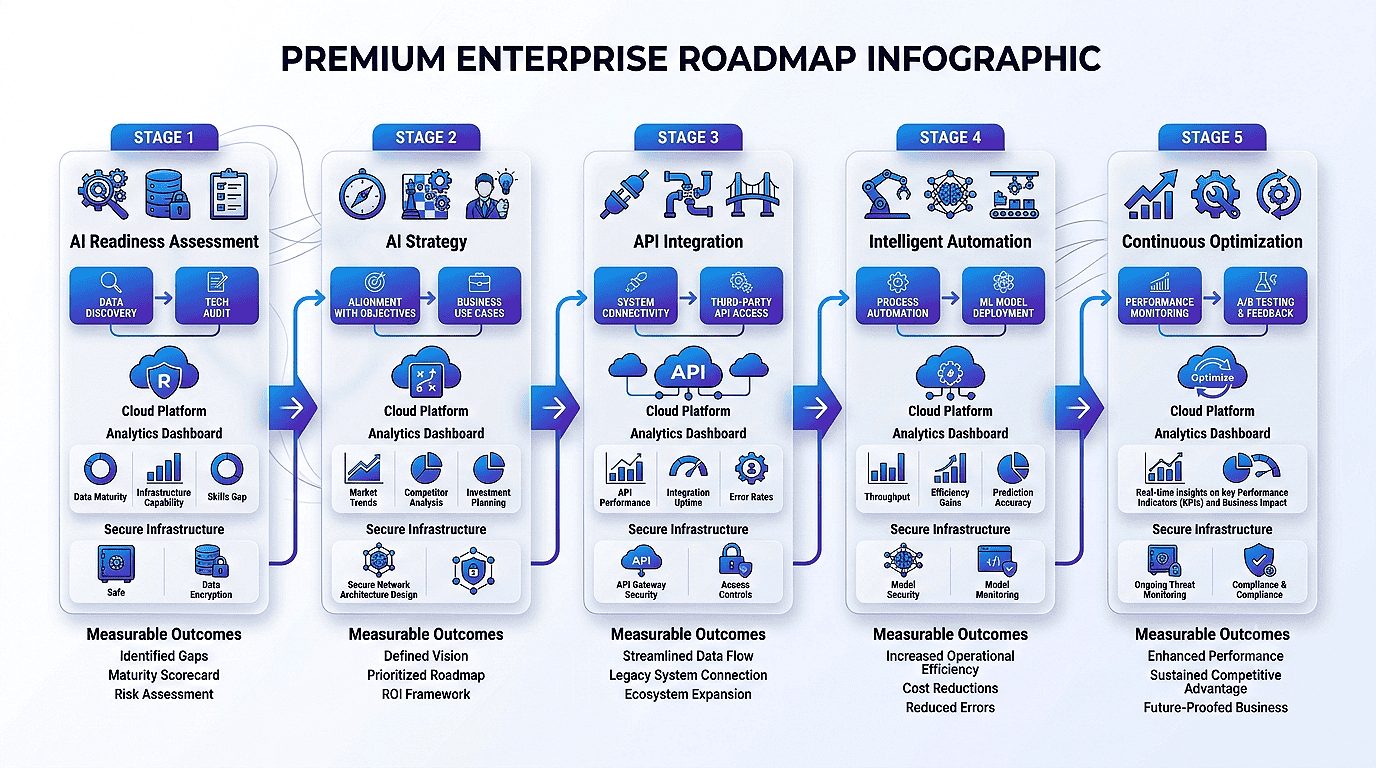
At Webo 360 Solutions, we help organizations move beyond experimentation by designing and implementing practical AI solutions that improve efficiency, reduce operational costs, and create long-term competitive advantages. From intelligent automation and custom AI applications to enterprise integrations, our team delivers solutions built around your business goals.
Our AI Integration & Development Services
Whether you’re building a new AI-powered product or enhancing existing systems, our experts can help you accelerate adoption with scalable, secure, and future-ready solutions.
Our Services Include:
You bring the vision, and we deliver the system that runs it. Our team handles the strategy, the build, and the integration, so you see results fast and scale with confidence.
Why Businesses Choose Webo 360 Solutions
Organizations partner with Webo 360 Solutions because we combine technical expertise with a business-first approach.
-
✔15+ years of software development experience
-
✔Custom AI solutions tailored to your industry
-
✔Secure API integrations and enterprise-grade architecture
-
✔Scalable cloud-native AI applications
-
✔Transparent communication throughout every project
-
✔Ongoing optimization and long-term technical support
Instead of recommending one-size-fits-all AI tools, we design solutions that integrate seamlessly with your existing systems, business workflows, and business objectives.
Ready to Build Your AI Roadmap?
The age of artificial intelligence is creating new opportunities across healthcare, education, cybersecurity, manufacturing, finance, and countless other industries. Organizations that begin planning today will be better positioned to innovate, improve customer experiences, and stay ahead of rapidly changing market demands.
Whether you want to automate business processes, develop an AI-powered application, integrate leading AI models, or create intelligent customer experiences, our specialists are ready to help.
During your consultation, we’ll help you:
- Identify the highest-impact AI opportunities that can deliver measurable value for your business.
- Evaluate your existing systems, workflows, and integration requirements to uncover technical gaps.
- Recommend the most suitable AI technologies, APIs, and implementation approach for your objectives.
- Develop a practical implementation roadmap that aligns with your business goals and growth strategy.
- Estimate project timelines, technical requirements, expected outcomes, and overall business impact.
Let’s build an AI solution that delivers measurable value today while preparing your business for the future.
AI Futures: Long-Term Predictions Beyond 2030
The next decade will reshape how the world works. The technology’s trajectory points toward systems that are more capable, more autonomous, and more woven into daily life. These are the AI futures many experts see coming.
AGI, or artificial general intelligence, moves from theory toward reality as systems handle a wider range of tasks at a human level. Debate over the timeline stays fierce, but the direction is clear. By 2030, many shifts that look like edge cases today become standard practice.
Autonomous businesses start to run core functions with minimal human input, from procurement to customer service. AI developers write, test, and ship code with speed that reshapes the software industry itself.
AI healthcare delivers earlier diagnoses and treatment tuned to each patient’s biology. AI governments use data to plan services and respond to crises faster, while wrestling with hard questions of privacy and fairness.
AI education gives every student a personal tutor that adapts in real time. AI finance sharpens fraud detection, risk modeling, and trading, and AI manufacturing runs factories that predict their own repairs and adjust on the fly.
The Next Decade: 2026 to 2035
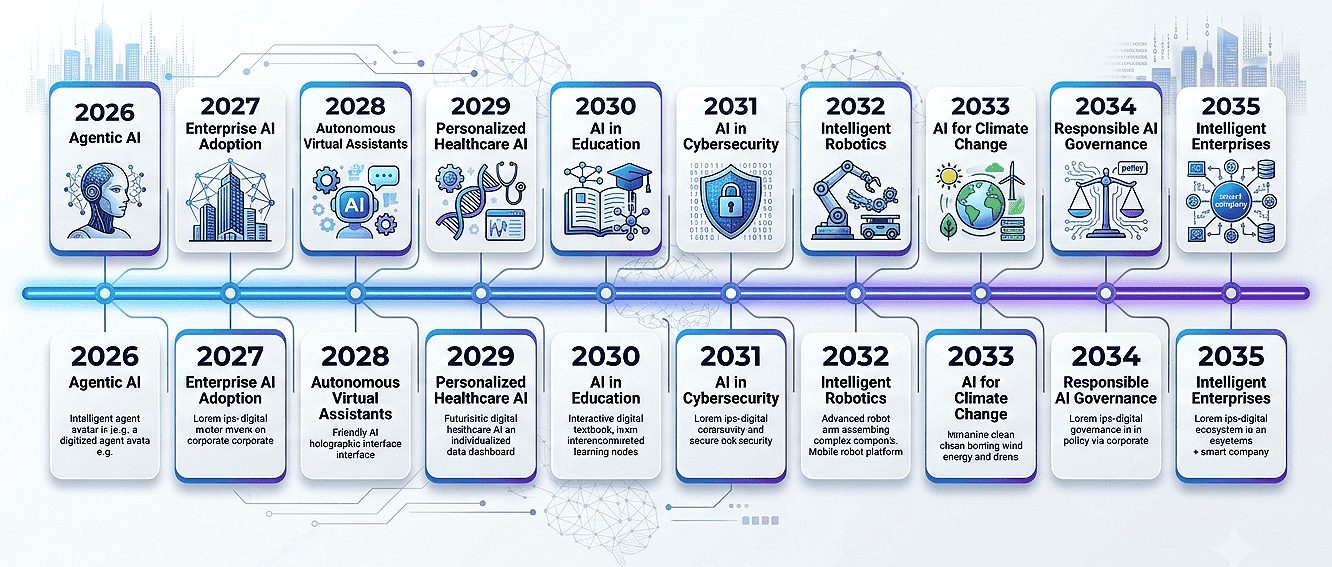
No one predicts the future with certainty, but adoption and investment trends point in a clear direction. Expect AI to move deeper into every function rather than sit beside it as a standalone tool.
The exact timing will move, but the trend is set. Organizations that build a strategy now will adopt each new advance faster than rivals starting cold.
Looking Beyond the Next Decade
While no one can predict every breakthrough with certainty, one trend is clear: Artificial intelligence will continue to evolve from a productivity tool into a strategic business capability.
Organizations that invest in responsible AI, modern data infrastructure, workforce readiness, and scalable integration today will be in the strongest position to adapt to tomorrow’s innovations. The following frequently asked questions address some of the most common concerns businesses and decision-makers have about the future of AI.
Conclusion: The AI Impact Ahead
The future of intelligent systems has arrived, and it rewards those who prepare. Agentic systems now run in the background of business, security, education, and healthcare, doing work that once took full teams. The top trends, from generative AI and autonomous agents to edge computing, all point the same way.
The opportunity is huge, and so is the responsibility. The AI impact reaches revenue, jobs, and the planet at once. You can cut costs, serve customers better, and open new revenue, but only if you manage the risks around privacy, bias, and sustainability with care. Businesses that adopt AI thoughtfully will lead their markets, while those that wait will spend years catching up.
The best time to start was yesterday. The next best time is now.
Frequently Asked Questions
What is the future of AI?
How will AI change businesses?
Is AI replacing human jobs?
Which industries benefit most from AI?
How does AI improve cybersecurity?
What is personalized healthcare AI?
How does AI help fight climate change?
How can businesses integrate AI into their existing systems?
Will AI replace software developers?
How can small businesses start using AI?
What industries will see the biggest impact from AI over the next decade?
As the AI revolution continues to evolve, organizations that integrate AI into daily operations will improve efficiency, reduce costs, and deliver more personalized customer experiences.