12 Best Email Marketing Platforms In 2026: Top Software, Free Tools & Services Compared
By the email team at Webo 360 Solutions LLC. Our strategists have managed email programs for over 15 years, sending on behalf of clients across retail, DTC, B2B, and subscription businesses. We specialize in deliverability, automation, and revenue-focused campaign strategy.
We review this guide quarterly and refresh pricing, platform changes, and statistics as vendors update their plans.
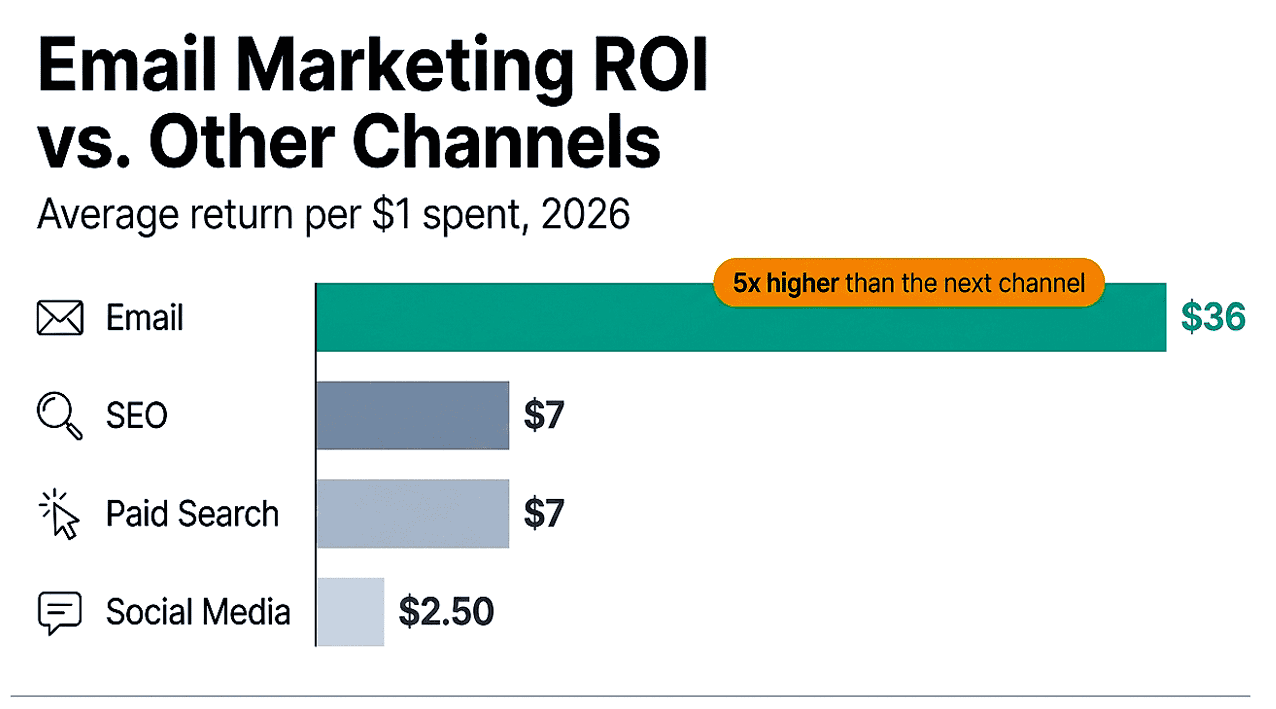
Email still delivers the highest return in digital marketing. For every $1 you spend, email returns an estimated $36, a number no other channel matches at scale. According to Litmus’s 2025 State of Email report, that return holds steady at $36 per dollar spent, and top-performing programs push it past 45:1. That single figure explains why founders, ecommerce brands, and marketers keep email at the center of their growth plans in 2026.
The tool you pick decides whether those returns actually show up. The best email marketing services do far more than send newsletters. They protect your sender reputation, land your messages in the primary inbox, and run revenue-generating automations without daily oversight.
Deliverability is why the stakes climbed. Since early 2024, Gmail and Yahoo require bulk senders to authenticate every message with SPF, DKIM, and DMARC, keep spam complaints under 0.3%, and offer one-click unsubscribe. The strongest email marketing platforms handle this setup for you, protect your sender reputation score, and push your inbox placement rates higher. Some now support BIMI (Brand Indicators for Message Identification), which displays your verified logo next to emails in supporting inboxes. Weak tools leave your campaigns stuck in spam.
The pressure is rising, not easing. Industry analysis projects inbox placement rates dropping 10% to 26% in early 2026 compared to 2024 levels, which makes authentication and list hygiene non-negotiable.
Real-World Insight
“In practice, deliverability breaks long before people notice. I took over an account once where open rates had quietly slid from 34% to 11% over five months. The platform was fine. The problem was a DMARC record set to “none,” so nothing was actually enforced, and a chunk of their sends were landing in Gmail’s spam folder. We fixed the record, ran a two-week re-engagement cleanup, and placement recovered within a billing cycle. Nobody had touched the settings in two years. Most deliverability problems I see are old configuration debt, not the tool.”
Price and capability swing hard across this market. Some email marketing software starts free and grows with your list, and a good free email marketing plan can carry a new business through its first year. Other tools charge by contact count, and the bill jumps fast once you pass 10,000 subscribers. Pick wrong, and you lose months plus thousands of dollars.
This guide fixes that. You will see the best email marketing software for 2026, what each email marketing tool does well, real starting prices, and the free-tier limits nobody puts in their ads. Run a solo email newsletter, a Shopify store, or a B2B sales engine, and you will still find a right-sized fit here.
We also cover the free email marketing tools worth using, so you can start at zero and only pay once the revenue justifies it.
We judged each tool on the things that move revenue: automation depth, deliverability, ease of use, and honest pricing. Let’s get into it.
How we evaluated these platforms
This guide reflects 15+ years of hands-on email marketing management across SMB, ecommerce, SaaS, and enterprise accounts. Our comparison combines vendor documentation, pricing checks, feature analysis, and practical email marketing experience in mid-2026. We earn no commission from the platforms listed, and rankings reflect real client outcomes, not affiliate payouts. All statistics are drawn from named 2025-2026 industry sources (Litmus, Statista, Klaviyo, Mailchimp, and others) and were verified against their original reports, not second-hand roundups.
Expert Tip
Before you send a single campaign on a new platform, warm the domain for two to three weeks. Start with your most engaged 20% of subscribers, then widen the audience as opens hold steady. Mailbox providers judge new senders fast, and one large blast to a cold list can flag you as spam before your first real campaign ever runs.
Looking for a team that manages everything from strategy and automation to deliverability and campaign optimization?
Our email marketing specialists help businesses build high-converting campaigns with measurable ROI. Request a Free Email Marketing Consultation
Methodology & Disclosure
This comparison of the best email marketing services is based on independent research, hands-on platform evaluations, official vendor documentation, product updates, pricing information, deliverability features, automation capabilities, security standards, and customer support quality available through mid-2026.
Each platform was reviewed using consistent evaluation criteria, including ease of use, email automation, deliverability, list management, integrations, pricing, scalability, reporting, and overall value for businesses of different sizes. Where available, we also considered compliance with industry standards such as GDPR, CAN-SPAM, and SOC 2.
Pricing, product features, and compliance certifications change regularly. Always verify the latest information directly with the software provider before making a purchasing decision. This guide is intended to help readers compare leading email marketing platforms using publicly available information and practical implementation experience rather than sponsored rankings.
About Webo 360 Solutions LLC
Webo 360 Solutions LLC is a software development and digital technology company that helps businesses build, integrate, and scale modern digital solutions. Our team develops custom websites, business software, ecommerce platforms, AI applications, API integrations, workflow automation systems, and email marketing solutions that support long-term business growth.
Beyond software development, we help organizations improve email deliverability, marketing automation, CRM integration, customer engagement, and system connectivity using proven technologies and industry best practices. Every solution is designed around security, performance, scalability, and measurable business outcomes.
We work with startups, small and medium-sized businesses, and enterprise organizations across the United States, United Kingdom, Canada, Australia, and the Middle East, delivering tailored technology solutions that solve real business challenges.
📋 15+ Years of Email Marketing Experience | Specialists in Email Deliverability, Marketing Automation, ESP Migration & CRM Integration | Serving Businesses Across the USA, UK, Canada, Australia & the Middle East
Connect: LinkedIn | Facebook | Instagram | Visit Webo 360 Solutions
Key Takeaways
- MailerLite offers the best overall value for small businesses thanks to its affordable pricing, generous free plan, and beginner-friendly interface.
- ActiveCampaign is the strongest choice for businesses that depend on advanced automation, CRM integration, and lead nurturing.
- Klaviyo and Omnisend remain the leading platforms for ecommerce brands, with powerful customer segmentation, revenue tracking, and pre-built shopping workflows.
- HubSpot is the best fit for B2B organizations that want email marketing, CRM, sales, and customer service inside one connected platform.
- Kit and Beehiiv are purpose-built for creators, publishers, and newsletter businesses that want audience growth and monetization features.
- Free plans are ideal for learning a platform, but most businesses benefit from upgrading once automation, branding, higher sending limits, or advanced reporting become business priorities.
- Marketing automation delivers the highest long-term ROI. Welcome emails, abandoned cart recovery, lead nurturing, post-purchase sequences, and win-back campaigns continue generating revenue long after they are built.
- Email deliverability matters more than email design. Proper SPF, DKIM, DMARC, list hygiene, authentication, and subscriber engagement have a greater impact on results than attractive templates alone.
- Compare total ownership costs instead of entry-level pricing. Contact-based platforms often become significantly more expensive as subscriber lists grow, making long-term pricing more important than the initial monthly fee.
- No platform succeeds without the right strategy. Segmentation, automation, consistent testing, deliverability monitoring, and performance optimization determine whether email becomes a dependable revenue channel.
Table of Contents
- What Are Email Marketing Services
- Why Businesses Still Invest in Email Marketing in 2026
- Best Email Marketing Software Compared: All 12 Platforms
- Quick Comparison Table
- The 12 Platforms Reviewed in Depth
- Best Email Marketing Platforms for Different Business Types
- Key Features of the Best Email Marketing Software
- Best Email Marketing Tools for Small Business
- Marketing Automation Tools That Save Time & Increase Revenue
- Free Email Marketing Tools: What Is the Best Free Email Marketing Service?
- How to Find the Best Email Marketing Service Provider (ESP)
- Common Email Marketing Mistakes Businesses Make
- Why Professional Email Marketing Services Deliver Better Results
- Why Businesses Choose Webo 360 Solutions
- Our Final Recommendations by Business Type
- Frequently Asked Questions
- Final Thoughts
- Ready to Grow Your Business with Professional Email Marketing Services?
1. What Are Email Marketing Services?
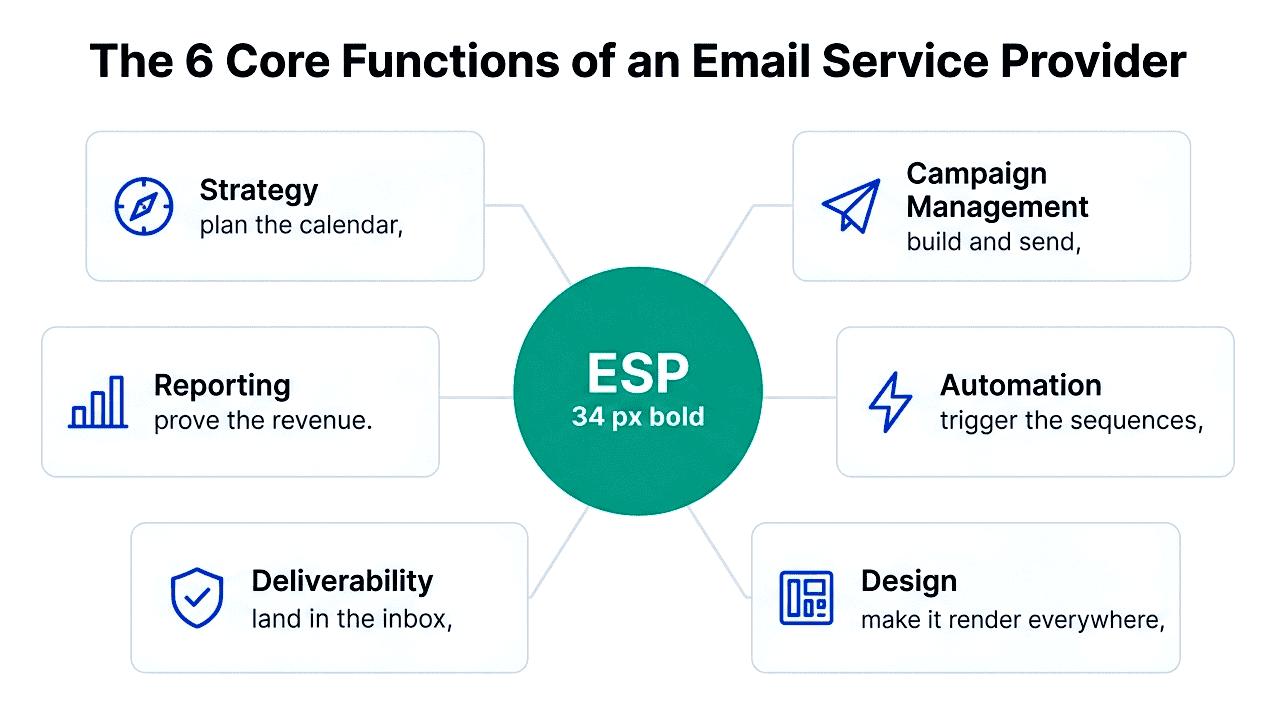
Email marketing services are platforms that help you build, send, and track email campaigns at scale. Most people also call them email service providers, or ESPs. They replace manual sending with tools built for speed, safety, and measurable results.
A strong ESP covers six core jobs:
- Strategy: Segmentation, audience building, and testing tools that shape who gets which message and when.
- Campaign management: A central place to plan, schedule, and send broadcasts, newsletters, and promotions.
- Automated marketing: Triggered sequences like welcome series, abandoned-cart flows, and re-engagement campaigns that run on their own. Most businesses outsource the build, which is where email automation services come in.
- Design: A drag-and-drop email editor, mobile-responsive email templates, dynamic content with merge tags, and AI writing tools that produce clean, personalized emails without code.
- Deliverability: Authentication setup (SPF, DKIM, DMARC), list hygiene, and sender reputation monitoring that keeps you out of spam.
- Reporting: Open rates, clicks, conversions, and revenue tracking so you know what works and cut what doesn’t.
In our experience, deliverability is where most programs quietly lose money. We’ve inherited accounts where a single misconfigured DMARC record was routing 20% of sends to spam, unnoticed for months. The platform matters, but correct setup matters more.
The right email marketing service also keeps you compliant. Built-in tools handle GDPR and CCPA compliance, consent tracking, and unsubscribe rate management, so you grow your list without breaking privacy law. The best platforms tie all six jobs together in one dashboard, which saves you from stitching separate tools into a fragile stack.
Even free email marketing software covers most of these jobs at a basic level. The paid tiers are where campaign automation, advanced reporting, and your own branding unlock.
2.Why Businesses Still Invest In Email Marketing In 2026
You own your email list. You rent your social audience. That difference alone keeps email essential, because an algorithm change can wipe out your reach overnight while your subscriber list stays yours.
Customers back this up: Twilio found 79% of consumers name email as their preferred way to hear from brands, ahead of every social platform.
The numbers reinforce it. More than 4.5 billion people use email worldwide, and that audience grows every year. Statista puts the 2025 figure at roughly 4.6 billion users, climbing toward 4.8 billion by 2027, so your audience is still expanding, not shrinking. Statista also estimates 376 billion emails move every day, which means standing out in a crowded inbox now depends heavily on deliverability and relevance.
ROI leads the case. Email consistently returns more per dollar than paid social, display, or search. It costs little to send and scales without a matching rise in spend.
Retention beats acquisition on cost. Keeping a customer runs far cheaper than winning a new one, and email is the cheapest retention channel you have. Post-purchase flows, loyalty campaigns, and win-back sequences compound revenue month after month.
Lead nurturing turns interest into sales. A single opt-in triggers a sequence that educates, builds trust, and moves prospects toward a purchase, all automatically.
Personalization and AI raised the ceiling. Today’s email marketing software pairs automated email marketing with behavior, purchase history, and AI to send the right message to the right person at the right moment. Adoption is already mainstream: 63% of marketers use AI in email, and in 2025 nearly half used generative AI to write copy, per Litmus. The upside is measurable, with Omnisend reporting AI-powered marketing tools lifting revenue by up to 41% and click-through rates by more than 13%. That level of targeting pushes open and conversion rates well above generic blasts.
3. Best Email Marketing Software Compared: All 12 Platforms
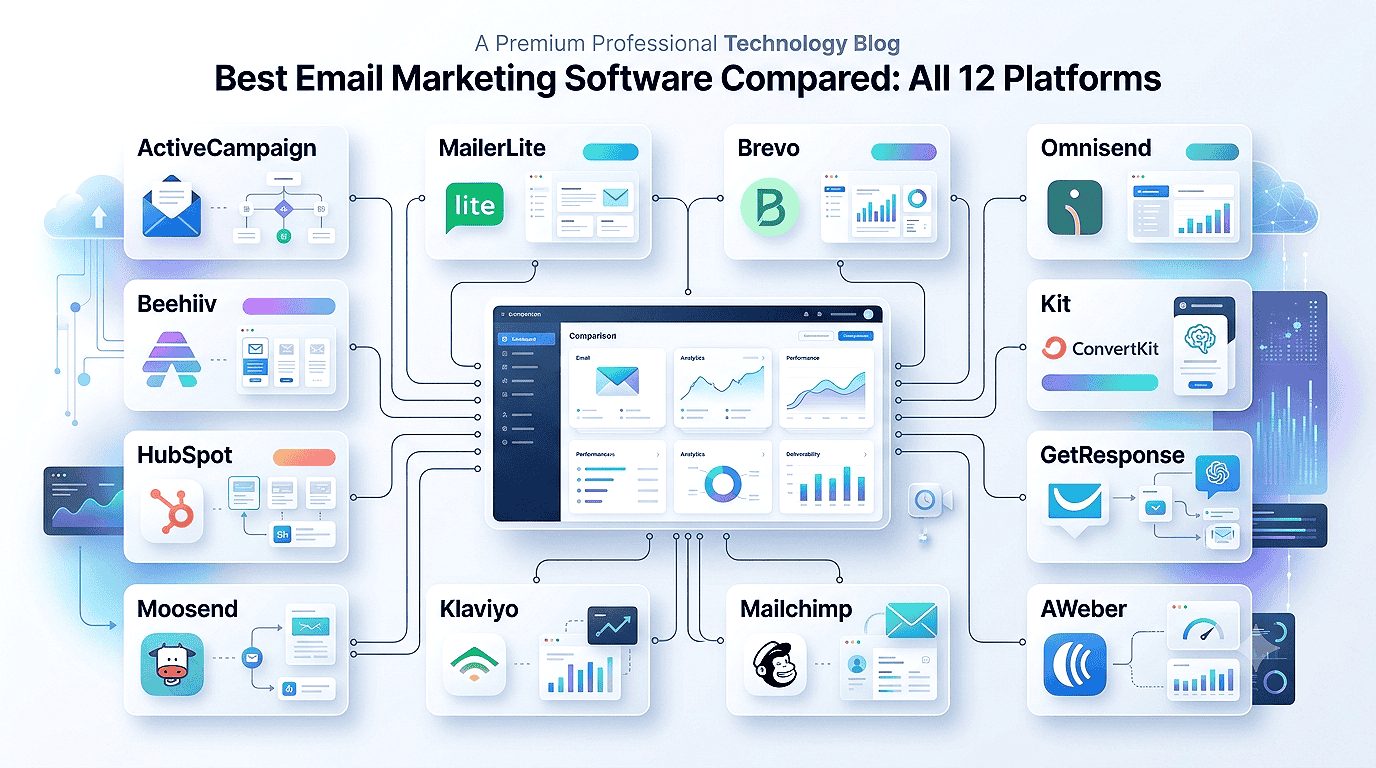
Here is the head-to-head view of the best email marketing software leading the market in 2026. This table ranks each email marketing tool on marketing process automation strength, entry price, free access, and user rating, so you can shortlist fast.
| Service | Best For | Automation | Pricing | Free Plan | Rating |
| ActiveCampaign | Advanced automation and CRM | Advanced | From $15/mo | No (14-day trial) | 4.5 |
| MailerLite | Small business and beginners | Strong | From $10/mo | Yes (1,000 subscribers) | 4.7 |
| Brevo | Unlimited contacts and transactional | Strong | From $9/mo | Yes (300 emails/day) | 4.5 |
| Omnisend | Shopify and ecommerce stores | Advanced | From $16/mo | Yes (250 contacts) | 4.7 |
| Beehiiv | Newsletter creators and monetization | Strong | From $43/mo | Yes (2,500 subscribers) | 4.6 |
| Kit (ConvertKit) | Authors, courses, and bloggers | Strong | From $33/mo | Yes (10,000 subscribers) | 4.4 |
| HubSpot | B2B teams and sales CRM | Advanced | From $15/seat/mo | Yes (2,000 sends/mo) | 4.4 |
| GetResponse | Sales funnels and webinars | Strong | From $19/mo | Yes (500 contacts) | 4.2 |
| Moosend | Budget choice for growing teams | Strong | From $9/mo | No (30-day trial) | 4.6 |
| Klaviyo | Advanced ecommerce data | Advanced | From $20/mo | Yes (250 profiles) | 4.6 |
| Mailchimp | Standard campaigns and brand familiarity | Solid | From $13/mo | Yes (250 contacts) | 4.4 |
| AWeber | Traditional bloggers and phone support | Moderate | From $12.49/mo | Yes (500 subscribers) | 4.2 |
4. Quick Comparison Table
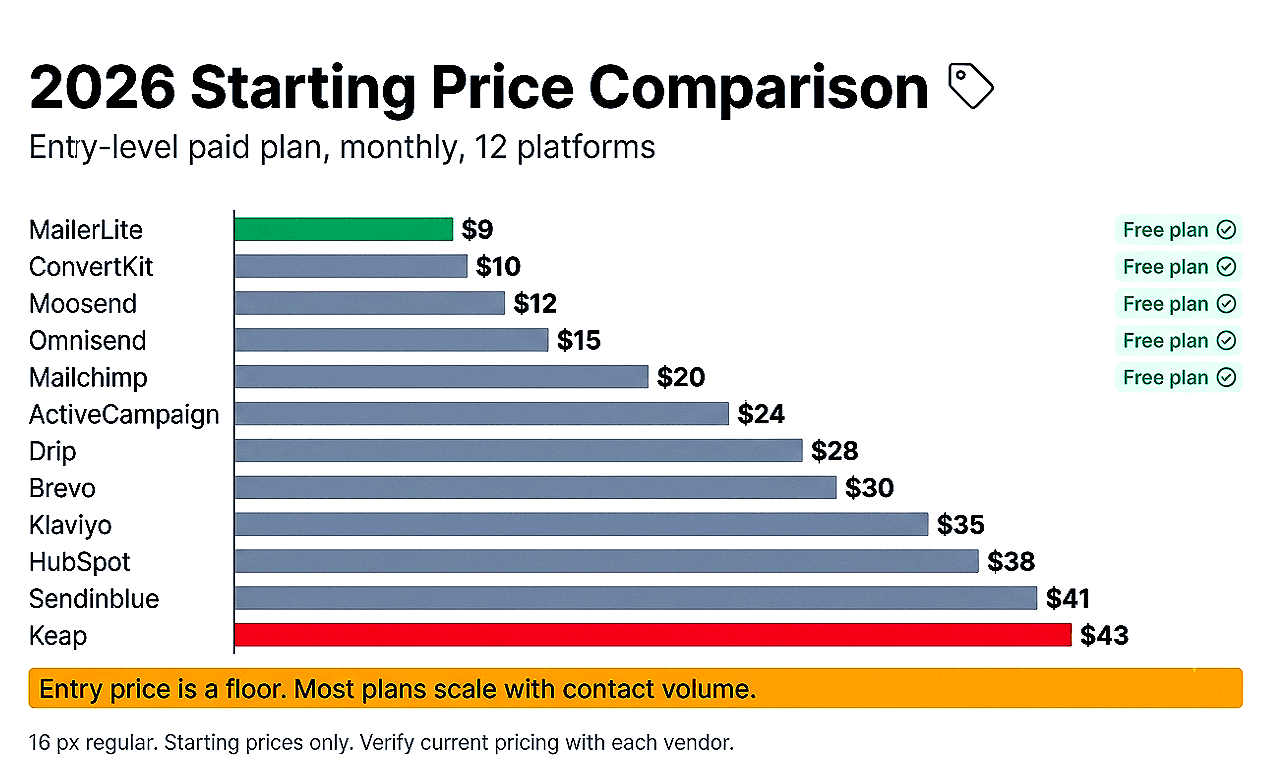
If you want the fastest path to a decision, start here. This view pairs each platform’s real 2026 starting price with its free-tier limits and the one advantage that sets it apart.
| Platform | Best For | 2026 Starting Price | Free Tier / Trial Limits | Standout Advantage |
| ActiveCampaign | Complex automation and CRM | From $15/mo (Starter, annual) | No free plan, 14-day trial | 900+ automation recipes plus built-in CRM |
| MailerLite | Small business and creators | From $10/mo ($9 annual) | Free, up to 1,000 subscribers and 12,000 emails/mo | Best value editor at a low entry price |
| Brevo | High contacts, low send frequency | From $9/mo ($8.08 annual) | Free, 300 emails/day with branding | Pay by emails sent, not contacts stored |
| Omnisend | Ecommerce email and SMS in one | From $16/mo (Standard) | Free, 250 contacts and 500 emails/mo | Email, SMS, and push bundled in one plan |
| Beehiiv | Newsletter monetization | From $43/mo ($49 monthly) | Free, up to 2,500 subscribers, unlimited sends | Built-in ad network and 0% subscription fee |
| Kit (ConvertKit) | Creators and course sellers | From $33/mo ($39 monthly) | Free, up to 10,000 subscribers | Largest free subscriber ceiling in the market |
| HubSpot | B2B and full go-to-market teams | From $15–$20/seat/mo (Starter) | Free CRM, 2,000 sends/mo with branding | Email tied to a complete CRM and sales pipeline |
| GetResponse | Funnels, webinars, and courses | From $19/mo ($15.58 annual) | Free plan, up to 500 contacts | Built-in webinars and funnels with unlimited sends |
| Moosend | Budget-conscious growing teams | From $9/mo (Pro) | No free plan, 30-day trial | Unlimited sends and strong automation, low cost |
| Klaviyo | Ecommerce and DTC brands | From $20/mo (500 contacts) | Free, 250 profiles and 500 sends/mo | Deepest ecommerce data and predictive segments |
| Mailchimp | Beginners and standard campaigns | From $13/mo (Essentials) | Free, 250 contacts and 500 sends/mo | Largest template library and integration list |
| AWeber | Traditional bloggers | From $12.49/mo (Lite, annual) | Free, up to 500 subscribers | Phone support on every plan |
A note on pricing: These figures reflect each vendor’s published 2026 rates, verified in mid-2026. Contact-based plans (Klaviyo, ActiveCampaign, GetResponse) charge more as your list grows, so treat the listed number as a starting point rather than your eventual bill. Brevo prices by sending volume instead, which favors large lists that mail infrequently.
A note on honesty: No single platform here is best for everyone, and we’ve flagged real weaknesses alongside strengths for every tool. If a platform doesn’t fit your use case, the wrong choice will cost you more than any price difference. We’d rather you pick correctly than pick us.
Expert Tip
“Calculate your real cost at your projected 12-month list size, not today’s. Contact-based platforms look cheap at 1,000 subscribers and painful at 25,000. Pull the pricing table, plug in your growth rate, and compare the 12-month figure across your shortlist. A tool that costs $20 now but $400 at scale is a very different decision than one that stays flat.”
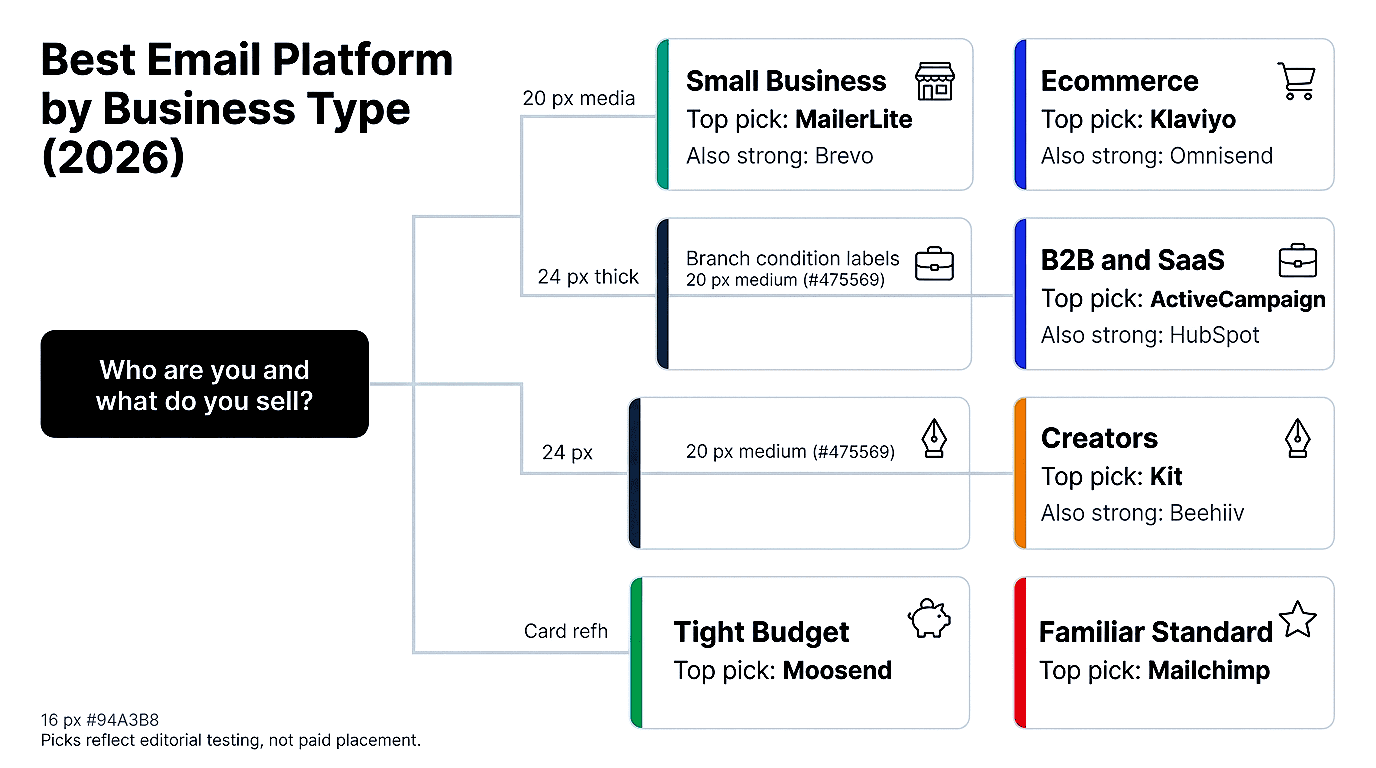
5. The 12 Platforms Reviewed In Depth
Below are full reviews of the 12 platforms that lead the market in 2026. Each one wins for a specific type of business, so read for your use case, not just the headline price.
One pattern we see repeatedly: businesses overbuy on features and underuse them. The best platform is not the most powerful one. It’s the one your team will actually operate every week. We factor that reality into every recommendation below.
These recommendations aren’t theoretical either. We’ve implemented email programs across every category covered here, from solo creators on free plans to enterprise teams on dedicated IPs, and the guidance reflects what actually worked at each stage.
Expert Tip
“Never migrate platforms during your busy season. Rebuilding automations, re-authenticating your domain, and re-warming a sending IP takes two to four weeks minimum, and something always breaks in testing. Move during your slowest month, run both platforms in parallel for two weeks, and confirm every flow fires with a live test contact before you shut off the old account.”
1. ActiveCampaign — Best for Advanced Email Marketing Automation & CRM
ActiveCampaign is the platform serious marketers graduate to when basic newsletters stop paying the bills. It pairs one of the deepest automated marketing platform builders on the market with CRM integration, so your email and sales data live in one place.
The visual workflow builder handles branching logic, conditional paths, and event triggers that most competitors gate behind enterprise plans. If your marketing is more than a welcome email, this is where it gets powerful.
Key Features:
- Visual automation builder with 900+ pre-built recipes and conditional logic
- Native CRM with lead scoring, pipeline management, and multi-touch attribution
- Predictive sending, dynamic content, and AI-assisted copy
- Site tracking plus Shopify, WooCommerce, and BigCommerce integrations
- SMS and WhatsApp on higher tiers
| Pros | Cons |
| Automation depth is hard to beat at this price | No free plan
|
CRM and email in one tool removes the need for a separate sales stack |
Costs scale sharply past 10,000 contacts. |
Strong deliverability track record |
Starter caps automations at five actions, which many outgrow fast |
2026 Pricing: Starter runs $15/month for 1,000 contacts on annual billing, with Plus at $49, Pro at $79, and Enterprise at $145. A 14-day free trial covers all tiers.
Why Pick It: Choose ActiveCampaign when automation and CRM matter more than a rock-bottom price. It rewards teams that build real customer journeys.
Real-World Insight
“A warning from experience: teams buy ActiveCampaign for the automation depth, then use maybe 15% of it. I’ve watched a SaaS client pay for Pro for a year while running two linear autoresponders they could have built on a $15 Starter plan. The deep builder only pays off if someone owns it weekly. Before you buy on features, ask who on your team will actually map the flows. If the answer is “we’ll figure it out later,” start one tier down. You can always upgrade once you outgrow it, and you rarely do as fast as you expect.”
2. MailerLite — Best for Small Businesses & Beginners
MailerLite proves that cheap does not mean basic. It offers a clean drag-and-drop email editor, solid marketing platform, and a genuinely useful free plan, all wrapped in an interface beginners actually understand.
Small businesses love it because nothing feels bloated. You get websites, landing pages, and signup forms alongside email, without paying for features you will never touch.
Key Features:
- Drag-and-drop email editor with AI writing assistant and clean email templates
- Lead nurturing automation builder, landing pages, and website builder included
- RSS-to-email campaigns that mail new blog posts automatically
- Signup forms, pop-ups, and both single and double opt-in options
- Sell digital products and paid newsletters, with 24/7 support even on lower tiers
| Pros | Cons |
| One of the best value-to-price ratios in the market | Automation is capable but not as deep as ActiveCampaign
|
Easy enough for a complete beginner |
Transactional email needs a separate product (MailerSend) |
| Free plan is usable, not just a demo | Approval process for new accounts can be strict |
2026 Pricing: The Growing Business plan starts at $10/month, with Advanced at $18–$20/month. The free plan covers up to 1,000 subscribers and 12,000 emails per month, though send limits have tightened for newer accounts.
Why Pick It: Pick MailerLite if you run a small business or email newsletter and want professional tools without a steep learning curve or bill.
Mailchimp vs MailerLite
Best for: Small businesses and beginners choosing an all-purpose email tool.
Strengths: Mailchimp offers brand familiarity, the largest template library, and the widest integrations. MailerLite counters with a cleaner interface, better value, and a more usable free plan.
Weaknesses: Mailchimp has trimmed its free plan to 250 contacts, counts unsubscribed contacts toward your bill, and raises prices faster than rivals. MailerLite’s automation is capable but shallower, and it runs a strict account-approval process.
Pricing: Mailchimp starts at $13/month (250 free contacts). MailerLite starts at $10/month with a free plan covering up to 1,000 subscribers and 12,000 emails.
Final recommendation: Choose Mailchimp if you value maximum integrations and a familiar, polished tool for standard campaigns. Choose MailerLite if you want better value, an easier learning curve, and a stronger free tier, which fits most small businesses starting out.
3. Brevo — Best for Unlimited Contacts & Transactional Emails
Brevo (formerly Sendinblue) flips the standard pricing model. Instead of charging by contacts stored, it charges by emails sent. That single difference saves a fortune if you hold a large list but mail it occasionally.
It also bundles SMS, WhatsApp, a sales CRM, and transactional email into one account, which makes it a strong pick for businesses that want more than newsletters.
Key Features:
- Send-based pricing with unlimited contacts on most plans
- Transactional API and SMTP relay setup built in for receipts and confirmations
- SMS, WhatsApp, and web push
- Free sales CRM with pipeline tracking
- Automation, landing pages, and signup forms
| Pros | Cons |
| Unlimited contacts favor large, low-frequency lists | Send-based pricing punishes high-frequency senders
|
Transactional and marketing email in one place |
Removing Brevo branding costs extra. |
Generous free plan for testing before you pay |
Automation locked out of the free and Starter tiers |
2026 Pricing: The free plan sends 300 emails per day, and Starter begins at $9/month (about $8.08/month on annual billing). Standard adds automation from roughly $18/month.
Why Pick It: Choose Brevo if you store a big list, send transactional email, or want multichannel messaging without paying per contact. If your needs are purely developer-driven and high-volume, a specialist like SendGrid is worth comparing for its transactional API, though Brevo covers both marketing and transactional in one account.
4. Omnisend — Best for Shopify & eCommerce Stores
Omnisend was built for online stores, not repurposed for them. It bundles email, SMS, and push into a single plan, which changes the math for ecommerce brands running omnichannel campaigns.
Pre-built ecommerce automations (abandoned cart, browse abandonment, post-purchase) work out of the box with Shopify, WooCommerce, and BigCommerce. You start driving revenue in hours, not weeks.
Key Features:
- Email, SMS, and web push in one subscription
- Ecommerce digital marketing flows ready to launch
- Product picker, dynamic content, and dynamic discount codes
- Interactive AMP for Email elements in supporting inboxes
- Advanced segmentation by shopping behavior, plus deep Shopify and ecommerce development integrations.
| Pros | Cons |
| Bundled channels simplify omnichannel ecommerce | Less suited to non-ecommerce businesses |
Strong free plan for early-stage stores |
SMS credits billed separately on newer plans |
Ecommerce features included, not sold as add-ons |
Costs climb with contact count |
2026 Pricing: The Standard plan starts at $16/month for 500 contacts, and the free plan covers 250 contacts with 500 emails per month. Intro promotions often cut the first month lower. Pro runs from $59/month.
Why Pick It: Pick Omnisend if you run a Shopify or WooCommerce store and want email plus SMS in one place, tuned for sales.
5. Beehiiv — Best for Newsletter Creators & Monetization
Beehiiv was built by former Morning Brew operators, and it shows. It is an email newsletter platform that bundles your website, email, and monetization tools into one product, used by publishers like TIME and TechCrunch.
The draw is money. Beehiiv includes an ad network, paid subscriptions, and a referral engine, and it takes 0% of your subscription revenue. For creators building a media business, that matters.
Key Features:
- Newsletter, website, and custom domain in one platform
- Built-in ad network and Boosts for growth
- Paid subscriptions with 0% platform fee
- RSS-to-email and referral programs with a recommendation network
- Segmentation, A/B testing, and AI tools on paid plans
| Pros | Cons |
| One of the most generous free plan options for creators | Automations locked out of the free plan |
Monetization tools built in, not bolted on. |
A steep jump from free to the first paid bracket |
Growth features (referrals, recommendations) rival paid competitors |
Less suited to traditional ecommerce or B2B |
2026 Pricing: The Launch plan is free for up to 2,500 subscribers with unlimited sends. Scale starts at $49/month ($43 annual), and Max at $109/month ($96 annual).
Why Pick It: Choose Beehiiv if you are building a newsletter into a business and want monetization baked in from day one.
6. Kit (ConvertKit) — Best Generous Free Plan for Authors & Course Sellers
Kit, formerly ConvertKit, is the creator’s email tool. It focuses narrowly on bloggers, authors, podcasters, and course sellers, and it does that job better than general-purpose platforms.
Its generous free plan is the largest in the category by subscriber count, and its marketing workflow automation sequences make it easy to nurture an audience toward a product or paid newsletter.
Key Features:
- Free plan for up to 10,000 subscribers
- Visual automation sequences and rule-based flows
- Sell digital products and subscriptions directly
- Creator Network for cross-promotion
- Unlimited emails, forms, and landing pages
| Pros | Cons |
| Best free-tier subscriber ceiling in the market | Paid plans jumped roughly 35% after the 2025 increase |
Built specifically for monetizing an audience |
Free plan limits you to one automation. |
Charges only for active subscribers, not duplicates |
Fewer email templates than design-led competitors |
2026 Pricing: The Newsletter plan is free up to 10,000 subscribers. Creator starts at $33/month on annual billing ($39 monthly), and Pro at $66/month. A 3.5% + $0.30 fee applies to product sales.
Why Pick It: Pick Kit if you sell courses, books, or a paid newsletter and want automation built around a creator business.
7. HubSpot — Best for Marketing and Sales in One Marketing Hub
HubSpot is not really a standalone email marketing tool. Its Marketing Hub is a full customer platform where email sits inside a CRM, sales pipeline, and marketing suite. For B2B teams that want marketing and sales in one system, that integration is the whole point.
The free CRM is genuinely capable, and email data flows straight into deal tracking and lead scoring. The trade-off is price. HubSpot gets expensive fast once you leave the entry tier.
Key Features:
- Free CRM with unlimited contacts
- Email marketing tied to deals, pipelines, and lead scoring, ideal if you connect HubSpot to your sales pipeline
- Multichannel process automation across email, ads, and chat
- Landing pages, forms, and reporting dashboards
- Deep Sales Hub and Service Hub integration
| Pros | Cons |
| Email, CRM, and sales in one connected system | Professional tier jumps to $890/month plus onboarding fees |
Strong fit for B2B lead nurturing |
You pay for CRM features even if you only need email. |
Free tier is useful for testing the platform. |
Marketing contact add-ons inflate the bill |
2026 Pricing: The free plan includes CRM and 2,000 email sends per month. Marketing Hub Starter runs $15–$20 per seat/month, Professional $890/month, and Enterprise $3,600/month.
Why Pick It: Choose HubSpot if you are a B2B team that wants marketing and sales unified, and you have the budget to grow into it.
8. GetResponse — Best for All-in-One Sales Funnels & Webinars
GetResponse does more than email. It bundles webinars, sales funnels, and a website builder into one platform, which makes it a strong pick for solopreneurs and small teams selling online.
The conversion funnel tool walks you from landing page to email sequence to checkout in one flow. Few competitors put webinars and funnels under the same roof.
Key Features:
- Built-in webinar hosting
- Conversion and custom sales funnel and landing page development
- Unlimited email sends on every plan
- AI email generator and autoresponders
- Landing pages, forms, and website builder
| Pros | Cons |
| Webinars and funnels included, a rare combination | Starter is single-user and lacks full automation |
Unlimited sends across all tiers |
Contact-tier jumps can spike the bill. |
Free plan available for small lists |
Interface feels busy compared to MailerLite |
2026 Pricing: Starter begins at $19/month for 1,000 contacts (about $15.58/month on annual billing). Marketer runs from $59/month, with a free tier for small lists.
Why Pick It: Pick GetResponse if you sell through webinars and funnels and want the whole conversion path in one tool.
9. Moosend — Best Budget Choice for Growing Teams
Moosend is the value pick that does not feel cheap. It delivers unlimited email sends, a strong visual automation builder, and behavioral tracking at a price that undercuts nearly everyone.
Growing teams like it because the entry plan includes real automation, five user accounts, and A/B testing, features that competitors reserve for pricier tiers.
Key Features:
- Unlimited email sends on every paid plan
- Visual marketing platform builder with behavioral triggers
- Website visit tracking and activity-based segmentation
- Landing pages, forms, and countdown timers
- Up to five user accounts on the entry plan
| Pros | Cons |
| One of the lowest entry prices with unlimited sends | No permanent free plan |
Automation quality punches above its price |
Fewer native integrations than larger rivals |
Team access included from the start |
Transactional email and some features are add-ons |
2026 Pricing: The Pro plan starts at $9/month for 500 contacts with a 30-day free trial and no credit card required. Annual billing drops it to about $7.20/month.
Why Pick It: Choose Moosend if you want serious automation on a tight budget and unlimited sends without contact-tier surprises on volume.
10. Klaviyo — Best for Advanced eCommerce Analytics & Data
Klaviyo is the data powerhouse for ecommerce. It stores far more customer detail than a standard ESP, then uses that data for predictive analytics, precise segmentation, and revenue attribution down to the individual flow.
For DTC brands doing real volume, the ROI justifies the premium. Klaviyo’s Shopify integration and predictive tools consistently drive returns that cheaper tools cannot match.
Key Features:
- Predictive analytics (churn risk, lifetime value, next order date)
- Granular segmentation by behavior and purchase history
- Pre-built ecommerce flows with revenue tracking and multi-touch attribution
- Dynamic content and merge tags for one-to-one personalization at scale
- Email plus SMS in one platform, with deep Shopify, WooCommerce, and BigCommerce data sync via custom ecommerce integrations
| Pros | Cons |
| Best-in-class ecommerce data and segmentation | Profile-based pricing gets expensive fast |
Revenue attribution proves what each flow earns. |
Overkill for small or non-ecommerce senders |
Predictive features lift conversion at scale. |
Reviews and CDP features cost extra |
2026 Pricing: The free plan covers 250 profiles and 500 sends per month, and the Email plan starts at $20/month for 500 contacts. Expect around $45/month at 1,500 contacts and roughly $175/month at 5,000.
Why Pick It: Pick Klaviyo if you run a growing ecommerce store and want the deepest customer data and analytics available.
Real-World Insight
“The Klaviyo debate usually answers itself once you look at flow revenue separately from campaigns. Across the DTC accounts we’ve managed, automated flows (welcome, cart, browse, post-purchase) routinely drive 25% to 35% of total email revenue while making up a small share of sends. One store generating around $40,000 a month in email revenue traced nearly a third of it to four flows we’d set up once. At that scale, a $175 monthly bill is noise. Klaviyo gets expensive, but the stores that complain about the price are almost always the ones not using the flows.”
11. Mailchimp — Best for Standard Campaigns & Brand Familiarity
Mailchimp is the name most people know, and for good reason. It offers a polished email editor, the largest email templates library in the market, and integrations with nearly everything. For standard campaigns, it remains a safe, capable choice.
The catch is cost creep. Since Intuit acquired it, Mailchimp has trimmed its free plan and raised prices, so the value proposition weakened against leaner rivals.
Key Features:
- Large email templates library and drag-and-drop editor
- Customer journey builder and basic automation
- Extensive third-party integrations
- Predictive segmentation on higher tiers
- Reporting, A/B testing, and multichannel add-ons
| Pros | Cons |
| Familiar, polished, and easy to start | Free plan cut to 250 contacts and 500 sends |
Widest integration support in the market |
Counts unsubscribed contacts toward your bill. |
Strong email templates for non-designers |
Pricing rises faster than many alternatives |
2026 Pricing: Essentials starts at $13/month for 500 contacts, with Standard from $20/month. The free plan now covers just 250 contacts and 500 sends per month.
Why Pick It: Choose Mailchimp if you value a familiar, well-supported tool for standard campaigns and want maximum integration options.
Real-World Insight
“I’ve run more migrations off Mailchimp than onto it, usually over the contact-counting issue. One ecommerce brand was paying for roughly 9,000 contacts when only 5,500 were engaged, because unsubscribes and inactives still counted. We moved them to a leaner platform, scrubbed the list on the way out, and cut their monthly bill by about 40% with no drop in revenue. If you migrate off any platform, budget two to four weeks and rebuild your automations from scratch. Flows almost never transfer cleanly between tools. The contact export is simple; recreating and testing the logic is the real work, and it’s where most self-managed migrations stall.”
12. AWeber — Best for Traditional Bloggers & Phone Support
AWeber is one of the oldest names in email marketing, and it has kept a loyal base of bloggers and small businesses. Its standout is service. Phone support comes on every plan, which most competitors reserve for enterprise buyers.
It is simple rather than cutting-edge. If you want reliable email, a solid editor, and a human to call when something breaks, AWeber earns its keep.
Key Features:
- Phone, email, and live chat support on all plans
- Drag-and-drop editor with a large email templates library
- Landing page builder and web push notifications
- Sell digital products directly
- AI writing assistant and automation
| Pros | Cons |
| Phone support across every tier | Automation is basic next to ActiveCampaign or Klaviyo |
Beginner-friendly and reliable |
Premium pricing for the feature set |
Free plan for small lists |
Interface feels dated in places |
2026 Pricing: AWeber keeps a free plan for up to 500 subscribers. The Lite plan starts at $15/month, or about $12.49/month on annual billing, with higher tiers adding advanced features.
Why Pick It: Pick AWeber if you are a blogger or small business that values simplicity and wants real phone support behind your email.
6.Best Email Marketing Platforms For Different Business Types
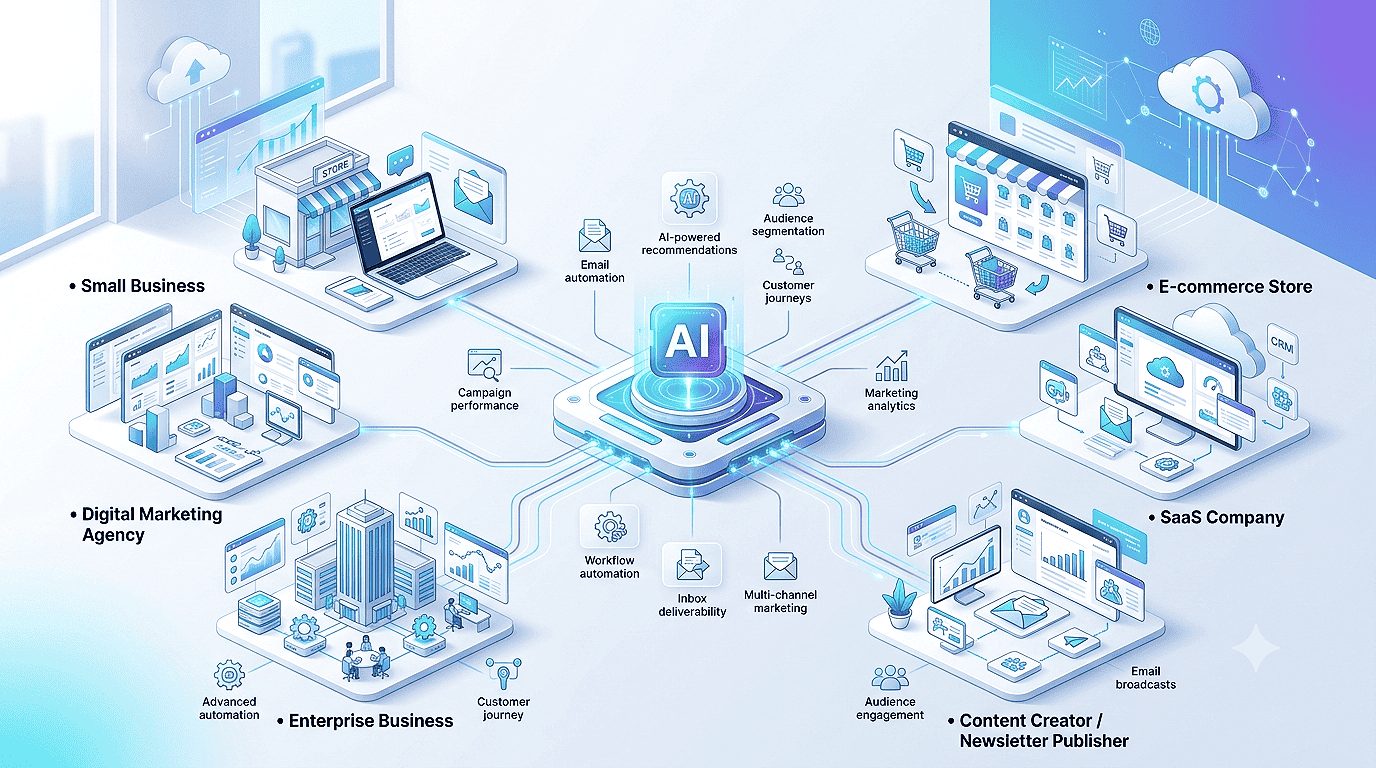
No single tool wins for everyone. The right pick depends on what you sell, how you grow, and who runs your campaigns. Here is the fast match by business type.
Best for Small Businesses: MailerLite & Brevo
Small businesses need low cost, an easy learning curve, and room to grow. MailerLite wins on simplicity and value, giving you email, landing pages, and automation without a bloated interface. Brevo wins if you hold a large list but mail it occasionally, since its send-based pricing keeps costs flat as your contacts climb. Constant Contact is another strong option for local small businesses and non-profits that want guided setup, event tools, and hands-on support over deep automation.
MailerLite and Brevo offer real free plans, so you can start at zero and upgrade only when revenue justifies it.
Brevo vs MailerLite
Best for: Small businesses deciding between send-based and contact-based pricing.
Strengths: Brevo charges by emails sent with unlimited contacts, ideal for large lists mailed occasionally, and bundles SMS, CRM, and transactional email. MailerLite charges by contacts, offers a cleaner editor, and includes websites and landing pages.
Weaknesses: Brevo’s send-based model punishes high-frequency senders, and automation is locked out of its lower tiers. MailerLite’s contact-based pricing climbs as your list grows, regardless of how often you send.
Pricing: Brevo’s free plan sends 300 emails/day; Starter begins at $9/month ($8.08 annual). MailerLite starts at $10/month with a 1,000-subscriber free plan.
Final recommendation: Choose Brevo if you hold a large list but email it infrequently, or need transactional and SMS in one account. Choose MailerLite if you send regularly to a growing list and want the simplest, best-value editor for newsletters and campaigns.
Best for Ecommerce: Klaviyo & Omnisend
Ecommerce lives on data and automation. Klaviyo is the choice for stores doing serious volume that want predictive analytics and revenue attribution behind every flow. Omnisend fits stores that want email and SMS bundled together at a friendlier price, with ecommerce automations ready out of the box.
Both integrate deeply with Shopify, so the deciding factor is usually data depth versus bundled channels.
Klaviyo vs Omnisend
Best for: Ecommerce brands weighing data depth against bundled value.
Strengths: Klaviyo wins on data. Its predictive analytics, granular segmentation, and revenue attribution are unmatched for stores doing real volume. Omnisend wins on simplicity and price, bundling email, SMS, and push into one plan with ecommerce flows ready out of the box.
Weaknesses: Klaviyo’s profile-based pricing climbs fast and overwhelms smaller stores. Omnisend lacks Klaviyo’s predictive depth and suits email-first brands more than heavy SMS senders on newer plans.
Pricing: Klaviyo starts at $20/month (250 free profiles); expect ~$45 at 1,500 contacts. Omnisend starts at $16/month with a 250-contact free plan.
Final recommendation: Choose Klaviyo if you’re scaling past six figures monthly and want the deepest customer data available. Choose Omnisend if you want strong ecommerce automation and email-plus-SMS in one plan at a friendlier price, especially under 25,000 contacts.
Best for SaaS & B2B: ActiveCampaign & HubSpot
B2B and SaaS run on lead nurturing and sales alignment. ActiveCampaign delivers the automation depth to nurture leads through long sales cycles, with a CRM attached. HubSpot goes further, uniting marketing, sales, and service in one platform for teams that want a single source of truth.
Either way, you will need to integrate your CRM and email data properly, since disconnected systems are the most common reason B2B email programs underperform.
HubSpot vs ActiveCampaign
Best for: B2B and SaaS teams choosing between a full platform and automation depth.
Strengths: HubSpot unifies marketing, sales, and service in one system with a genuinely capable free CRM, ideal for teams wanting a single source of truth. ActiveCampaign delivers deeper automation and lead scoring at a fraction of the cost.
Weaknesses: HubSpot gets expensive fast, jumping to $890/month at the Professional tier plus onboarding fees. ActiveCampaign has no free plan, and its automation depth goes unused by teams without someone to own it.
Pricing: HubSpot offers a free CRM (2,000 sends/month), then $15-20/seat/month for Starter. ActiveCampaign starts at $15/month for 1,000 contacts with a 14-day trial.
Final recommendation: Choose HubSpot if you want marketing and sales fully unified and have the budget to grow into it. Choose ActiveCampaign if automation is your priority and you want enterprise-grade workflows without enterprise pricing.
Best for Enterprises
Enterprises need scale, security, and support. Platforms like HubSpot Enterprise, Klaviyo, and ActiveCampaign Enterprise offer dedicated account teams, advanced permissions, custom reporting, and multi-touch attribution across channels.
Three requirements separate enterprise buyers from everyone else. First, the dedicated IP vs. shared IP decision. A dedicated IP gives you full control over your sender reputation, but it requires IP warming, a gradual ramp in send volume that builds trust with mailbox providers before you send at scale. Second, governance: role-based permissions, audit logs, and single sign-on become mandatory once multiple teams touch the same account. Third, data residency and compliance controls, which matter for any business sending into the EU or handling regulated customer data.
At this level, pricing moves to custom quotes, and the negotiation usually centers on contact volume, seats, and support tier rather than a published rate. Budget for implementation and onboarding as separate line items, since enterprise deployments typically take four to twelve weeks before the first campaign goes out.
Best for Agencies
Agencies juggle many clients, so they need multi-account management, white-label options, and predictable billing. ActiveCampaign, HubSpot, and GetResponse all run agency or partner programs with client management tools and consolidated invoicing.
Judge agency platforms on four criteria. Look for a single dashboard that switches between client accounts without separate logins, since seat-juggling wastes hours weekly. Check whether the partner program offers revenue share or discounted client pricing, which directly affects your margin. Confirm you can white-label reports with your own branding, because client-facing deliverables carry your name, not the vendor’s. Finally, verify that client data stays properly separated, since cross-account contamination creates both compliance and deliverability risk.
The platforms with mature partner programs also assign a dedicated partner manager, which becomes valuable when a client account hits a deliverability problem, and you need an answer the same day.
Best for Creators & Media: Kit & Beehiiv
Creators monetize an audience, not a product catalog. Kit suits authors, course sellers, and bloggers who want automation and a huge free tier. Beehiiv suits newsletter operators who want a built-in ad network, paid subscriptions, and growth tools under one roof.
The split comes down to what you sell: products to your list, or the newsletter itself.
Kit vs Beehiiv
Best for: Creators choosing between audience monetization and newsletter-first publishing.
Strengths: Kit excels at selling products and courses to your list, with visual automation and the largest free tier (10,000 subscribers). Beehiiv is built for newsletter businesses,
bundling an ad network, paid subscriptions, and referral growth with 0% subscription fees.
Weaknesses: Kit’s paid plans jumped ~35% after 2025, and its free tier allows only one automation. Beehiiv locks automations out of its free plan and suits publishers more than product sellers.
Pricing: Kit is free up to 10,000 subscribers; Creator starts at $33/month ($39 monthly). Beehiiv is free for up to 2,500 subscribers; Scale starts at $43/month ($49 monthly).
Final recommendation: Choose Kit if you sell digital products, courses, or a paid newsletter and want automation built around a creator business. Choose Beehiiv if you’re building a newsletter into a media business and want monetization and growth tools baked in.
7.Key Features Of The Best Email Marketing Software
The best email marketing software shares a common set of capabilities. When you compare platforms, judge each email marketing tool on these pillars rather than price alone.
Automated marketing software solutions are the engine of modern email. The best tools let you build branching, behavior-triggered workflows, not just linear autoresponders. Advanced email automation reacts to what each subscriber actually does. Analytics and reporting turn sends into decisions, tracking opens, clicks, conversions, and multi-touch attribution so you can prove revenue per campaign and cut what fails.
Segmentation decides who gets which message. Strong tools split your list by behavior, purchase history, and engagement, then use dynamic content and merge tags to personalize a single send for every reader. Mailchimp measured the payoff: segmented campaigns see about 14% higher opens and double the click rate of generic blasts, while trimming unsubscribes at the same time. Email templates and a solid email editor decide how fast you ship. Look for responsive email templates you can brand once and reuse, so every email send looks professional without a designer. Landing pages and forms capture leads without a separate builder, keeping your funnel in one place.
Expert Tip
“Segment by engagement before you segment by demographics. Split your list into 0-30 day, 31-90 day, and 90+ day openers, then send your main campaigns only to the first two groups. This one change protects your sender reputation and often lifts open rates within weeks, because mailbox providers reward lists that mostly reach people who actually open.”
SMS rounds out the reach, letting you hit customers where they respond fastest, often bundled with email in tools like Omnisend and Brevo. CRM integration ties email to sales data, essential for B2B teams tracking deals, and most stacks need API integration services to connect cleanly. RSS-to-email turns your latest blog posts into automatic campaigns, while newer features like AMP for Email add interactive elements (polls, carousels, one-click actions) inside the message itself. And AI writing now drafts subject lines, body copy, and send-time predictions, cutting production time and lifting performance.
Litmus quantified that shift: teams needing two weeks or more to build one email dropped from 62% to 6% in a single year, almost entirely due to AI and automation.
The strongest platforms combine these features. Weaker ones force you to bolt on separate tools, which fragments your data and raises your true cost.
8. Best Email Marketing Tools For Small Business
If you run a small business, your priorities differ from an enterprise. You want the best email marketing tools for small business, which means five things above all.
The budget comes first. Look for a real free plan or a low entry price, so you start earning before you spend. Ease of use matters just as much, because you likely run marketing yourself without a dedicated team. A steep learning curve costs you time you do not have.
Email templates get you sending fast, letting you launch a professional email newsletter without a designer. Automation then does the heavy lifting, running welcome series and follow-ups while you focus on the business. And scalability protects your future, so the tool grows with your list instead of forcing a painful migration later.
Recommendations: For most small businesses, MailerLite offers the best balance of price, ease, and features. Brevo is the smart pick if you hold a large list or want SMS and transactional email included. Moosend wins on pure budget with unlimited sends, and AWeber suits owners who value simple setup and real phone support.
Start with free email marketing tools where you can, prove the ROI, then upgrade with confidence.
9. Marketing Automation Tools That Save Time & Increase Revenue
The real power of email is automated email marketing. The best email automation tools run revenue-generating sequences continuously, without you touching them. Six core flows do most of the work, and every platform in this guide supports them at some level.
The revenue math is lopsided: automated emails make up roughly 2% of sends but drive 320% more revenue than one-off campaigns, according to Omnisend data.
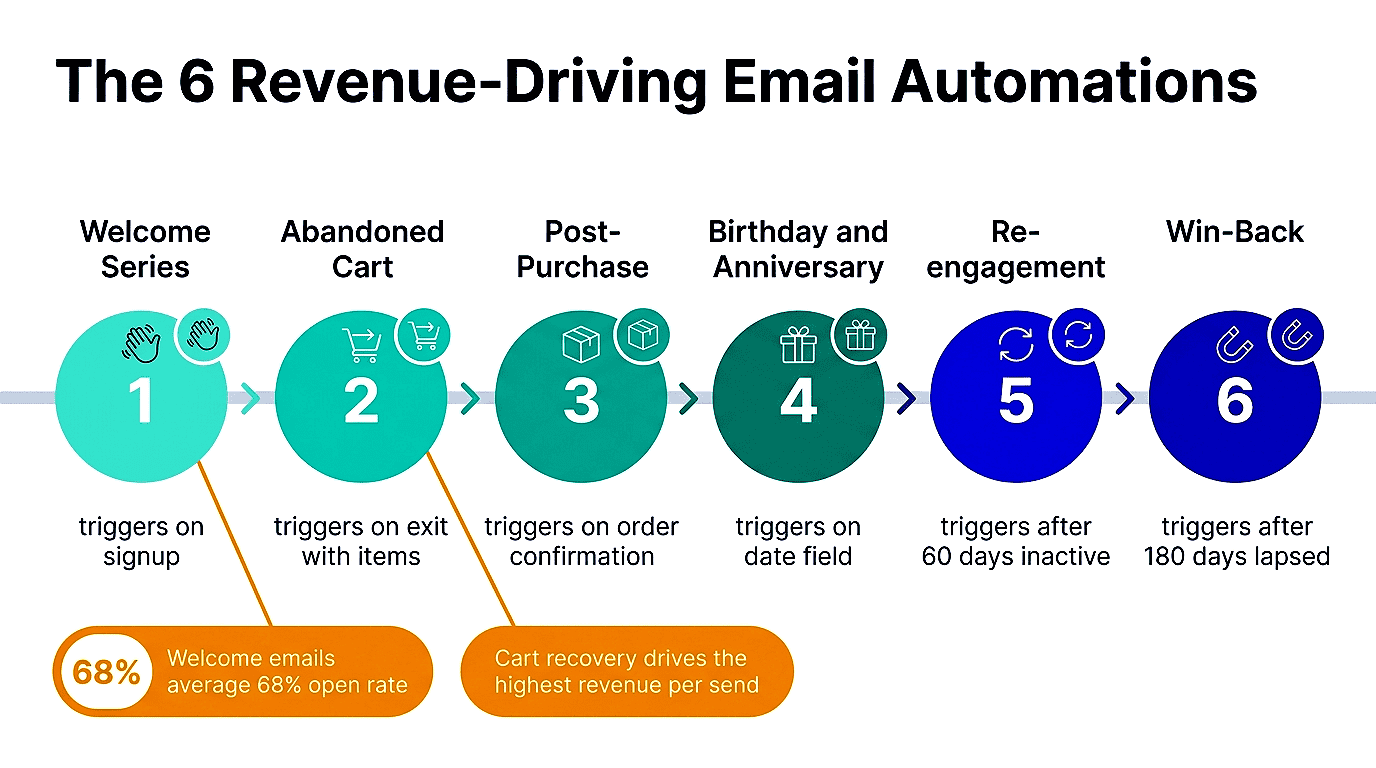
Welcome Series: Your highest-engagement moment. A new subscriber wants to hear from you, so a 3-5 email welcome sequence introduces your brand, sets expectations, and drives a first purchase. Benchmarks put the average welcome-email open rate at 68.6%, which is why this first touch is the highest-value real estate you own.
Expert Tip
“Cap your welcome series at one clear goal per email. The instinct is to cram your brand story, best sellers, a discount, and social links into one message. Resist it. Email one sets expectations, email two delivers the offer, email three drives the first purchase. One goal per send consistently outperforms the everything-at-once approach, because a single obvious action beats five competing ones.”
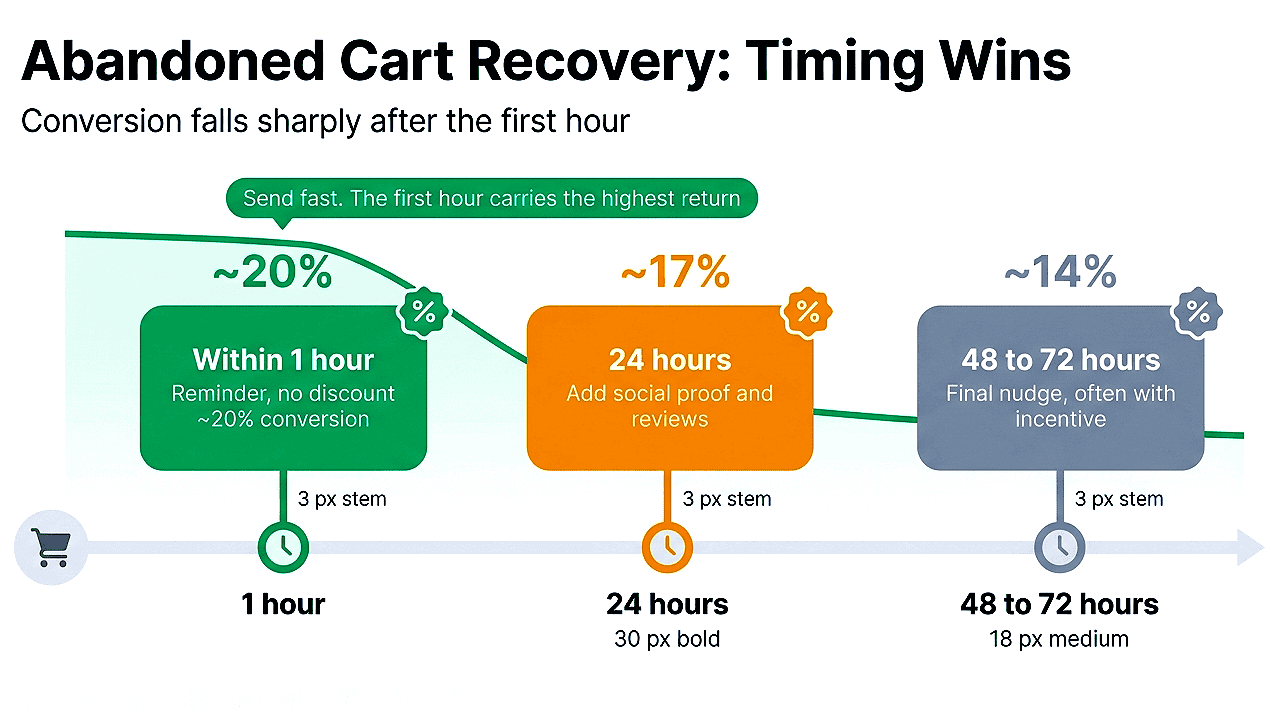
Abandoned Cart: The single most profitable ecommerce flow. When a shopper leaves items behind, a timed reminder (often with a discount) recovers sales that would otherwise vanish. Klaviyo’s data shows cart emails average a 50.5% open rate, and moving from one recovery email to a three-email sequence lifted revenue from $3.8M to $24.9M across the brands studied.
Speed decides the outcome: Carts emailed within the first hour convert nearly 20%, while waiting a full day cuts that to roughly 12%.
Lead Nurturing: The B2B workhorse. A sequence that educates prospects, builds trust, and moves them toward a demo or sale, all triggered by a single opt-in. It keeps your pipeline warm without manual follow-up.
Re-engagement: Subscribers go quiet over time. A re-engagement flow targets inactive contacts with a reason to return, winning back attention before they churn and protecting your sender reputation by trimming dead weight.
Birthday Emails: A simple, personal touch that performs. An automated birthday or anniversary message with a small offer feels thoughtful and converts well, running entirely on data you already hold.
Win-Back Campaigns: The last line of defense. For customers who have not purchased in months, a win-back sequence with a strong incentive revives lapsed revenue at a fraction of the cost of acquiring someone new.
Real-World Insight
“One caution on automation, because I’ve seen it bite good teams: flows fail silently. A welcome series with a broken trigger doesn’t throw an error. It just quietly stops sending, and you lose weeks of first-touch revenue before anyone checks. I now audit live automations monthly, sending a real test contact through every active flow to confirm each email fires. On one account, that check caught an abandoned-cart flow that had died after a Shopify integration update. It had been down for 18 days.”
Expert Tip
Set a recurring calendar reminder to send a real test contact through every live automation once a month. Flows fail silently after integration updates, template changes, or tag edits, and no error message warns you. A dead abandoned-cart flow can leak revenue for weeks unnoticed. Five minutes of monthly testing protects the automations quietly earning most of your email income.
Layer behavior-based automation on top, triggering emails from clicks, page views, and purchases, and you personalize at scale. AI automation now optimizes send times, subject lines, and content per subscriber, squeezing more revenue from every flow. Set these up once with proper done-for-you automation setup, and they compound for years.
Great software is only part of the equation. The highest-performing campaigns combine the right platform with expert strategy, automation, and deliverability optimization. Our team can build and manage complete email marketing systems tailored to your business goals. Book a Strategy Call
10.Free Email Marketing Tools: What Is The Best Free Email Marketing Service?
Free email marketing tools are a smart place to start, but they come with real limits. Every major platform (Mailchimp, Brevo, MailerLite, Kit, HubSpot, Omnisend) offers free email marketing software at some level, and each one draws a line you will eventually cross.
So what is the best free email marketing service? For creators, Kit wins on raw subscriber count. For general business use, MailerLite offers the most complete free email marketing tools, including a real email editor, email templates, and basic marketing workflow automation.
The pros are clear. You test the platform with zero risk, learn the interface, and start building a list before you spend a dollar. For a new business or a small email newsletter, a generous free plan often carries you through your first months.
The cons show up as you grow. Free tiers cap your contacts, limit monthly sends, and stamp their branding on your emails. Brevo restricts you to 300 emails per day. Mailchimp now caps its free plan at 250 contacts, down from 2,000 in 2022, a reduction that shows how quickly these limits tighten. Automation, the feature that actually drives revenue, is often locked out entirely.
Know your limits before you commit. A daily send cap can strangle a growing list mid-campaign. Contact ceilings force an upgrade the moment you gain traction. And branded footers quietly undercut your professionalism with every send.
Compare free plans on three things: the subscriber cap, the monthly email send limit, and whether marketing automation is included. A platform with a high contact ceiling but no automation will stall your revenue faster than one with a smaller list cap and working flows.
Upgrade when the math flips. The moment your list generates revenue, or you need automation, higher send volume, or your own branding, a paid plan pays for itself. If a $10 to $20 monthly plan unlocks flows that recover even one abandoned cart a week, the free tier is costing you money, not saving it.
11.How To Find The Best Email Marketing Service Provider (ESP)
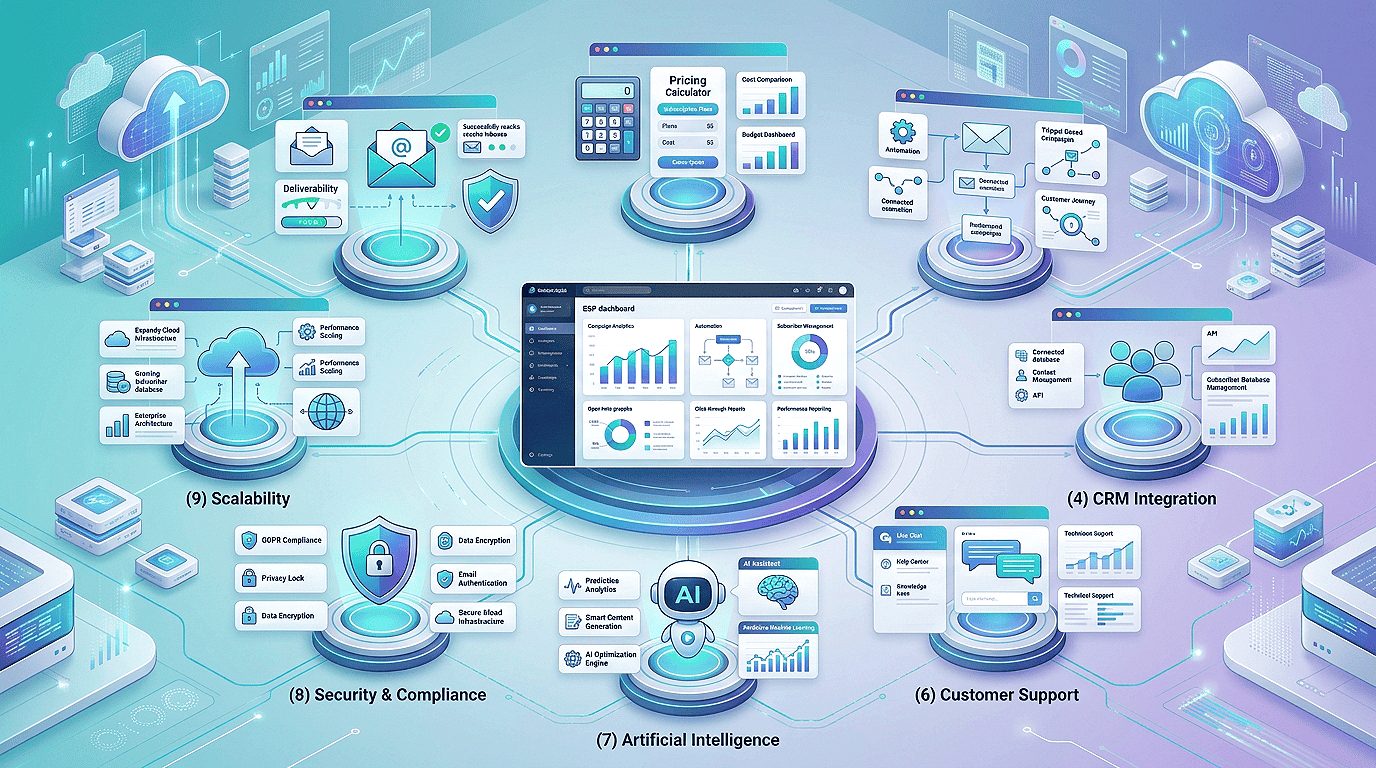
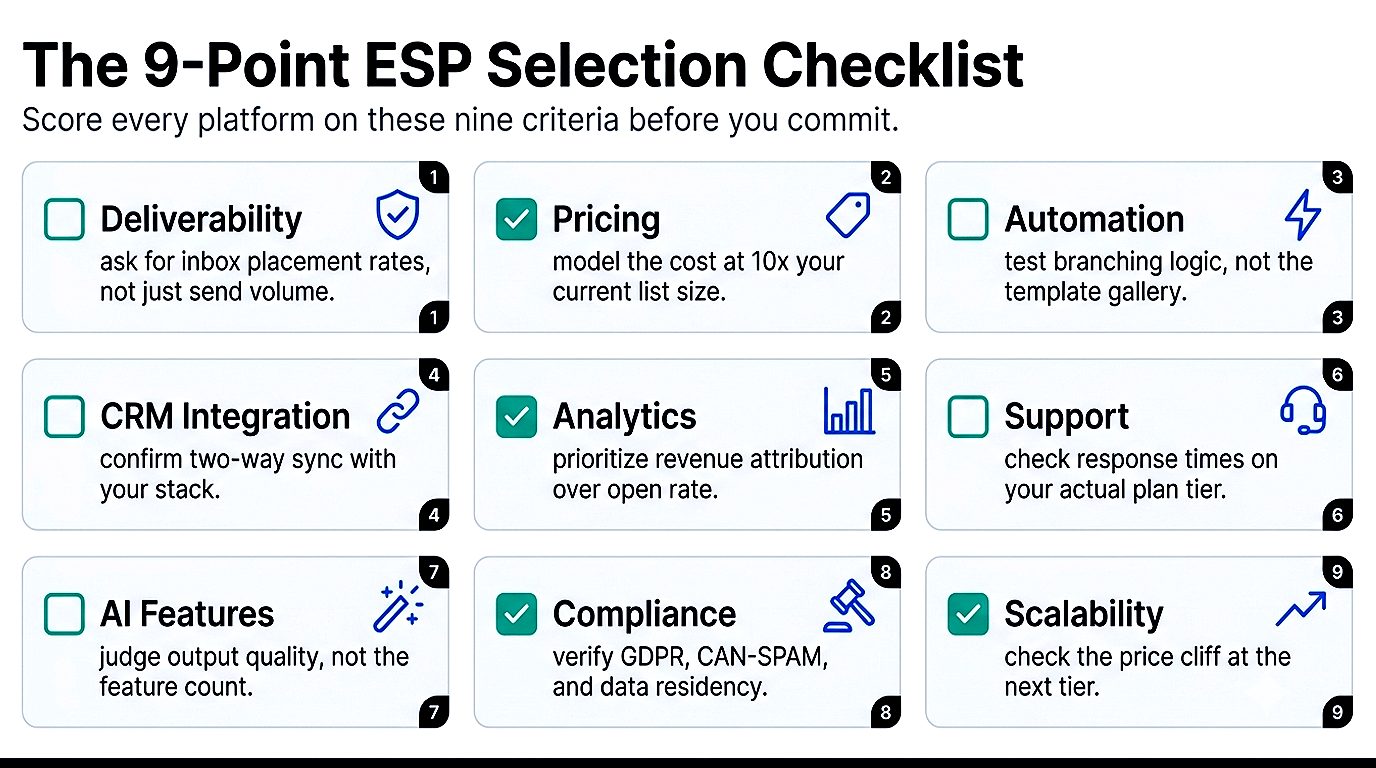
To find the best email marketing platform among dozens of email service providers (ESPs), score each one against a fixed checklist. Run every shortlist candidate through these nine criteria.
- Deliverability: The most important factor. Check that the platform supports SPF, DKIM, DMARC, and BIMI, offers a dedicated IP vs. shared IP choice at scale, and posts strong inbox placement rates. Great emails mean nothing in spam.
- Pricing: Understand the model. Contact-based plans climb as your list grows, while send-based plans favor large, low-frequency lists. Project your cost at 10,000 and 50,000 contacts, not just today.
- Marketing automation: Look for a visual builder with branching logic and behavior triggers, not just basic autoresponders. This is where revenue comes from.
- CRM: If you run B2B or a sales team, a built-in or well-integrated CRM keeps email and deal data together.
- Analytics: You need clear reporting on opens, clicks, conversions, and revenue per campaign, so you can cut what fails and scale what works.
- Support: Check the hours and channels. Phone, live chat, and fast response times matter most when a send breaks.
- AI: Modern tools draft copy, predict send times, and build segments. Strong AI features save real hours.
- Compliance: Confirm the platform handles GDPR and CCPA compliance, CAN-SPAM, double opt-in, and one-click unsubscribe, and helps you meet Gmail and Yahoo sender requirements.
- Scalability: Pick a tool that grows with you, so you never face a painful migration just as your business takes off. Businesses outgrowing off-the-shelf tools sometimes move to custom software and platform development instead.
We treat compliance as a deliverability issue, not just a legal one. Clean consent practices and honest unsubscribe handling protect your sender reputation as much as they protect you from GDPR or CCPA penalties. The two goals reinforce each other.
Our take heading into 2026: deliverability, not creative, is now the top constraint on email revenue. With inbox placement tightening across Gmail and Yahoo, the platforms that invest in authentication and reputation tooling will separate from the ones that don’t.
Weight the list to your needs. An ecommerce store leans on marketing automation and deliverability, while a B2B team weighs CRM and analytics. That weighting is how you find the best fit rather than the most popular name.
Expert Tip
“Judge platforms on their true engagement rate, not vanity opens. Since Apple’s Mail Privacy Protection auto-loads images and inflates open rates, opens are now unreliable. Anchor your reporting to click-through rate, conversions, and revenue per recipient instead. When you compare tools, prioritize the ones with clean click and revenue attribution, because those are the numbers that actually reflect performance.”
12.Common Email Marketing Mistakes Businesses Make
Even good tools fail in the wrong hands. These are the mistakes that quietly kill campaigns.
- Buying email lists: The fastest way to destroy your sender reputation. Purchased contacts never opted in, so they mark you as spam, tank your deliverability, and can trigger legal trouble. Grow your list, never buy it.
- Skipping double opt-in: Single opt-in fills your list faster, but double opt-in confirms every address and keeps bots and typos out. That cleaner list protects your inbox placement rates and lowers spam complaints from day one.
- Skipping authentication: Sending without proper SPF, DKIM, and DMARC records lands you in spam under the 2024 Gmail and Yahoo rules. This single technical gap wrecks otherwise strong campaigns.
- Neglecting list hygiene: Dead addresses and chronic non-openers drag down your sender reputation score. Regular list scrubbing removes them, and active unsubscribe rate management keeps your complaint rate under the 0.3% threshold mailbox providers watch.
- Poor segmentation: Blasting one message to your entire list drags down engagement. Relevant, segmented emails consistently outperform generic sends by wide margins.
- Ignoring mobile: The data is blunt here. 78% of opens happened on mobile in 2025, and 75% of users delete an email outright when it renders badly on a phone.
- No marketing automation: Sending everything manually wastes time and leaves money on the table. Welcome and abandoned-cart flows run themselves and drive revenue you would otherwise miss.
- Weak subject lines and no testing: Vague or spammy subject lines kill your open rate before the content gets a chance. A/B testing subject lines, content, and send times compounds small wins into large gains.
Expert Tip
“Test your emails in Gmail, Apple Mail, and Outlook before every send, not just your own inbox. Apple Mail alone accounts for roughly half of all opens, and it renders differently from Gmail. A layout that looks clean in one client can break badly in another. Two minutes of preview testing prevents the broken send that quietly tanks a campaign’s clicks.”
Fix these, and your results improve before you change a single tool.
Real-World Insight
“The mistake I see most often is treating a big list as an asset when it’s actually a liability. A B2B client insisted on keeping 22,000 contacts because the number looked good on board decks. Half hadn’t opened anything in a year. Every send to those dead addresses dragged their sender reputation down and pushed more of the good emails toward spam. We suppressed everyone inactive past 180 days, dropped the active list to about 11,000, and their inbox placement jumped almost immediately. Sending to fewer, engaged people beat sending to everyone, every single time we test it.”
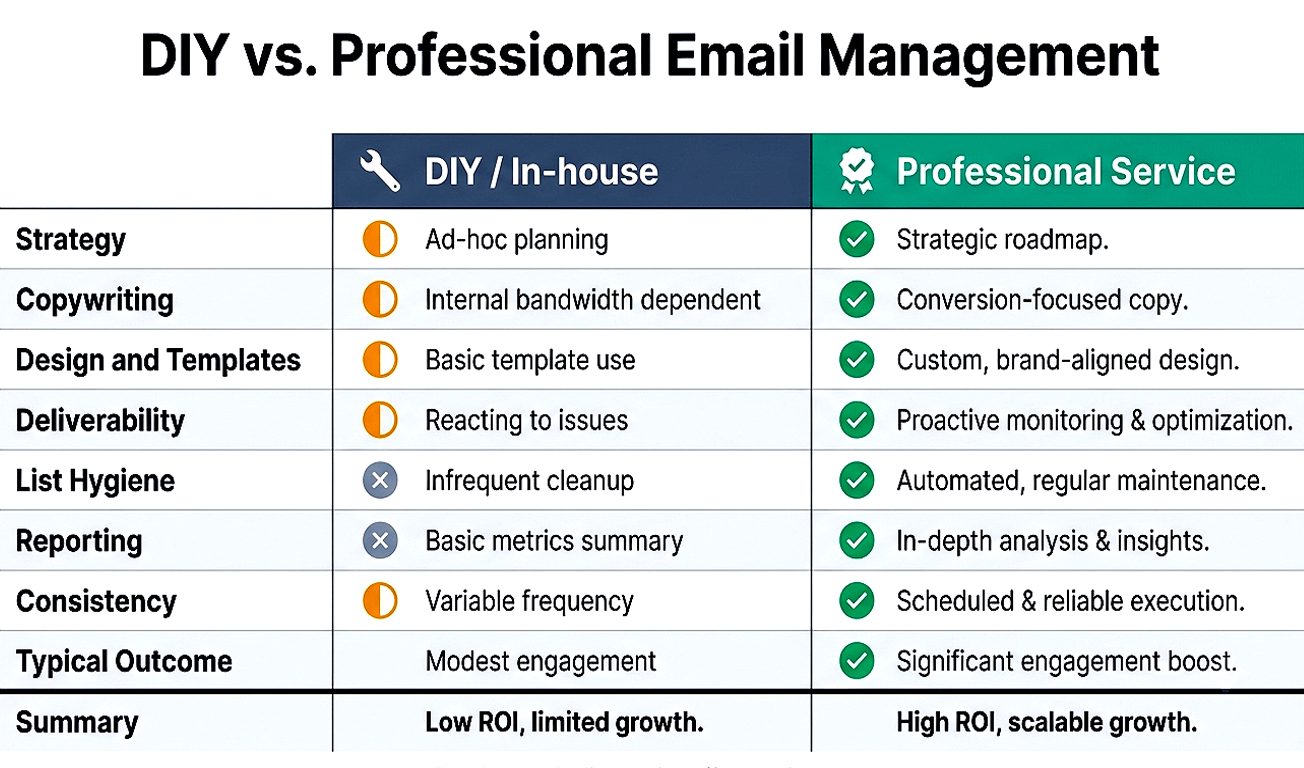
13.Why Professional Email Marketing Services Deliver Better Results
Great software still needs a skilled operator. That is the gap between a platform that could work and campaigns that actually do.
DIY has real costs. Running email yourself means learning deliverability, writing copy, designing templates, building automations, and analyzing data, all while running your business. Most owners manage two of those well and let the rest slide. The result is a capable tool producing mediocre returns.
Professional services close that gap. A dedicated team brings expertise across every part of the system, so nothing gets neglected. Here is what that looks like in practice:
Real-World Insight
“The gap is rarely about intelligence. It’s about attention. A founder running email between twelve other jobs will set up a solid welcome series, then not revisit it for a year while their catalog, pricing, and audience all change. The flow slowly drifts out of date. What a dedicated operator actually provides is consistent iteration: testing subject lines, refreshing segments, catching the broken trigger before it costs a month. I’ve inherited plenty of accounts with good bones and stale execution, and simply maintaining them properly lifted revenue 20% to 30% before we added anything new.”
- Strategy: A campaign calendar and segmentation plan built around your revenue goals, not guesswork.
- Marketing automation: Fully built welcome, cart, nurture, and win-back flows that generate revenue while your team focuses elsewhere.
- Copywriting: Subject lines and body copy written to convert, tested and refined over time.
- Design: On-brand, mobile-ready email templates that look professional in every inbox.
- Deliverability: Correct SPF, DKIM, and DMARC setup, BIMI configuration, IP warming for new dedicated IPs, and ongoing monitoring to keep you out of spam.
- List hygiene: Regular list scrubbing that removes dead contacts, protects your sender reputation score, and lowers your bill.
- Compliance: GDPR and CCPA safeguards, proper opt-in flows, and unsubscribe rate management that keep you on the right side of privacy law.
- Reporting: Clear multi-touch attribution that ties every campaign to revenue and guides the next move.
The ROI difference is the point. A professional team turns a platform’s potential into measurable growth, often recovering their fee many times over through better inbox placement, stronger automation, and higher conversion. At Webo 360 Solutions LLC, that is exactly the work we do: full-service email marketing management that makes your email a reliable revenue channel instead of a chore.
Need experts to manage your email marketing from start to finish?
Our team helps businesses improve inbox placement, automate customer journeys, design high-converting campaigns, and maximize ROI using leading email platforms. Get a Free Email Marketing Proposal
14.Why Businesses Choose Webo 360 Solutions
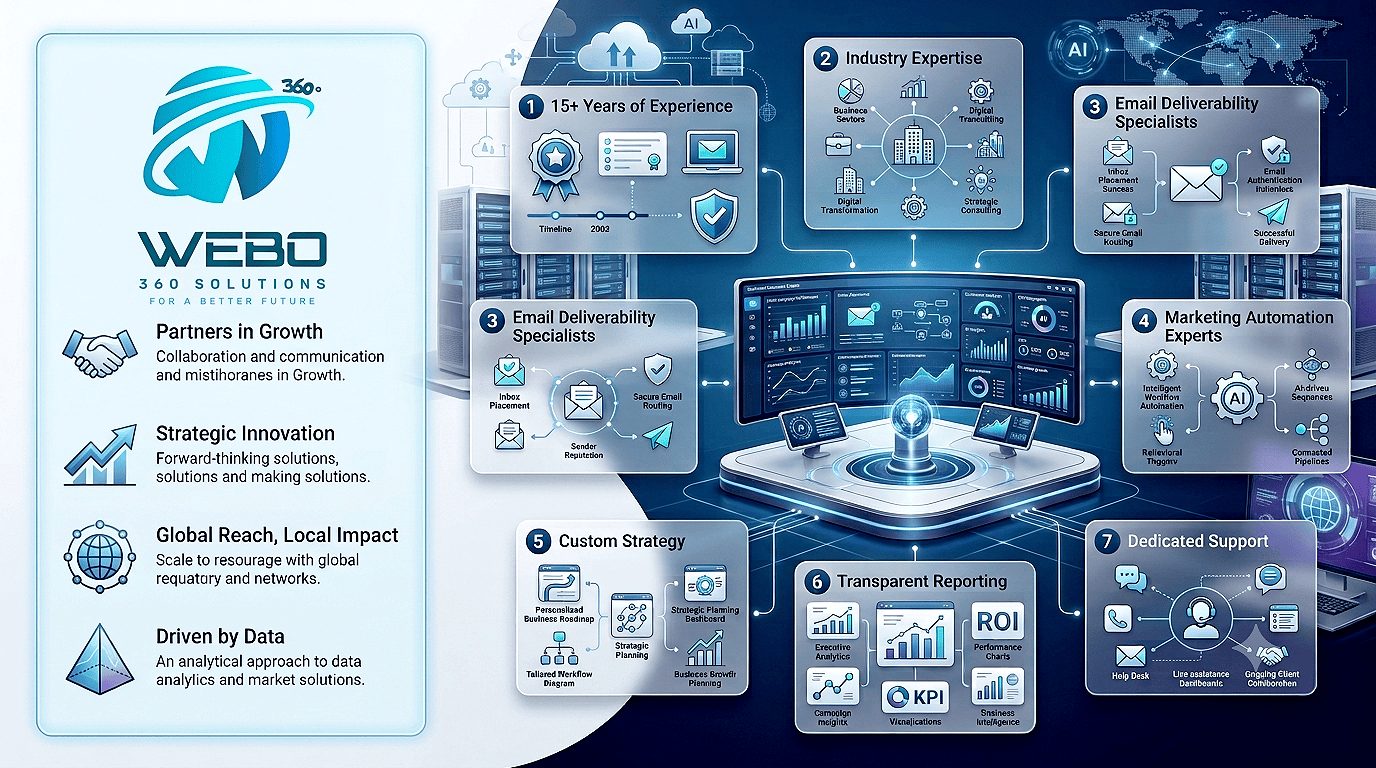
Choosing a platform is the easy part. Running it well, month after month, is where most email programs stall. That is the gap we close.
- 15+ years of experience. We have managed email for SMBs, ecommerce brands, SaaS companies, and enterprises since before Gmail and Yahoo tightened their sender rules. We have seen what breaks, and we know how to fix it fast.
- Industry expertise. Retail, DTC, B2B, and subscription businesses each need a different playbook. We build strategies around your model, not a generic template.
- Deliverability specialists. Authentication, IP warming, and sender reputation are our core craft. We get your emails into the primary inbox and keep them there.
- Automation experts. From welcome series to win-back flows, we build sequences that earn revenue continuously and audit them so they never fail silently.
- Custom strategy. No recycled calendars. We map segmentation, cadence, and campaigns to your specific revenue goals.
- Transparent reporting. You see exactly what each campaign earns, tied to revenue and click-through, not vanity opens. Every month, in plain language.
- Dedicated support. You work with a real team that knows your account, not a ticket queue and a canned reply.
The result is email that performs like the revenue channel it should be. We handle the strategy, the deliverability, and the day-to-day execution, so you can focus on running your business while your list compounds into sales.
15.Our Final Recommendations By Business Type
You’ve seen 12 platforms, six business types, and real 2026 pricing. Here is the whole decision compressed into one table, so you can find your fit in seconds.
| Business Type | Recommended Platform | Reason | Alternative Choice |
| Small Business | MailerLite | Best value, easy learning curve, and a usable free plan for up to 1,000 subscribers | Brevo |
| Ecommerce (scaling) | Klaviyo | Deepest customer data, predictive analytics, and revenue attribution per flow | Omnisend |
| Ecommerce (value) | Omnisend | Email, SMS, and push bundled in one plan with ready-made store automations | Klaviyo |
| B2B & SaaS | ActiveCampaign | Deep automation and lead scoring with a built-in CRM at a fair price | HubSpot |
| Enterprise | HubSpot | Unified marketing, sales, and service with dedicated support and controls | Klaviyo |
| Creators (products) | Kit (ConvertKit) | Built to sell courses and paid newsletters, with the largest free tier | Beehiiv |
| Newsletter Publishers | Beehiiv | Built-in ad network, paid subscriptions, and 0% subscription fees | Kit (ConvertKit) |
| Budget-Conscious Teams | Moosend | Unlimited sends and strong automation at one of the lowest entry prices | Brevo |
| Standard Campaigns | Mailchimp | Familiar interface, largest template library, and the widest integrations | MailerLite |
| Bloggers (support-first) | AWeber | Phone support on every plan with reliable, simple sending | GetResponse |
| Funnels & Webinars | GetResponse | Webinars, sales funnels, and unlimited sends in one platform | ActiveCampaign |
How to Use This Table
Start with your business type, not the price. The recommended column is the platform that fits most businesses in that category, and the alternative is the strong runner-up worth testing if your priorities differ.
Then apply two filters. First, project your cost at your 12-month list size, since contact-based tools look cheap at the entry tier and climb fast. Second, use the free plan or trial before you commit, so you confirm the interface and automation match how you actually work.
If two options feel close, let your constraint decide. A tight budget points you to the alternative; deeper data or automation needs point you to the primary pick. Whichever you choose, remember the platform is only half the result. The strategy, deliverability, and execution behind it drive the other half.
16. Frequently Asked Questions
What are the best email marketing services?
The best email marketing services in 2026 include ActiveCampaign for automation, Klaviyo and Omnisend for ecommerce, MailerLite and Brevo for small business, HubSpot for B2B, and Kit and Beehiiv for creators. The right pick depends on your business type, list size, and budget.
What are the best email marketing services for small businesses?
The best email marketing services for small businesses are MailerLite for value and ease, Brevo for send-based pricing on large lists, and Constant Contact for guided setup and support. Each offers affordable plans, simple automation, and templates that help owners launch campaigns without a marketing team.
Which email marketing platform is best?
No single platform wins for everyone. ActiveCampaign leads on automation, Klaviyo on ecommerce data, MailerLite on value, and HubSpot on B2B and CRM. Match the platform to your specific goals, your list size, and how much you plan to grow.
Which email marketing software is easiest to use?
MailerLite and Moosend rank among the easiest email marketing software for beginners, with a clean email editor and ready-made email templates. Constant Contact and AWeber also suit non-technical users, and both offer strong support if you get stuck during setup or your first campaigns.
What is the best free email marketing service?
Kit offers the most generous free plan for creators, covering up to 10,000 subscribers with unlimited emails. Beehiiv gives email newsletter publishers 2,500 subscribers with unlimited sends. For general business use, MailerLite and Brevo provide the most usable free email marketing tools, including email templates and basic marketing automation.
Which marketing automation tools are best?
ActiveCampaign and Klaviyo lead the email automation tools category for advanced email marketing automation and behavior-based triggers. Omnisend excels at ecommerce flows, while HubSpot suits B2B nurturing. For budget-conscious teams, Moosend delivers strong visual automation at one of the lowest entry prices available.
What is the difference between an ESP and CRM software?
An ESP (email service provider) builds, sends, and tracks email campaigns to your subscribers. CRM software manages contacts, deals, and the full sales pipeline. Platforms like HubSpot and ActiveCampaign combine both, so email data flows directly into lead scoring and sales tracking in one system.
How much do email marketing software platforms cost monthly?
Most email marketing software costs $9 to $30 per month for small lists, rising with your contact count. Entry plans start around $9 (Brevo, Moosend), while ecommerce and B2B tools like Klaviyo and HubSpot climb to hundreds monthly at scale. Free plans exist for testing before you commit.
How much do professional email marketing services cost?
Professional email marketing management typically runs $500 to $5,000+ per month, depending on scope, list size, and campaign volume. Most agencies price by the work involved: strategy, copywriting, design, automation, and deliverability. The return usually outweighs the fee through higher conversions and better inbox placement.
Why is email deliverability important for email marketing?
Email deliverability decides whether your messages reach the inbox or land in spam. Even a perfect campaign earns nothing unread. Strong SPF, DKIM, and DMARC authentication, a healthy sender reputation score, and clean list hygiene keep your inbox placement rates high and protect your return on every send.
Can small businesses benefit from email marketing?
Absolutely. Email delivers one of the highest returns of any channel, often around $36 for every $1 spent, and works for businesses of every size. With affordable tools and simple automation, small businesses can nurture leads, retain customers, and drive sales on a modest budget.
How do I choose an email service provider (ESP)?
Score each email service provider on deliverability, pricing, automation, CRM, analytics, support, AI, compliance, and scalability. Weight the list to your needs: ecommerce prioritizes automation and data, while B2B leans on CRM. Start with a free trial before you commit to a paid plan.
17.Final Thoughts
The right email platform can turn a quiet list into a dependable revenue channel. Across this guide, you have seen how the best email marketing services differ, where each one wins, and what real 2026 pricing looks like.
Your choice comes down to fit. The strongest email marketing platforms in 2026 match your business type, your list size, and your growth plans, whether that is Klaviyo for a scaling store, ActiveCampaign for a B2B team, or MailerLite for a lean small business.
Choosing the right email marketing software is a real decision, and it matters. Yet the platform is only half the equation. The other half is execution: sharp strategy, clean deliverability, tested copy, and automation that runs without you.
That is where working with experienced professionals pays off. The right team lifts your inbox placement, builds automation that converts, and ties every campaign back to ROI, so your email consistently earns more than it costs.
18.Ready to Grow Your Business With Professional Email Marketing Services?
Whether you need campaign management, automation setup, deliverability optimization, list management, or a complete email marketing strategy, our experts can help you achieve measurable growth.