Software Development Company in USA: Custom Web, Mobile & SaaS Solutions
The US custom software market will reach $65.85 billion by 2026. The global building technology market will exceed $1 trillion. Yet more than 50% of domestic tech employers cannot fill critical AI roles today. For CTOs and founders, that gap is not an abstraction. It is a direct threat to delivery timelines, product quality, and long-term competitive position.
Choosing the right software development company in the USA matters more than most executives admit. Your security posture depends on it. So does your time-to-market speed. And when regulations shift, the wrong partner forces you to rebuild from scratch. This guide covers the decision framework, financial benchmarks, and vendor evaluation criteria. Use each one to choose the right partner with precision.
Everything in this guide reflects what we have learned delivering 150+ software projects at Webo 360 Solutions LLC across healthcare, fintech, retail, SaaS, logistics, and education. We have built compliance-grade systems for regulated clients, shipped AI-enabled products at production scale, and managed complex cloud migrations and application development projects across major industries. The frameworks here are the same ones we use with our clients.
📌Highlights
-
✔50%+ of US employers cannot fill AI engineering roles — the right technology partner closes that gap without a 12-month internal ramp.
-
✔Dedicated team models average only 15% cost overrun versus 32% for fixed-price contracts.
-
✔The average US data breach costs $10.22 million — vendor security certifications are a financial risk decision, not a preference.
-
✔Poor cloud architecture produces a 35% spend overrun that compounds every month after launch.
-
✔Webo 360 Solutions has delivered 150+ projects across healthcare, fintech, SaaS, and logistics with senior engineers averaging 8+ years of experience.
1. The 2026 US Tech Landscape: Why Strategic Outsourcing Is No Longer Optional
The framing has changed. Outsourcing used to be a cost-reduction exercise. In 2026, the primary driver is access to specialized technical expertise that internal teams cannot build fast enough to remain competitive.
American business leaders now treat external software development partners as direct extensions of their engineering organizations. Companies that have not made that shift are often slower, more expensive to operate, and more exposed to security and delivery risks than their competitors.
Bridging The AI Talent Gap: Accessing Elite US Engineering Specialists
More than 50% of US employers struggle to find qualified AI specialists. That is not a future prediction. It is the reality facing organizations today.
The shortage extends beyond machine learning engineers. Organizations also need AI product managers, data engineers, MLOps architects, and specialists who can deploy production-ready systems rather than experimental prototypes.
A general software developer often requires 12 to 18 months of focused experience to become productive in modern AI development. Most internal teams cannot absorb that ramp-up time while maintaining delivery commitments.
The result is delayed product launches, missed market opportunities, and escalating operational costs.
Building an internal AI team can cost 40–60% more than partnering with a strategic software engineering provider when recruiting expenses, compensation competition, onboarding time, and opportunity costs are included. The right custom software development company provides immediate access to proven AI delivery frameworks and specialized expertise.
At Webo 360 Solutions, we maintain dedicated AI and machine learning engineering capacity. For example, when a healthtech client required real-time patient risk scoring integrated into an existing EHR environment, our team deployed a production-ready ML pipeline in 11 weeks — a project their internal estimates projected at approximately nine months.
Beyond Cost Reduction: Why 72% Of US Enterprises Choose Strategic Development Partners
Nearly 72% of organizations now engage software development partners primarily for specialized expertise and accelerated delivery. Cost savings remain important, but they are no longer the primary driver.
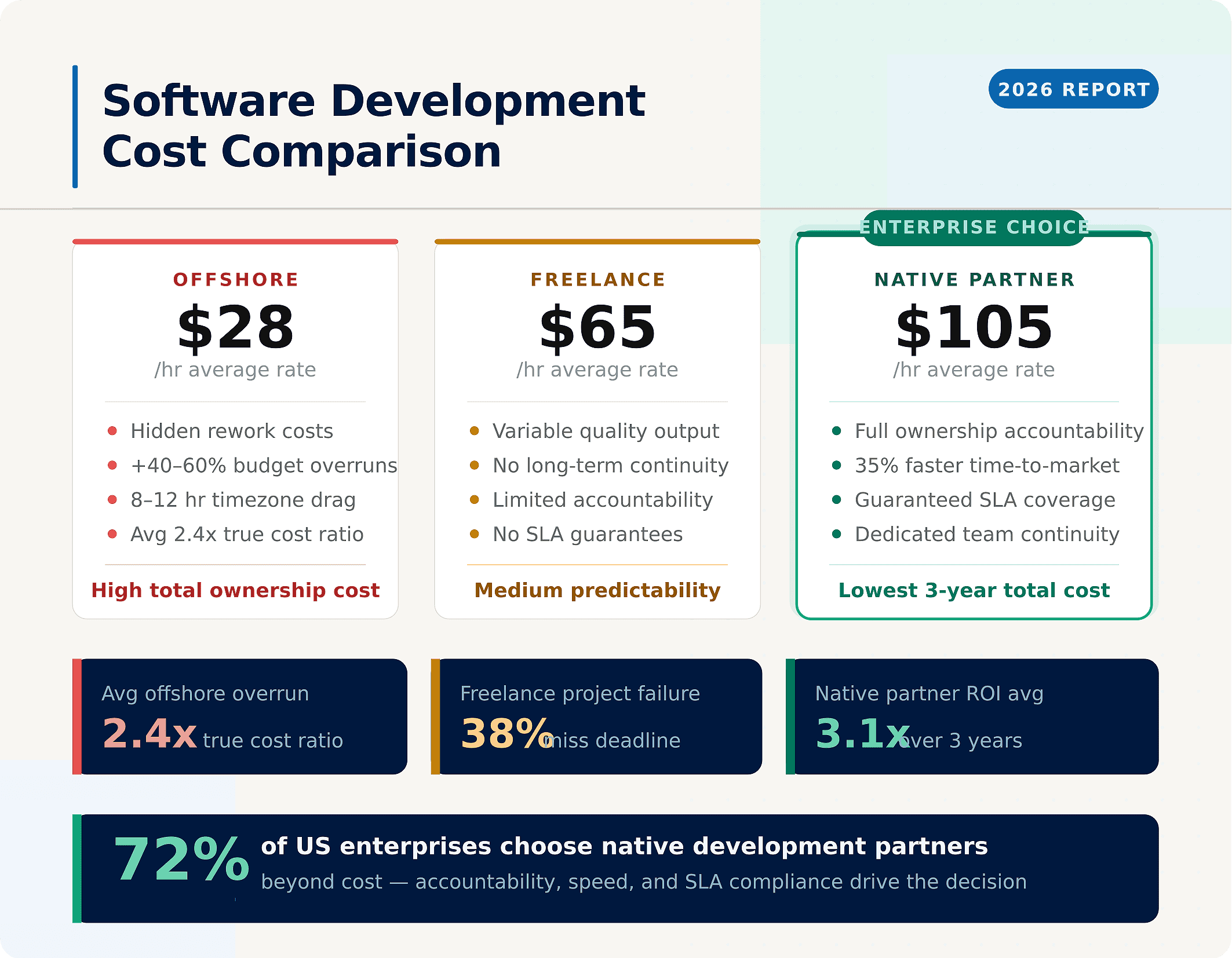
The convergence of cloud-native architecture and AI requirements has created a skills gap that many internal teams cannot close on their own. Business leaders are being forced to reassess build-versus-buy decisions faster than ever before.
The right partnership can deliver an 18 to 24-month advantage in time-to-market. That speed matters. Launching an AI-enabled product before competitors react is often the difference between leading a market and chasing it.
Companies that treat software development outsourcing as a long-term capability extension consistently outperform those that view it as a transactional vendor relationship. The table below illustrates how the strategic outsourcing model has evolved:
2. Security-First Architecture: Mitigating The $10.22M Data Breach Threat
Security is no longer a feature layer added before launch. It is a foundational engineering requirement built into every stage of software delivery. The financial consequences make that reality impossible to ignore.
The average US data breach now costs $10.22 million. That figure includes forensic investigations, legal expenses, regulatory penalties, operational disruption, remediation costs, and long-term damage to customer trust. Choosing an inexperienced partner for your custom software development services exposes your organization to each of these risks.
Hardening The Supply Chain: Defending Against Third-Party Vendor Vulnerabilities
Approximately 30% of security incidents originate from third-party vendor vulnerabilities. Your technology partner’s security posture effectively becomes part of your own attack surface.
Weak controls within a vendor’s infrastructure can provide attackers with a direct path into your environment. A custom software solution built on poor security practices quickly becomes a business liability rather than a competitive advantage.
Your development partner should operate under clearly defined security standards and governance controls. At Webo 360 Solutions, we follow SOC 2 Type II protocols and ISO 27001-aligned security frameworks. Every engagement includes threat modeling during architecture design, automated static analysis within CI/CD pipelines, dependency vulnerability scanning, and zero-trust security principles from the first sprint.
Code review standards and compliance certifications are non-negotiable. Verify them before signing anything.
Data Privacy In The Age Of Intelligent Apps: Protecting IP From AI Data Leakage
AI-enabled application development introduces new categories of data exposure. Model training pipelines, inference logs, vector databases, third-party AI APIs, and analytics platforms all interact with sensitive business information. Every one of these touchpoints requires explicit governance and security controls.
Recent SEC cybersecurity disclosure requirements have elevated cyber risk to a board-level concern. At the same time, state privacy regulations continue to expand. A software development partner that treats security as a final checklist rather than an engineering discipline places your intellectual property, customer data, and brand reputation at unnecessary risk.
Leading software engineering organizations incorporate threat modeling during architecture design, run automated static and dynamic security testing throughout CI/CD pipelines, and implement zero-trust security principles from day one. This approach identifies vulnerabilities early—before they become production incidents.
3. Bulletproof Compliance: Navigating Regulatory Pressures In Modern Software Engineering
Approximately 38% of US organizations identify regulatory compliance as a significant operational challenge. Frameworks such as HIPAA, GDPR, and CCPA are not simply technical requirements. They carry substantial legal, financial, and reputational consequences.
Managing customer and operational data across multiple states, countries, and regulatory jurisdictions is increasingly complex. While a technology partner can help implement controls, accountability ultimately remains with the organization collecting and processing the data. Your vendor’s security and governance practices directly influence your compliance posture.
Designing For Strict Governance: HIPAA, GDPR, And CCPA Integration
HIPAA compliance requires significantly more than encryption alone. Organizations must maintain signed Business Associate Agreements (BAAs), implement secure transmission protocols, maintain detailed audit logs, enforce access controls, and conduct ongoing security assessments.
GDPR and CCPA introduce additional obligations. Both frameworks emphasize privacy-by-design principles, transparent consent management, data portability, retention controls, and the ability to fulfill deletion requests. These capabilities must be engineered into the platform from the outset. Retrofitting compliance after launch is significantly more expensive and substantially increases project risk.
The right custom software development partner integrates governance requirements directly into system architecture. Compliance becomes an engineering discipline embedded throughout the software lifecycle rather than a final-stage audit exercise.
Webo 360 Solutions has delivered HIPAA-compliant healthcare systems and GDPR-ready SaaS platforms for organizations operating in highly regulated environments. We maintain Business Associate Agreement templates, documented data processing agreements, and dedicated compliance review checkpoints throughout every development sprint to ensure governance remains aligned with delivery objectives.
Proactive Risk Auditing: Overcoming The 38% Compliance Roadblock In New AI Implementations
AI implementations introduce an entirely new category of compliance and governance risks. Training datasets, model outputs, prompt logs, vector databases, and inference pipelines all create potential regulatory exposure. A technology partner without a dedicated AI governance framework can place your product, your data, and your organization at significant risk.
Leading software development agencies adopt ISO 27001-aligned operational standards, maintain formal compliance review processes, and employ specialists who continuously monitor evolving regulatory requirements. They also bring documented experience from regulated industries where governance failures carry substantial legal and financial consequences.
When evaluating a potential partner, request sample Data Processing Agreements (DPAs), review their incident response procedures, and verify their current certifications. Ask how they handle AI governance, model auditing, and data retention policies. Reputable firms provide this documentation without hesitation because transparency is part of their operating model.
4. Financial Predictability: Eliminating Scope Creep And Cloud Cost Overruns
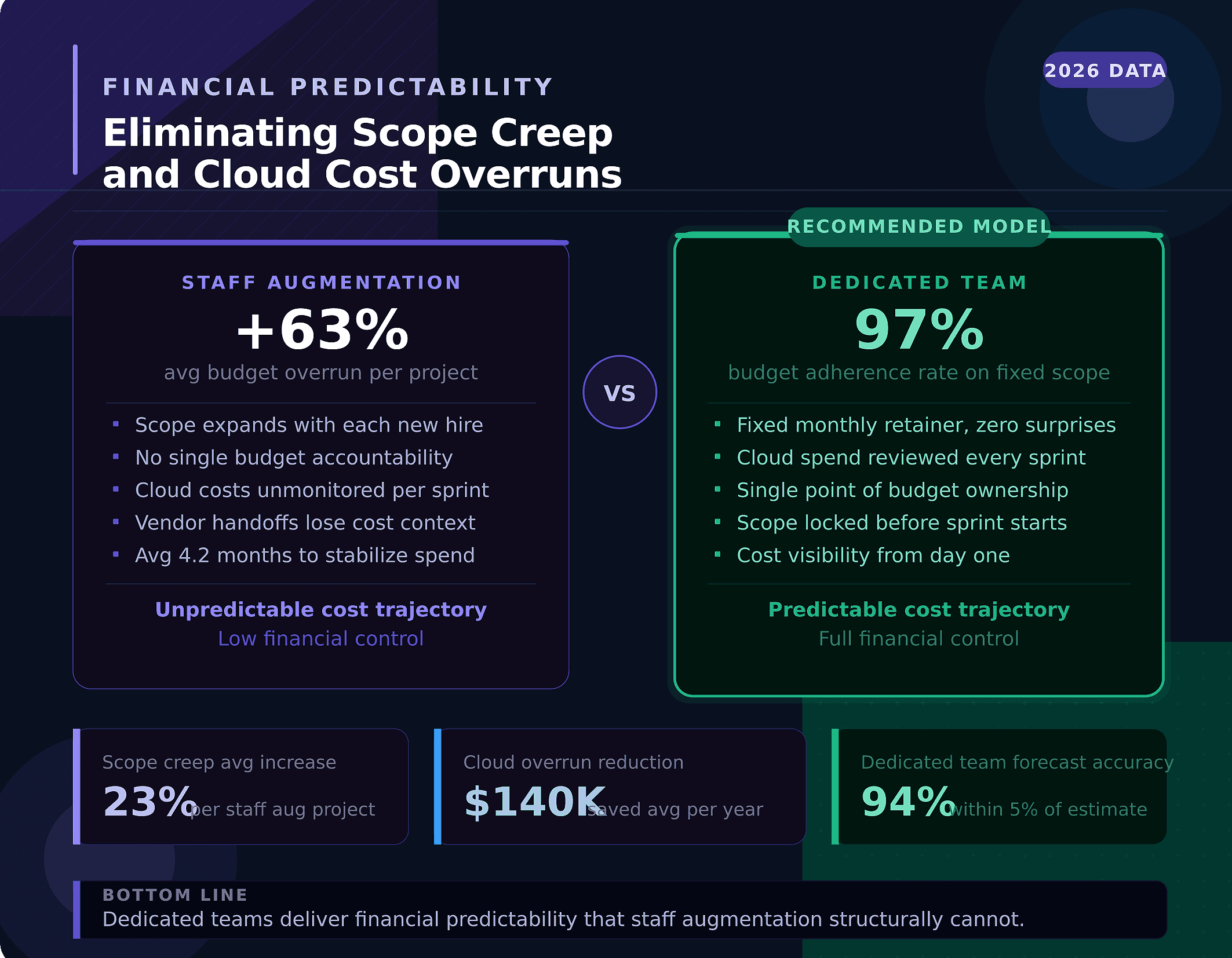
Two financial risks consistently undermine software initiatives. The first is the 27% average project cost overrun. The second is the 35% average cloud spend overrun. Both problems are common, and both are preventable when projects are managed with the right planning, governance, and engineering discipline.
Curbing The 35% Cloud Spend Balloon: FinOps-Driven Cloud Architecture
The 35% cloud spend overrun is usually the result of architectural decisions made early in the project lifecycle. Teams without deep cloud expertise often provision oversized infrastructure, leave resources running unnecessarily, and fail to establish governance controls. Those inefficiencies compound month after month, long after the initial deployment is complete.
Preventing unnecessary cloud costs starts with disciplined architecture. This includes rightsizing infrastructure for actual workloads, implementing automated scaling policies, leveraging reserved capacity where appropriate, and enforcing tagging standards that tie every infrastructure expense to a measurable business function.
Modern FinOps practices make cloud spending visible and accountable. Engineering teams gain clear insight into the costs generated by their architectural decisions, while leadership gains the forecasting accuracy needed to manage growth. Regular architecture reviews and cost optimization audits identify inefficiencies before they become recurring budget issues.
Precision Scope Definition: Guarding Against The 27% Project Budget Overrun
The average 27% project cost overrun is rarely caused by technology alone. More often, it originates during planning and discovery. Integration complexity is underestimated, technical dependencies remain undocumented, and quality assurance efforts are compressed to preserve unrealistic delivery timelines.
Scope creep amplifies these challenges. New features, workflow changes, and stakeholder requests are introduced mid-project without formal impact analysis or change-control procedures. Each adjustment may seem small in isolation, but collectively they can significantly increase budgets, timelines, and operational risk.
Every app development engagement at Webo 360 Solutions valued above $50,000 begins with a mandatory discovery sprint. This phase delivers a detailed technical specification, integration dependency map, architecture recommendations, and cloud infrastructure plan before development begins. Clients who complete this process consistently experience fewer surprises and more predictable delivery outcomes.
The most effective way to prevent overruns is a discovery-first approach. Every major technical dependency, integration requirement, security consideration, and operational constraint should be identified before development starts. Industry data consistently shows that dedicated team engagement models produce lower average overruns than traditional fixed-price arrangements because they provide greater transparency, flexibility, and ongoing alignment.
5. Synchronized Collaboration: Eliminating Time-Zone And Communication Friction
Technical expertise alone is not enough to ensure project success. Teams must also communicate effectively and resolve issues quickly. Time-zone misalignment slows decision-making, while delayed responses can transform minor questions into significant delivery bottlenecks.
How Webo 360 Solutions Handles Real-Time Collaboration
Webo 360 Solutions operates on US business hours across all client engagements. Every client is assigned a named senior engineer who serves as a primary technical point of contact rather than relying on a rotating support structure. Sprint planning, stakeholder reviews, blocker resolution, and project updates take place during standard business hours to accelerate decision-making and maintain momentum.
This approach matters because delayed communication compounds over time. Questions that sit unanswered for an entire business cycle can create cascading delays across engineering, QA, design, and stakeholder approval workflows. Over the course of a large project, those delays can significantly impact delivery timelines.
Communication Standards We Apply On Every Project
Every engagement begins with a documented communication framework and escalation path. Each sprint includes a written progress update covering completed work, active risks, identified blockers, upcoming milestones, and confirmed next-sprint objectives.
Dedicated delivery teams with named engineers consistently outperform anonymous resource pools because ownership remains clear throughout the project lifecycle. Your team always knows who is responsible for each component, and critical knowledge remains with the people building and supporting the solution from start to finish.
6. Blueprint For Selection: How To Vet A Software Development Company In The USA
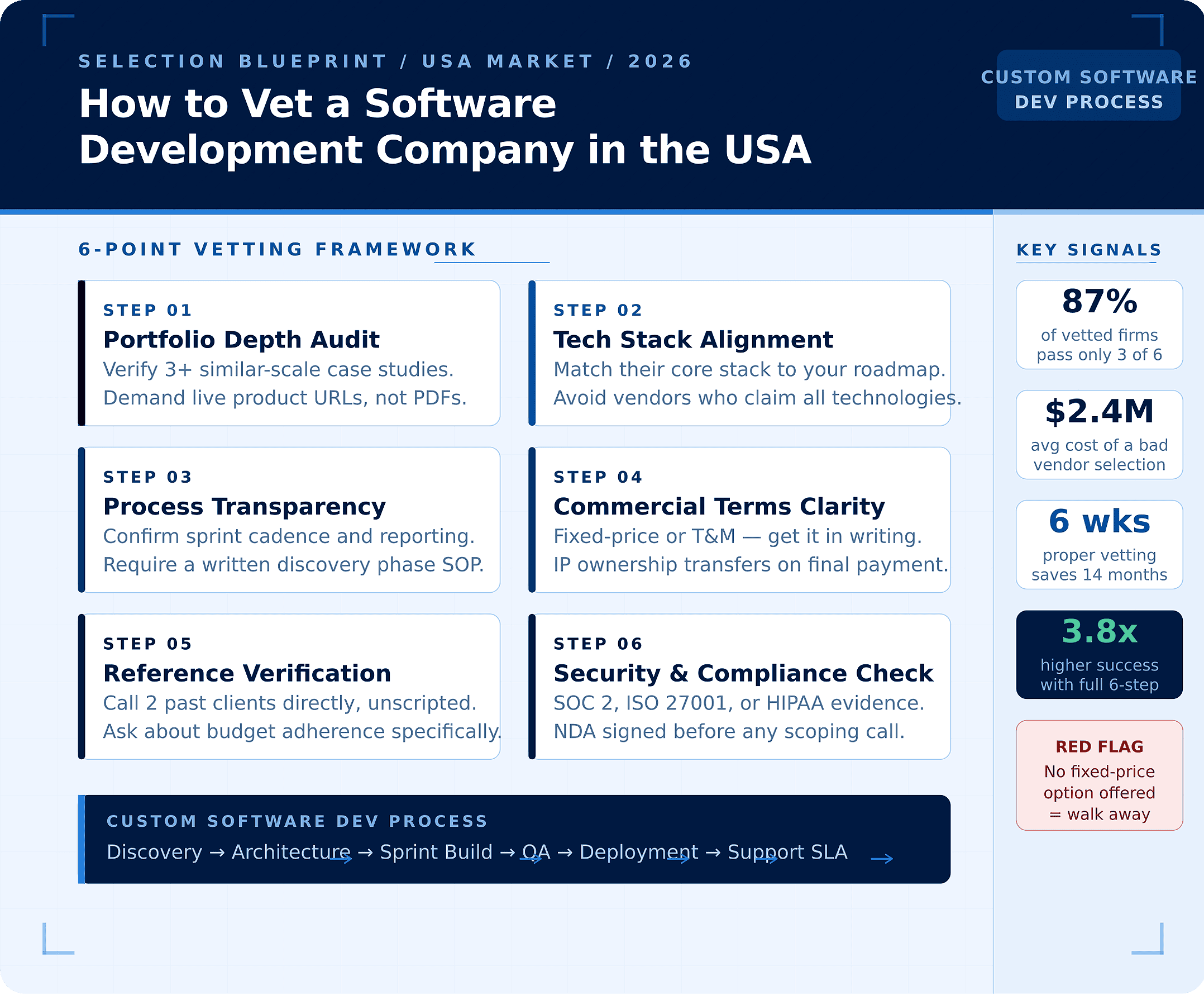
Geographic proximity matters far less than verified capability, communication quality, and cultural alignment. The right software development firm demonstrates deep domain expertise, mature security practices, and a delivery model designed for long-term accountability rather than short-term project execution.
The Security Checklist: Mandating ISO 27001, SOC 2, And Industry-Specific Certifications
Security certifications should be considered a minimum requirement, not a differentiator. Every software development partner under consideration should be able to demonstrate compliance with relevant security frameworks and provide evidence of ongoing governance practices.
Every development partner you evaluate should be prepared to demonstrate the following:
Firms with an engineer retention rate of 80% or higher consistently deliver better outcomes. Webo 360 Solutions assigns senior engineers with 8+ years of experience to every client engagement, with a named lead who stays on your project from discovery through deployment.
Before Signing a Contract, Ask These Four Questions
Choosing Your Engagement Framework: Staff Augmentation vs. Dedicated Product Teams
The engagement model determines how risk is distributed and how your budget behaves over time.
- Fixed-Price: Best for clearly defined projects with stable requirements and timelines under six months. The vendor assumes delivery risk, while scope changes typically require formal change requests.
- Time & Materials: Ideal for discovery phases, agile development, and evolving roadmaps. Billing is based on actual effort, providing flexibility while the client assumes cost-related risk.
- Dedicated Teams: Best suited for long-term product development. A stable team of engineers works exclusively on your product, building deep domain knowledge, accelerating delivery, and preserving institutional expertise over time.
Staff augmentation works best when you already have strong internal technical leadership and established architecture standards. Without that structure, an external team has no standard to anchor to.
7. What Webo 360 Solutions LLC Builds and How We Work
Webo 360 Solutions LLC builds complex software and production-grade systems for businesses that cannot afford to get it wrong. Our clients operate in regulated, competitive, and technically complex environments — healthcare systems handling patient data, fintech platforms processing financial transactions, SaaS companies scaling to thousands of users, and logistics operations running on real-time data.
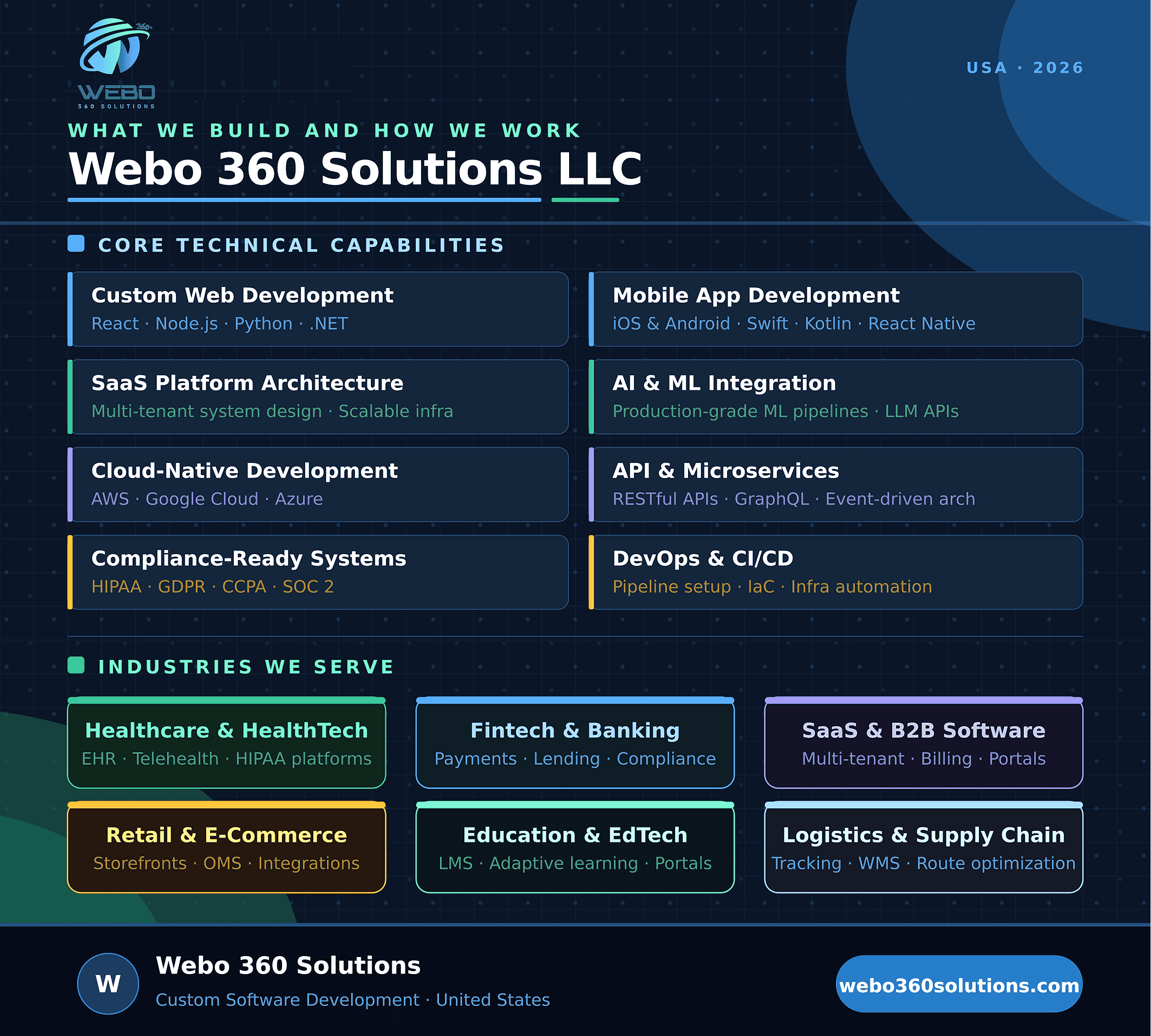
In every engagement, we assign a named senior engineer with 8+ years of active delivery experience from the first day of discovery through final deployment. No junior-heavy teams. No mid-project rotations. You work with the same people who scoped your project until it ships.
We have delivered 150+ projects across six industries. Every engagement begins with a mandatory discovery sprint that produces a documented technical specification, an integration dependency map, and a cloud architecture plan before a single line of production code is written. That process is one reason our dedicated team engagements average 15% cost overrun against an industry benchmark of 27%.
Core Technical Capabilities
Our engineering team covers the full development stack across web, mobile, cloud, AI, and app development. We do not subcontract core development work. Every capability listed below is delivered by in-house engineers who have shipped production systems using these technologies.
How We Deliver Every Project
Every Webo 360 Solutions app development or systems engagement follows the same four-stage delivery process regardless of project size or industry.
Discovery comes first. Before any development begins, we produce a full technical specification, an integration dependency map, and a cloud architecture plan. This phase surfaces every technical risk before it becomes a budget problem.
Architecture review follows. Our senior engineers validate the proposed system design against your compliance requirements, your expected scale, and your existing infrastructure. Security threat modeling happens here, not as a final checklist before launch.
Development runs on two-week sprints with written status updates at every sprint close. You receive completion percentages, identified blockers, and confirmed next-sprint scope in writing after every cycle. Your named senior lead is reachable during US business hours throughout the build.
Deployment and handover include documented runbooks, infrastructure-as-code repositories, and a post-launch support window. You own everything we build — all source code, all architecture documentation, all credentials.
Industries We Serve
Our compliance experience and domain knowledge run deepest in six industries. Each engagement type and its associated regulatory requirements are listed below.
8. The Real Cost of Custom Software Development: Rate Comparison
Market rates for custom software development vary significantly based on location, seniority, and scale. The table below covers the main tiers across the leading firms in the US market:
Webo 360 Solutions operates in the US mid-market tier at $120 to $250 per hour, depending on engagement type and technical complexity. A technical discovery session produces a documented project estimate with no development commitment required.
Total cost of ownership tells a more honest story than hourly rates. A low rate with an inexperienced team produces expensive rework and technical debt. Senior teams handling software modernization, compliance systems, or AI integration ship a custom software solution faster and with fewer defects. That difference compounds over the full product lifecycle.
Financial Risk Warning: Poor vendor evaluation results in staggering liabilities. A 27% project cost overrun from inadequate discovery and a 35% cloud budget overrun from weak infrastructure design are industry averages, not edge cases.
9. Conclusion: Schedule Your Technical Discovery Session Today
Your choice of software development companies today shapes your security posture and technical trajectory for years. With average breach costs at $10.22 million and project overruns at 27%, this is a strategic risk decision, not a procurement task.
Marketing materials only show a surface view of a vendor’s actual capability. Direct technical discussions reveal architectural thinking, cultural fit, and real responsiveness.
A technical discovery session gives you an honest feasibility assessment for your specific project. It clarifies your roadmap, identifies architectural risks, and defines budget parameters before any commitments are made.
Ready to build secure, scalable, and future-ready software?
Schedule a Technical Discovery Session with Webo 360 Solutions LLC.
Our senior engineers will evaluate your project requirements, identify technical and compliance risks, estimate software development expenses, and create a practical roadmap aligned with your business goals.
Whether you are building a SaaS platform, mobile application development project, healthcare system, fintech product, enterprise app development project, or complex software solution, our team provides the expertise needed to move from concept to production with confidence.
Request a Free Consultation Today and receive a documented technical assessment before any development commitment is required.
Sources and Industry References
The statistics, market figures, and research findings cited throughout this guide draw from primary reports published by recognized industry research organizations. Each source is listed below with the specific report edition referenced.
Primary Research Sources
IBM Security — Cost of a Data Breach Report 2024. This annual report analyzes data breach costs across industries and geographies. The $10.22 million average US breach cost cited in Section 2 is drawn directly from this edition.
Flexera — State of the Cloud Report 2024. An annual survey of cloud decision-makers covering cloud adoption, spending patterns, and infrastructure waste. The 35% cloud budget overrun figure cited in Section 4 references this report.
CompTIA — State of the Tech Workforce 2025. The definitive annual assessment of US technology employment trends, hiring difficulty, and skills gap data. The 50%+ AI talent shortage figure cited in Sections 1 and the Highlights draws from this edition.
Standish Group — CHAOS Report 2024. A longitudinal study of software project outcomes tracking cost overruns, schedule delays, and delivery failures across thousands of projects. The 27% average project cost overrun figure cited in Sections 4 and 8 references this report.
Gartner — IT Spending Forecast 2025. Gartner’s annual global technology spending analysis covering enterprise software, cloud infrastructure, & services markets. Referenced for market scale context in Section 1.
McKinsey & Company — Global Survey on AI Adoption 2024. McKinsey’s annual survey tracking AI deployment rates, organizational readiness, and competitive impact across industries and geographies.
Deloitte — Tech Trends Report 2025. Deloitte’s annual technology outlook covers enterprise digital transformation priorities, regulatory compliance pressures, and emerging infrastructure patterns. The 38% compliance roadblock figure cited in Section 3 references this edition.
U.S. Bureau of Labor Statistics — Occupational Outlook Handbook, Software Developers and Related Occupations 2024. The primary federal source for US technology employment data, wage benchmarks, and workforce projections.
Statista — Custom Software Development Market Report 2024. The $65.85 billion US custom software market projection cited in the introduction and Section 1 references this report.
National Institute of Standards and Technology (NIST) — Cybersecurity Framework 2.0, published 2024. The federal standard for enterprise cybersecurity architecture is referenced in Section 2 discussions of security-first development practices.
International Organization for Standardization (ISO) — ISO/IEC 27001:2022 Information Security Management Standard. The internationally recognized information security management framework is referenced throughout Sections 2, 3, and 6 as a vendor certification baseline.
A Note on Data Currency
Technology market conditions, talent availability, and breach cost figures shift year over year. The statistics in this guide reflect the most current publicly available editions of each report as of mid-2026. Where report editions are updated after this publication date, we recommend verifying figures directly against the publisher’s latest release before using them in internal business cases or procurement decisions.
If you would like to verify any specific figure cited in this guide, contact Webo 360 Solutions LLC directly, and we will provide the exact source page reference.
Frequently Asked Questions
How do we choose the right engineering firm for digital transformation?
Why is finding AI specialists difficult for organizations today?
What are the financial risks of selecting the wrong development vendor?
Which engagement model suits long-term product building?
How do top firms handle HIPAA, GDPR, and CCPA compliance?
What technology trends dominate custom software development through 2026?
How much does custom software development cost in the US in 2026?
Webo 360 Solutions’ discovery session produces a documented cost estimate for web platforms, app development, and compliance-grade systems before any development commitment.