Web Development vs Software Development | 7 Key Differences (2026)

Web Development vs Software Development: Key Differences & Guide

Understanding the differences between these two development approaches is essential in 2026 for businesses building digital products. This guide breaks down cost, required skills, and real-world use cases.
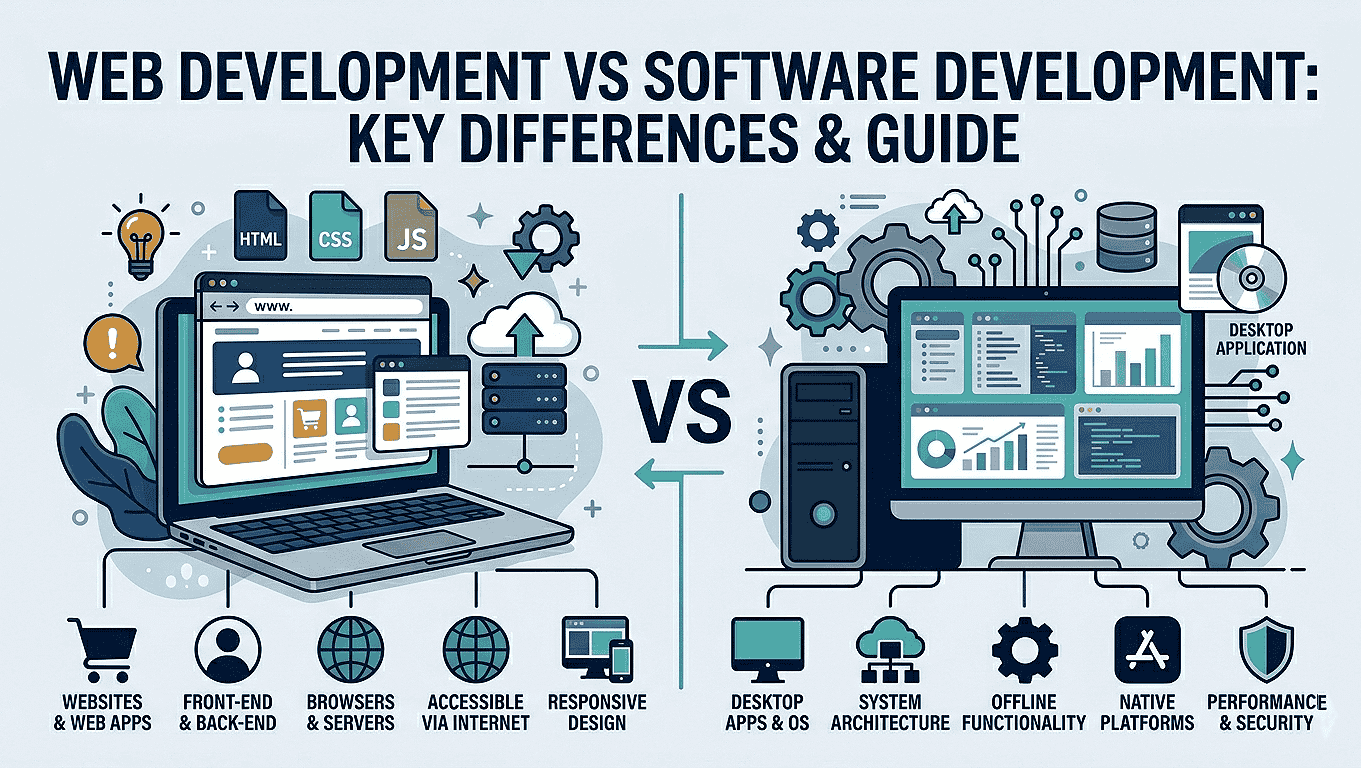
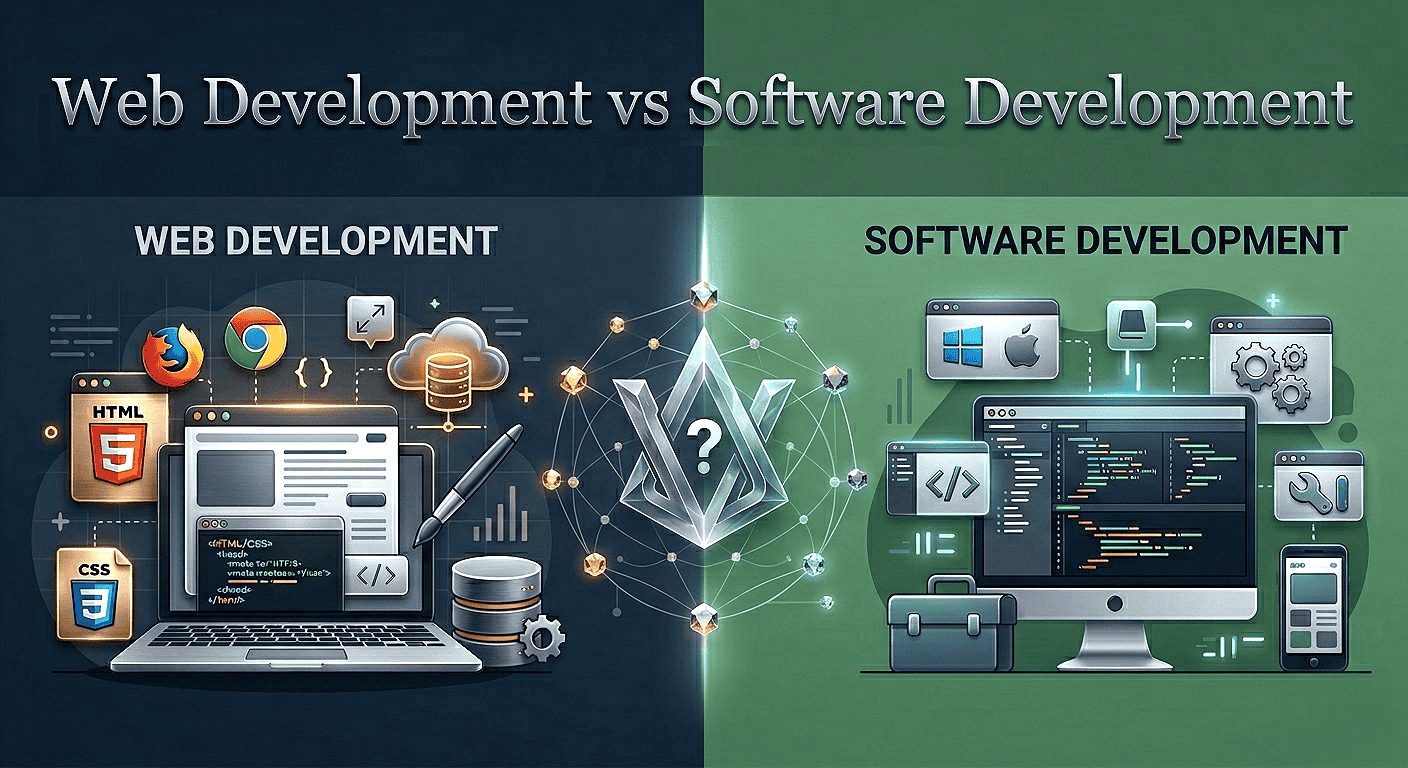
Comprehensive comparison chart highlighting the key differences between web development and software development for the 2026 guide.

You need clarity when choosing a path for a new product, upgrade, or internal platform. This guide explains how web and software development differ—and how those differences impact cost, hiring, and project planning. It compares both fields side by side and covers timelines, costs, hiring considerations, and tools, based on USA market data.

Businesses should evaluate trade-offs carefully to choose the best approach for their goals. The developers you hire matter. The choice between a web developer and a software developer directly affects how fast you ship, how secure your product is, and the value you generate—whether you’re a startup, a small product team, or a large IT department.

Keep reading to compare web and software development side by side. You’ll find real use cases, tech stacks, USA cost ranges, hiring tips, and key trends to watch in 2026.

Web Development vs Software Development:

Web development focuses on building websites and applications that run in a browser using technologies like HTML, CSS, and JavaScript. Software development is a broader field that includes building systems, mobile apps, and enterprise platforms. This is the core distinction in Web Development vs Software Development.

The main difference lies in the execution environment and system design requirements. Web systems prioritize browser performance and accessibility, while software systems focus on architecture, scalability, and long-term maintainability.

📌
Highlights

  • Web projects often ship faster and cost less upfront than system builds. Keep this in mind when planning MVPs or customer-facing apps.
  • Choose the path that matches your timeline, budget, platform needs, and regulatory constraints.
  • Hiring specialists pays off. Choose developers who know your tech stack and deployment setup. This reduces risk and helps your team ship faster.
  • Good frameworks and solid engineering habits make a real difference over time. They keep your code easier to maintain, your system running well, and your total costs down.
  • We help with web and software projects from start to finish. This includes advisory support, team augmentation, and full delivery.

Defining Web Development And Software Development

Begin with a clear definition so you can match project needs to the right team. The difference between web development and software development becomes easier to understand when you break down their roles and environments.

What Is A Web Developer?

A web developer builds interactive websites and web applications that run in browsers and progressive web apps (PWAs). Many use modern technologies such as TypeScript, React, Next.js, and Node.js. The goal is to deliver a fast, clean experience that works seamlessly across devices.

Focus: Client-side features, responsive design, accessibility, performance, and rapid iteration for public-facing experiences.

They optimize content, accessibility, and front-end performance, while testing across browsers to ensure consistency for all users. Accessibility standards such as WCAG guide their work. Common web projects include landing pages, eCommerce storefronts, SaaS front-ends, and marketing microsites.
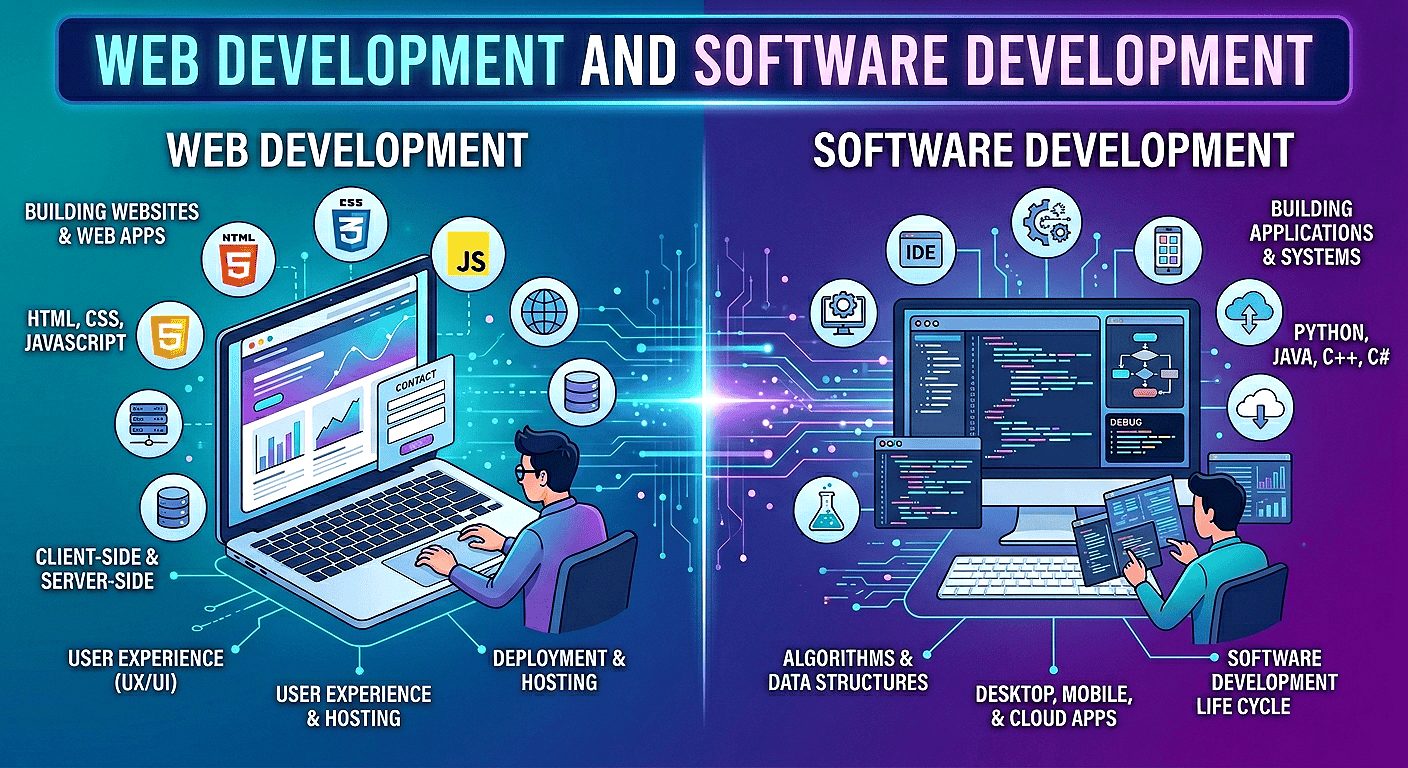
Clear definitions of web development and software development highlighting their unique roles in the 2026 tech landscape.

What Is A Software Developer?

Software developers build and maintain applications across the full software lifecycle. This includes desktop software, mobile apps, backend systems, and embedded systems. Their responsibilities cover requirements gathering, architecture design, coding, testing, deployment, and long-term maintenance.

Common programming languages in 2026 include Java, C#, Python, Go, and Rust. For mobile development, Kotlin is widely used for Android and Swift for iOS.

Focus: Building robust, scalable systems, handling business logic, designing data models, managing integrations, and operating beyond browser-based environments.

Software developers create backend services, databases, and system integrations that power enterprise workflows, regulated industries, and applications requiring high computational performance. Typical projects include ERP systems, fintech platforms, healthcare applications, firmware, and large-scale distributed systems.

  • Web developers: Focus on interfaces and browser behavior. They optimize client-side performance and work with tools like TypeScript, React, and Next.js.
  • Software developers: Handle the full project lifecycle, including architecture, system logic, and complex integrations. Common languages include Java, Python, Go, and Rust, often paired with cloud services.
  • Cross-functional teams: Modern products rely on multiple roles, including web developers, backend engineers, DevOps specialists, and SREs working together.

Web Development vs Software Development: Key Differences

Where you deploy your code matters. Your target runtime shapes the trade-offs you face across public websites, browser apps, and system-level software.

Where your code runs is the most important practical difference. Web projects operate in browsers, progressive web apps (PWAs), or edge environments. Software applications typically run on servers, desktops, mobile devices, or embedded systems. This deployment choice directly impacts performance, security, testing, and release strategies.

Because of these environments, priorities diverge. Web developers focus on dynamic content, accessibility, cross-device user interfaces, SEO, and rapid iteration. Software development teams prioritize strong architecture, system reliability, complex data processing, and controlled release cycles.

Modern web stacks now include advanced build pipelines similar to traditional software systems—such as server-side rendering (SSR), static generation, bundlers, CI/CD pipelines, and serverless functions. While the line between web and software practices is increasingly blurred, their runtime constraints and system requirements remain distinct.

  • Web projects: Public-facing builds prioritize performance, accessibility (WCAG), SEO, and fast time-to-value.
  • System & platform software: Focus on security and compliance, with strong scalability, maintainability, and seamless integration into enterprise systems.
  • Timeline & cost: Simple websites or PWAs can launch in days or weeks, while regulated or deeply integrated systems often require months and higher investment. See the comparison section for USA market cost ranges.

Web Development vs Software Engineering

Web development focuses on browser-based experiences, including front-end interfaces, client-server integration, and content delivery. Software engineering is broader—it includes system architecture, application design, formal testing, and long-term maintenance.

If your product requires high throughput, low latency, or fault tolerance, software engineering practices—and experienced system architects—are essential.

Web Development vs App Development

Choosing between a web app and a native mobile app depends on your goals. A PWA or responsive web app offers broader reach and faster time-to-market. Native iOS or Android apps are better suited for hardware integration, high-performance graphics, and strong offline functionality.

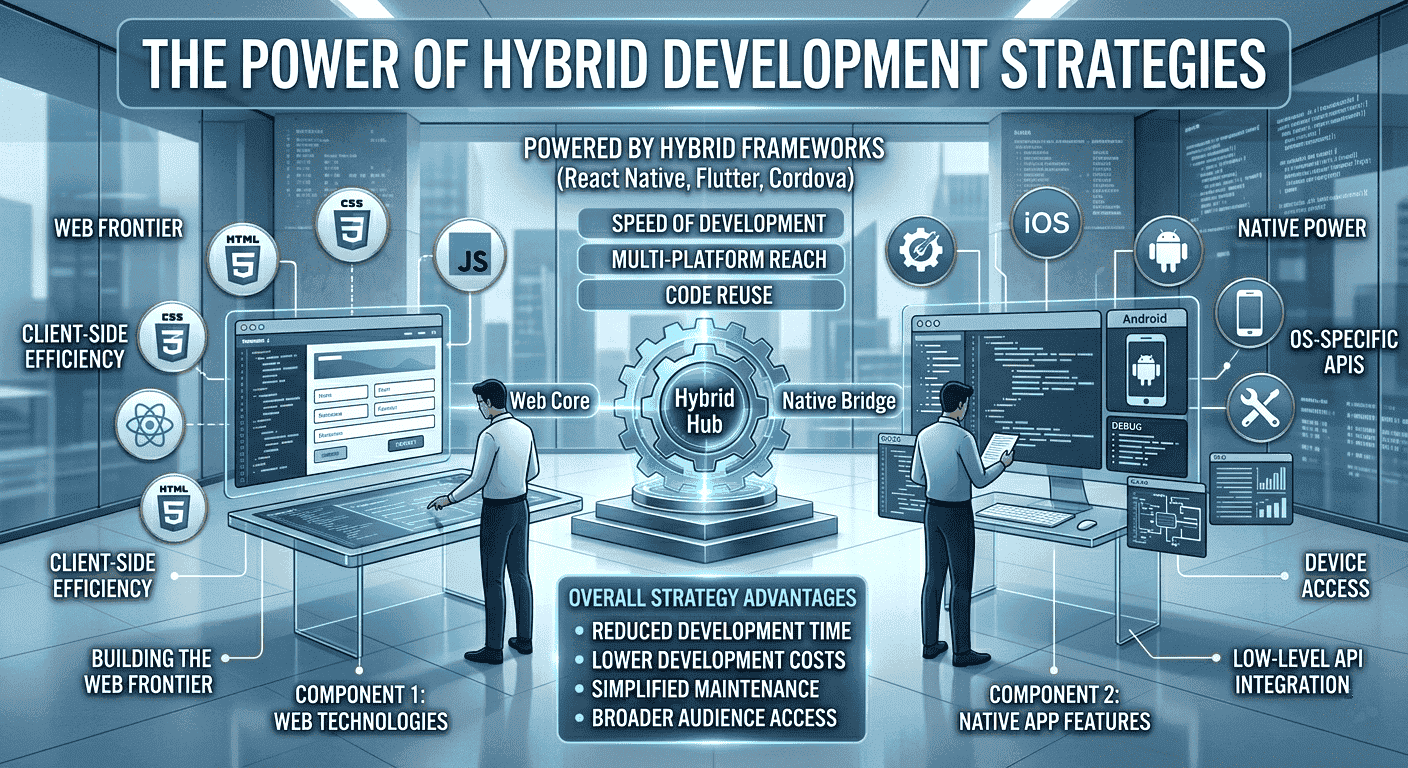
Hybrid frameworks like React Native, Flutter, and WebAssembly can bridge the gap. Evaluate trade-offs in performance, development speed, and long-term maintenance before making a decision.

Quick Use-Case Snapshot

Examples to guide your choice:

  • Choose web development: Ideal for marketing sites, eCommerce stores, SaaS front-ends, and MVPs where speed of iteration and SEO are priorities.
  • Choose software development: Best for banking systems, medical platforms, firmware, and backend services requiring strict compliance, high security, or heavy computation.
  • Choose a hybrid approach: Use for eCommerce or enterprise apps needing complex integrations, such as combining a web storefront with ERP or inventory systems.

Our teams help you find the right approach for your project. We map your requirements and help you plan your timeline, budget, and staffing with confidence.

Technical Skill Sets For Modern Developers

Modern products need more than one skill set. Teams now combine fast interface work with deep system engineering to keep up.

Essential Web Skills

Web developers still start with HTML, CSS, and JavaScript. But most 2026 stacks go further. Expect TypeScript, component frameworks like React, Vue, or Svelte, and meta-frameworks like Next.js or Nuxt. Web developers also need to know PWAs, server-side rendering, and edge functions. These help deliver fast and resilient web apps.

When hiring a web developer, look for these skills. They should have a strong sense of UI/UX and be proficient in TypeScript. They should know state management tools like Redux, Zustand, or server components. Performance tuning with Lighthouse and Core Web Vitals matters too. Accessibility to WCAG standards is also important. So are secure front-end practices like CSP and input sanitization. Make sure they test across browsers and devices too.

AI tools and automation are speeding up how teams work. Many teams now use code assistants, automated linting, and CI integrations. This cuts repetitive work and keeps web projects more consistent.

Key Software Competencies

Software development requires deep knowledge of programming languages and system design. In 2026, that usually means proficiency in Java, C#, Python, Go, or Rust, plus platform languages like Kotlin and Swift for mobile. Strong candidates demonstrate data structures, algorithms, concurrency, and architecture patterns (microservices, event-driven systems).

Strong candidates also bring cloud-native experience with AWS, GCP, or Azure. They should know containerization with Docker and orchestration with Kubernetes. CI/CD pipelines, automated testing, and observability tools like logging, metrics, and tracing round out the skill set.

  • Proven engineering experience: Strong background with development tools and CI/CD pipelines, including automated builds, testing, and deployments.
  • Scalable system design: Ability to translate requirements into reliable, maintainable code and robust architecture.
  • Security & continuous improvement: Commitment to secure coding practices, compliance standards, and ongoing learning.

Technologies Used In Both Fields

Many tools overlap across web development and software development. Expect the following in modern stacks:

  • Front-end: HTML, CSS, JavaScript, TypeScript, React, Vue, Svelte, Next.js, Nuxt.
  • Back-end: Node.js, Java, Python, Go, Rust, .NET.
  • Datastores: PostgreSQL, MySQL, MongoDB, Redis.
  • DevOps & infrastructure: Docker, Kubernetes, Terraform, CI/CD tools (GitHub Actions, GitLab CI, Jenkins).
  • Cloud & services: AWS, GCP, Azure, serverless functions, edge computing.
  • AI/ML & performance: WebAssembly, WebGPU, model inference tools, and observability stacks.

Hiring: Skills To Screen For

When hiring, ask for proof of work. Look for code samples, architecture docs, test coverage, and deployment history. For web roles, prioritize portfolio examples with measurable performance or accessibility improvements. For software roles, dig into system design. Ask how they have handled past production incidents. Check their experience with CI/CD and observability tools.

Emerging Trends In Web Development For 2026

AI and edge computing are reshaping how web experiences behave, feel, and scale in 2026.

AI is moving into the browser and the edge. This makes web apps and PWAs smarter and more responsive. They can now deliver personalized experiences without sending all data to the cloud. AI-powered PWAs can work offline and load instantly. They can also run on-device inference to keep privacy-sensitive features secure.

Motion UI, voice search, and conversational interfaces boost accessibility and engagement. Developers now design interactions that feel natural across devices. Serverless functions, edge computing, and distributed CDNs move computers closer to users. This cuts latency and lowers operational costs for global audiences.

WebAssembly and WebGPU bring near-native performance to the browser. Teams can now build powerful tools right in the browser. Examples include CAD software, video editors, and data visualizations. Users get these features without downloading a native apps.

Trend Benefit Use case (example)
AI-powered PWAs App-like UX, offline inference, privacy-preserving personalization Personalized e-commerce recommendations and inbox triage that work offline
WebAssembly & WebGPU Near-native speed, complex computation in the browser Browser-based CAD, real-time data visualization, image/video processing
Edge + Serverless Lower latency, autoscale, lower TCO for spikes Real-time dashboards, localized personalization, API edge-auth
Client-side ML & Privacy Reduced data transfer, better compliance On-device inference for personalization and anomaly detection
AI-assisted developer tooling Faster delivery, better code quality Automated test generation, intelligent code review, CI pipeline helpers

Many of these trends are ready for production use. They do require updated skills and a slightly higher upfront investment. The payoff is better performance and stronger privacy. See the hiring and cost sections for guidance on staffing PWAs, WebAssembly/WebGPU projects, and edge deployments.

Innovations Shaping The Future Of Software Engineering

In 2026, enterprise AI, automation, and cloud-native practices are changing how software gets built and run.

Enterprise AI And Machine Learning

AI and ML now power smarter, more reliable enterprise systems. Applied models work in real time. They can predict user behavior, detect anomalies, and optimize how resources are allocated. They also cut latency through smart caching and prefetching.

Our software developers integrate models into applications using proven pipelines. These cover data ingestion, feature engineering, and model training with TensorFlow or PyTorch. For deployment, we use managed tools like SageMaker, Vertex AI, or MLflow. This keeps systems secure and scalable. It also handles large data volumes and complex inference workloads.

AI tools now handle code generation, test creation, and CI/CD automation. This cuts down on repetitive work for engineering teams. This frees engineers to focus on architecture, reliability, and higher-value work. This improves code quality and speeds delivery for mission-critical applications.

  • Real-world ML impact: Machine learning delivers measurable value—predictive maintenance improves uptime in manufacturing, while fraud detection reduces costs in fintech.
  • Scalable system design: Strong architecture ensures scalability, security, and reliable data management. Patterns like microservices and event-driven systems are ideal for enterprise environments.
  • ML-powered solutions: We build intelligent systems that streamline operations, surface actionable insights, and support better data-driven decisions.

Technologies Used In Enterprise Software

Common stacks and infrastructure you should plan for include:

  • ML & data infrastructure: TensorFlow, PyTorch, Kafka/Redpanda, Spark, and modern data warehouses.
  • Model ops & deployment: SageMaker, Vertex AI, MLflow, ONNX.
  • Back-end & services: Java, Python, Go, Rust, .NET, with APIs using gRPC or GraphQL.
  • Databases: PostgreSQL, CockroachDB, MongoDB, Redis.
  • Cloud & infrastructure: AWS, GCP, Azure, Docker, Kubernetes, Terraform.
  • Observability: Prometheus, Grafana, OpenTelemetry, and ELK/EFK stacks.

Hiring & Staffing Note: Building ML-powered enterprise systems takes a full cross-functional team. A typical team includes data engineers, ML engineers, and backend developers. You will also need SREs and product and UX specialists. See the hiring guide section for role checklists and interview topics to evaluate candidates.

Not sure whether to go to the web or system? A practical guide can help.

For example, an analytics-heavy platform points toward software engineering. A customer-facing SaaS UI points toward web development. Either way, the goal is to match your use case to the right team and technology investments.

When To Choose Web Development For Your Project

Pick a browser-based solution when you need to launch fast, reach more users, and keep things accessible to everyone.

Best for MVPs, eCommerce, marketing sites, and customer-facing SaaS front-ends. Web-first usually means you ship faster and spend less to find and validate your first customers. It’s the right choice when you need cross-platform reach, SEO, and frequent iteration.

High-performing web development teams focus on building sites and apps that rank well and convert visitors, and get measurably better over time. They optimize content, layout, and Core Web Vitals so users find and engage with your product with minimal friction.

If you need to launch fast on any device or test whether your idea has legs, go with web development. The right team — a mix of front-end and full-stack developers — ships quickly and releases without breaking things.

Web Development vs Software Development Cost Comparison (USA)

Understanding cost differences between web development and software development (also referred to as web vs software development or software development vs web development) is critical for planning your project. Below is a USA market-based comparison to help you estimate budgets and timelines effectively.
Web Development Cost Examples (USA)

Startup MVP / Pilot
Goal: Validate core features and user flow.
Time to value: Days–weeks.
Typical output: Landing page + basic web app.
$5k–$40k

E-commerce Storefront
Goal: Sell online with great UX and conversion.
Time to value: Weeks.
Typical output: Storefront, product pages, checkout, CMS.
$15k–$80k

Marketing / Content Site
Goal: Lead generation and SEO.
Time to value: Days–weeks.
Typical output: Content-rich site with analytics and CMS.
$3k–$20k

SaaS Front-end
Goal: Polished customer UI for a cloud product.
Time to value: Weeks–months.
Typical output: SPA or SSR front-end integrated with APIs.
$30k–$150k

When To Hire Which Web Role

  • Hire a front-end web developer: Ideal when you need a polished UI, strong accessibility, and fast-loading performance (HTML, CSS, JavaScript/TypeScript, React, Next.js).
  • Hire a full-stack web developer: Best for MVPs and small SaaS products when one developer can handle both front-end and light back-end development.
  • Hire specialized developers or teams: Required for high-traffic platforms, advanced features (WebAssembly/WebGPU), or complex integrations—look for expertise in performance, security, and CI/CD.

These ranges are a starting point. Your actual cost will vary based on scope, integrations (payments, ERPs), design effort, and compliance needs. See the cost comparison section for a deeper Web vs software development comparison and staffing guidance.

When To Prioritize Software Development

When business rules are complex, performance constraints are strict, or security/compliance is non-negotiable, custom software development is the right choice.

Choose software development for backend platforms, enterprise tools, fintech systems, healthcare applications, and embedded or device software that require deep business logic, rigorous testing, and formal compliance (HIPAA, PCI-DSS, SOC2, etc.).

Software development teams typically handle everything — from architecture and data modeling to secure coding, integrations, testing, deployment, and ongoing maintenance. These engineers design systems that handle sensitive data and multi-step workflows with precision while meeting regulatory and performance requirements.

Software Development Cost Examples (USA)

Banking / Fintech Platform
Core transaction systems, risk engines, and payment processing.
Time to value: Months
USA estimate: $150k–$1M+
Healthcare Systems
EMR/EHR integrations, secure data pipelines, and audit logging.
Time to value: Months–years
USA estimate: $200k–$1M+
ERP / Inventory Systems
On-premise solutions with complex integrations and local data handling.
Time to value: Months
USA estimate: $100k–$600k
Embedded / IoT Systems
Hardware-level development with strict testing and certification requirements.
Time to value: Months–years
USA estimate: $100k–$800k+

Want an accurate cost estimate for your project in the USA market? Request a free quote and get a detailed breakdown within 24 hours.

When To Hire Software Developers (Roles & Seniority)

  • Senior software engineer: Hire when you need ownership of critical systems—architecture, performance tuning, and security at scale.
  • Backend developers: Best for API design, database modeling, and integrations (Java, Go, Python, .NET).
  • DevOps / SRE: Essential for CI/CD, infrastructure-as-code, observability, and production reliability.
  • Specialists: Add ML engineers, embedded engineers, or security experts when your project requires advanced capabilities or compliance.

Software Development Vs Web Development — Decision Checklist

Choose software development when:

  • You need strict security, audit trails, or regulatory compliance.
  • Your business logic is complex and requires custom algorithms or transaction guarantees.
  • You must integrate with hardware, legacy systems, or on-prem environments.
  • Performance, uptime, and fault tolerance are mission-critical.

Estimated US Hourly Rates (Guideline):

  • Senior developers: $120–$250/hr
  • Mid-level developers: $80–$150/hr
  • DevOps/SRE & specialists: Typically at the higher end of the range

These are general estimates—actual rates vary by location, engagement model, and demand.

Prioritizing software development enables secure, scalable, and maintainable systems. Our engineers help you scope, estimate, and staff projects to meet regulatory, performance, and business goals.

The Power Of Hybrid Development Strategies

Merging public interfaces and private systems creates a single source of truth for your business.

A conceptual graphic illustrating hybrid development strategies bridging the gap between web development and software development in 2026.

A hybrid strategy links your customer-facing website with your internal systems. Your storefront, CRM, inventory, and fulfillment all share the same data. They also run on consistent APIs. This works best for eCommerce, retail, and SaaS businesses that need fast UX and reliable back-office operations.

Development teams connect storefronts, API gateways, and back-end systems to ensure seamless integration. Orders, inventory, and customer data move seamlessly across every platform. The result is faster checkouts, fewer reconciliation errors, and cleaner fulfillment processes.

We balance the speed of web solutions with the stability of enterprise platforms. That blend boosts engagement, reduces manual work, and improves overall operational efficiency.

Key Benefits:
Unified customer experience across websites, mobile apps, and internal applications.

Keep inventory and orders in sync across your storefront and back-office in real time. Use event-based updates or change data capture (CDC) .

Scalable, observable architecture that grows with your business and supports audits and compliance.

Architecture Overview (Text)

Typical hybrid architecture includes:

  • Frontend layer: Customer-facing web app or PWA (React/Next.js) communicating through an API gateway.
  • API gateway: Handles routing, authentication, and rate limiting while directing traffic to services or serverless functions.
  • Business services: Core domains (orders, inventory, users) implemented as microservices with resilient patterns.
  • Event-driven layer: Message bus or event stream (Kafka, SNS/SQS) enabling near real-time synchronization with ERP and warehouse systems.
  • Data layer: Databases (PostgreSQL, Redis) acting as the single source of truth for transactional data.

When To Choose A Hybrid (Checklist)

  • You need a fast, continuously evolving customer experience alongside strong back-office consistency.
  • You must integrate legacy systems or ERPs with a modern web storefront.
  • Your platform needs to handle traffic spikes on the frontend while keeping backend systems stable and transaction-safe.

Skills & Roles Required

Hybrid projects need a full team. That includes full-stack developers, API engineers, back-end developers, and DevOps and SRE professionals. Together, they manage CI/CD pipelines, system observability, and infrastructure. Look for teams with proven integration experience (APIs, event-driven architecture, and databases).

Whether you need a new website or a complex software tool, our hybrid approach ensures all assets work together. You keep operational control while delighting customers and maintaining secure, auditable back-end systems.

Comparing Development Approaches At A Glance

Lay out the trade-offs in a clear table so you can pick the right mix of speed, security, and cost.

This comparison breaks down the core difference between browser-facing work and system-level projects. Use it as a quick web development vs software development guide. Use this table as a quick decision aid in your Software development vs web development guide.

Aspect Browser Interface System (Web Development) Platform (Software Development)
Primary goal Fast launch, strong UX, discoverability Reliability, complex business logic, long-term scalability
Typical team Front-end developers, UI/UX designers, full-stack devs, SEO/content Backend developers, systems engineers, DevOps/SRE, data engineers
Typical technologies HTML/CSS/JS, TypeScript, React/Next.js, PWAs, edge, WebAssembly/WebGPU Java, C#, Python, Go, Rust, databases, Kubernetes, APIs
Use cases Marketing sites, eCommerce, SaaS front-ends, MVPs ERP, fintech, healthcare, analytics platforms
Time to value Days–weeks to weeks–months Months–years depending on scope
USA cost range $3k–$150k depending on scope $100k–$1M+ enterprise systems
Maintenance focus Content, performance, SEO, web security Security, compliance, scalability, monitoring
When to choose Fast validation, SEO, cross-platform reach Strict SLAs, compliance, heavy computation
Key hiring roles Front-end, full-stack dev, UX designer Senior engineers, backend, DevOps, security

Not sure which approach fits your project? Get a free consultation and receive a tailored development roadmap based on your goals and budget.

How To Choose Between Web Development vs Software Development

Choosing between web development and software development (difference between web development and software development) depends on your business goals, budget, and technical requirements. Many businesses compare web vs software development before making a final decision.

A decision guide on how to choose between web development vs software development based on project goals, budget, and scalability in 2026.

Decision Checklist (Non-Technical)

Who are my users?

Do I need offline or hardware integration?

How strict are security or compliance needs?

What is my timeline and budget?

Choose web development for fast, customer-facing experiences…

Choose software development when you need strong system reliability…

Still deciding between web and software development? Talk to our experts and get a clear, step-by-step recommendation for your project.

Web Development vs Software Development: A Quick Overview

Choose web development for fast, customer-facing experiences and lower upfront costs. Choose software development when you need strong system reliability, compliance, or complex integrations. For many businesses, a hybrid approach (web front-end + robust back-end) is the pragmatic choice.

Decision Checklist (Non-Technical): Ask:
Who are my users?

Do I need offline or hardware integration?

How strict are security/compliance needs?

What is my timeline and budget?

Use answers to map to the rows above and follow the Software development vs web development guide in this blog for next steps.

Expert Solutions For Your Next Digital Initiative

Work with a partner that delivers polished interfaces, native-quality mobile apps, and GPU-powered features. Every project is backed by solid engineering practices and clear delivery standards.

UI And UX Design

Design that sells and retains. Our team designs user journeys that turn prospects into customers. We also reduce churn by keeping existing customers engaged at every step.

We combine user research, rapid prototyping, and A/B testing to build designs that work. Every layout and content decision is tied to measurable business goals. Expect improved conversion rates, faster onboarding flows, and fewer support tickets.

Mobile Application Expertise

Cross-platform (React Native, Flutter) and native apps can be built to deliver fast and reliable performance (Kotlin, Swift) apps that feel fast and reliable on phones and tablets. Our mobile apps feature polished UI and strong back-end integration. We also prioritize secure data handling and full app store readiness.

Web development vs app development? If you need a wide reach and rapid iteration, a PWA or web-first approach often wins. Need device sensors, advanced offline features, or platform-native performance? We recommend native or cross-platform mobile development. We help you choose the right path and execute it.

WebGPU Performance

High-performance graphics for modern websites. Our web developers use WebGPU and WebAssembly to bring near-native speed and rendering to the browser. Create interactive data visualizations, 3D product configurators, and powerful web tools. No native install required.

This approach delivers responsive visuals, faster load times, and smoother interactions. Users stay focused on your product instead of waiting for assets to load.

Why Choose Webo 360 Solutions For Your Web & Software Needs (2026)

Why choose Webo 360 Solutions for expert web development and software development services in 2026.

  • Cross-functional teams: Senior web developers, backend engineers, and SREs working under a single delivery manager for clear ownership and fast collaboration.
  • US-aligned delivery: US-based project leadership combined with global engineering talent for predictable communication and timezone overlap.
  • Transparent pricing: USA-focused cost estimates with scoped quotes and a free 30-minute discovery call.
  • Security & compliance: Experience with HIPAA, PCI, and SOC2 for regulated environments.
  • Future-ready tech: PWAs, edge computing, WebAssembly/WebGPU, and cloud-native architectures.

Proof Points & Services

Selected anonymized examples:

  • Retail client: Rebuilt storefront using PWA and headless CMS → achieved 28% faster checkout and 18% increase in conversion rate.
  • Healthcare platform: Migrated from monolith to microservices with CI/CD and observability → improved deployment frequency and reduced incident MTTR by 40%.
We offer a full range of services to support your project from start to finish. These include;
Discovery and scoping

Design and UX

Web development

Mobile app development

Back-end and integrations

WebGPU and WebAssembly features

Cloud migration, and team augmentation.

Need hiring help? We provide staff augmentation and full delivery teams to scale quickly.

  • Build with 2026-ready solutions: Modern web and mobile apps designed for performance, scalability, and future growth.
  • Book a free 30-minute call or request a free technical audit and USA cost estimate for your project.
  • End-to-end delivery: From prototype to production, our web and software teams support your product through launch and long-term growth.
  • Contact us to schedule your free audit and get expert guidance for your next project.

Web Development vs Software Development: Pros and Cons

Web Development

Pros

  • Faster development and deployment
  • Lower initial cost
  • Easy access across devices
  • SEO and marketing friendly

Cons

  • Limited access to device hardware
  • Performance limitations for complex systems
  • Dependency on browser environment

Software Development

Pros

  • High performance and scalability
  • Full control over system architecture
  • Better for complex and secure systems
  • Works across multiple environments (desktop, mobile, server)

Cons

  • Higher development cost
  • Longer timelines
  • Requires specialized expertise

Quick Decision Guide: Web vs Software Development

Web Development

Choose this if you need a fast, cost-effective solution that works across all devices.

Software Development

Best for projects requiring complex logic, high security, or deep system integration.

Hybrid Approach

Ideal when you need both a customer-facing interface and a powerful backend system.

Smart Tip: Start with web for speed, scale with software for power, or combine both for maximum flexibility.

About the Author
Webo 360 Solutions Team
Experience: 14+ years in web development, software engineering, and AI-driven solutions
Projects Delivered: 500+ across USA and global markets
Expertise: Custom web development, enterprise software, SaaS platforms, and scalable cloud solutions

Conclusion

Choosing between Web Development vs Software Development directly affects time to market, cost, and scalability. The right choice depends on your project goals, whether you need fast browser-based solutions or complex system-level applications, security posture, and total cost of ownership, security posture, and total cost of ownership.

The difference between web development and software development is strategic. A fast public-facing launch needs a different team, stack, and process than a deep enterprise system. Our web developers and software developers bring the right skills to every project. We also have the experience and judgment to choose the best approach for your needs.

Whether you need a high-performance website, a native mobile app, or a robust back-end platform, we have you covered. We deliver clean code, reliable integrations, and measurable user impact. Want a clear software development vs web development guide tailored to your goals? We will map out your options, costs, and timelines in a short scoping session.

Where To Start (3 Quick Steps)

  • Define your scope: Identify your core users and clearly describe the primary problem your product needs to solve.
  • Set timeline & budget: Share your target launch window and a realistic budget range to guide planning.
  • Get expert guidance: Book a free 30-minute scoping call or request a no-obligation estimate—we’ll recommend whether web, software, or a hybrid approach fits your project best.

🚀 Need help choosing between web development and software development?

Get a FREE 30-minute consultation with our experts and receive a custom roadmap based on your goals and budget.

Frequently Asked Questions (Web Development vs Software Development)

What’s the main difference between web development and software development?
The main difference between web development and software development is that web development focuses on browser-based applications, while software development includes broader systems like mobile apps, enterprise software, and backend platforms.
Which skills should you learn first if you want to become a developer?
Start with programming fundamentals like variables, logic, and data structures. For web development, learn HTML, CSS, JavaScript, and a framework like React. For software development, begin with languages like Python or Java and focus on system design, databases, and testing practices.
Can one person do both site and system projects effectively?
Yes, one person can handle both web and software development, especially on small projects. Full-stack developers often manage front-end and back-end tasks. However, complex systems usually require specialized roles such as backend engineers, DevOps experts, and security professionals.
What programming languages are most useful in 2026 for each path?
For web development, JavaScript and TypeScript are essential, along with frameworks like React or Next.js. For software development, popular languages include Python, Java, Go, and C#. The best choice depends on your project requirements, performance needs, and ecosystem support.
How does user experience (UX) factor into technical decisions?
User experience (UX) influences both design and technical decisions. Web projects focus on performance, responsiveness, and accessibility. Software systems prioritize usability in workflows and data handling. A strong UX ensures better engagement, efficiency, and overall user satisfaction.
When should you pick a browser-based solution instead of a native application?
Choose web development if you need cross-platform access and fast deployment without installation. Choose native apps when performance, hardware access, or offline functionality is critical. Hybrid solutions like PWAs and React Native offer a balance between reach and performance.
What emerging trends should you watch in 2026?
Key trends include AI-powered applications, edge computing, WebAssembly, and WebGPU for high performance. AI-assisted development tools are also improving productivity. These technologies are making both web and software applications faster, smarter, and more scalable.
How do security requirements differ between site projects and larger software systems?
Web applications must handle risks like XSS, CSRF, and API security. Software systems require deeper security measures such as encryption, access control, and compliance with standards like HIPAA or PCI-DSS. Security should be integrated throughout the development lifecycle.
What project management approaches work best for technical initiatives?
Agile methodologies like Scrum and Kanban are widely used for both web and software projects. They support fast iteration and continuous feedback. Larger systems may also require architecture reviews, testing phases, and structured release processes to manage complexity.
How do you estimate timelines and costs for a digital project?
Project costs depend on scope, complexity, and team size. Simple websites may cost a few thousand dollars, while enterprise software can reach six or seven figures. Estimation should include design, development, testing, and ongoing maintenance for accuracy.
What role does data play in choosing the right approach?
Data needs determine storage, processing, and privacy choices. High-volume analytics need scalable databases and stream processing. Kafka is a popular tool for this. Transactional systems have different needs. They rely on ACID guarantees and require reliable backups. Data laws like GDPR and CCPA affect architecture, consent flows, and where data is stored or processed.
When should you hire a web developer vs a software developer?
Hire a web developer for browser-based UX, SEO, and frontend work. Hire software developers for backend systems, integrations, and scalable architecture. Many teams compare web vs software development before deciding on hiring strategy.
How do you choose between in-house development and hiring external teams?
Choose in-house when you need deep domain knowledge, long-term ownership, and rapid iteration. Outsource or augment with external teams for specialist skills, faster time to market, or to scale capacity. Hybrid models (in-house + vendor) can provide flexibility and cost control.
Cost comparison (USA market-focused) — what should I expect?
High-level USA estimates (guideline):

  • Simple brochure/marketing websites: $3k–$20k;
  • E-commerce storefronts: $15k–$80k;
  • SaaS front-ends: $30k–$150k;
  • Custom enterprise platforms and regulated systems: $100k–$1M+.

Typical US hourly rates:

  • Mid-level developers: $80–$150/hr;
  • Senior engineers: $120–$250+/hr.

These are estimates — get a scoped quote for accurate pricing.

Which is better for startups?

Web development

is usually better for startups because it allows faster launch, lower costs, and wider reach. It helps validate ideas quickly through MVPs. Software development is more suitable when the product requires complex systems or advanced functionality.
Is web development part of software development?
Yes,web development is a subset of software development. It specifically focuses on building applications that run in browsers, while software development includes a wider range of systems such as desktop apps, mobile apps, and enterprise platforms.

Leave a Comment

Your email address will not be published. Required fields are marked *

*
*