

Develop Powerful Mobile Apps with Our App Development Services

📌 Highlights
-
✔Explains how custom mobile app development services help businesses improve customer engagement, brand visibility, and operational efficiency.
-
✔Covers the complete mobile app development process, from idea validation and UX/UI design to development, testing, launch, and ongoing maintenance.
-
✔Highlights the importance of building high-performance, scalable mobile apps for both iOS and Android platforms.
-
✔Showcases the benefits of working with experienced mobile app developers to ensure security, speed, and a seamless user experience.
-
✔Emphasizes how mobile apps support business growth, user retention, and higher conversions in a mobile-first digital landscape.
-
✔Demonstrates how Webo 360 Solutions delivers end-to-end mobile app development solutions tailored to unique business goals and industry needs.
What if your product could meet users where they already spend most of their time?
We design and deliver end‑to‑end app development solutions that convert ideas into reliable, revenue‑driving mobile apps for phones and tablets. Our approach blends product strategy, UX design, engineering, testing, launch, and post‑launch growth so your app reaches the right users and delivers measurable business outcomes.
Our services cover strategy, design, engineering, testing, launch, and growth, so your product matches user needs and business goals. Clients typically see faster activation and higher retention after we optimize onboarding, leverage native features, and instrument analytics to iterate on the experience.
Smartphones are the primary platform for commerce and communication for most audiences — recent industry data shows global smartphone penetration well over half of the population and often exceeding three quarters in many markets. That reach makes mobile app development an essential channel for customer acquisition, retention, and direct monetization.
We lean on native capabilities — GPS for location‑aware offers, camera and barcode scanning for simplified checkout and fulfillment, Bluetooth for device pairing, and biometric login for secure access — to craft experiences a website cannot match. These native features, combined with polished design and performance tuning, increase session depth and conversion.
From developer program enrollment and store submission to analytics instrumentation and scalable back‑end architecture, our consultative process reduces launch risk and shortens time to market. We produce a clear roadmap and phased plan so stakeholders see progress and outcomes early.
Contact us to get a tailored app strategy and a fast estimate, or Request a Quote for your project scope. For example, an anonymized retail client we worked with reduced checkout friction and saw a measurable lift in conversion within three months of launch.
Key Takeways:
- Full‑lifecycle app development focused on outcomes — from discovery to growth — so you launch faster and measure impact (typical MVP to first release in 8–14 weeks for scoped projects).
- Native capabilities deliver differentiated experiences — GPS, camera, Bluetooth, and biometrics enable flows a website cannot, improving conversion and retention by design.
- Market validation before code reduces risk — prototypes and user tests identify product‑market fit and prioritize features that move KPIs.
- We manage store compliance and launch readiness — optimized listings and review handling speed approvals on the App Store and Google Play.
- Measured business results — clients see lifts in revenue, engagement, and operational efficiency (examples include 30–100% engagement gains depending on vertical and feature set).
Want to see how mobile apps and expert app development can drive growth for your product? Request a Quote or Schedule a Discovery Call to get a tailored estimate and roadmap.
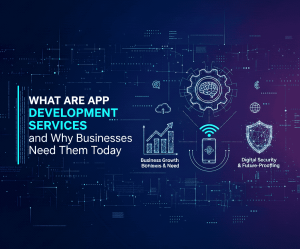
What Are App Development Services and Why Businesses Need Them Today
We create targeted software solutions that leverage device features to solve real user problems.
What this work includes: practical product discovery and planning, user‑centered UI/UX design, front‑end and back‑end engineering, API integration, automated and manual testing across real devices and networks, store publishing, and post‑launch support. Each phase of mobile app development is tied to measurable business goals so your mobile app delivers value from day one.
Mobile app development requires more than code: distribution involves developer program enrollment, asset and privacy preparation, and compliance with platform policies. The Apple Developer Program ($99/year) and Google Play Developer registration (one‑time fee) are part of the setup; review times vary by region and complexity. Android typically offers broader market reach, while iOS’s smaller device matrix can simplify QA and often yields stronger retention among high‑value segments. We evaluate reach, retention, and monetization to recommend the right platform strategy for your product.
Why Professional Partners Matter
Working with an experienced team shortens time to market, reduces the risk of store rejections, and ensures a secure, maintainable architecture. Professional app development vendors bring cross‑functional teams (product, UX, iOS/Android engineers, QA, DevOps) and repeatable tools—CI/CD, automated tests, and observability—that together produce predictable releases and measurable ROI.
- Design prototypes and CI/CD pipelines to reduce development cycles and accelerate feedback.
- Enterprise readiness: scalable APIs, analytics instrumentation, and security controls that support growth.
- Cross‑functional teams that maintain quality across platform versions and devices.
Do You Need A Mobile App? A Short Checklist
- If your users spend repeated, frequent time on tasks you control (purchases, scheduling, content consumption), a mobile app can improve retention and LTV.
- If you require native access to sensors (GPS, camera, Bluetooth), offline behavior, or background processing, favor native mobile app development.
- If rapid discovery and SEO are priorities with limited hardware needs, consider a PWA or hybrid approach.
| Platform | Strength | Typical use | Distribution notes |
| Android | Large market share, flexible policies | Wide reach, diverse devices | Google Play registration; generally faster review cycles |
| iOS | Fewer device variants, high retention | Premium segments, complex native integrations | Apple Developer Program; stricter review policies |
| Cross‑platform | Shared codebase, faster releases | MVPs, faster parity across platforms | Separate store submissions per platform |
Regulatory and Compliance Considerations (By Vertical)
- Healthcare: HIPAA/PHI requirements—secure data storage, audit logging, and stricter testing.
- Finance: PCI/PSP integrations, privacy disclosures, and rigorous review of encryption and key management.
- Education & Government: accessibility (WCAG), data residency, and consent mechanisms.
We include compliance checkpoints in discovery and create a rollout plan that mitigates regulatory risk without stalling delivery. Our guide helps stakeholders choose platforms, balance cost versus speed, and set a roadmap for continuous improvement.
Request a platform assessment to get a short, actionable recommendation: which platform to start on, estimated MVP timeline, and a prioritized feature map tailored to your users and business goals.
Business Benefits of Custom Mobile Apps
Designing bespoke solutions that exploit native hardware lets your business offer experiences customers prefer — and that drive measurable commercial outcomes.
Fuel Growth With Differentiated Features And Native Device Capabilities
We identify high‑impact features—location‑aware offers, barcode scanning, and biometric login—that turn routine interactions into revenue opportunities and increase retention. For example, a retail client we rebuilt with barcode scanning and streamlined checkout reduced fulfillment errors and shortened average checkout time by 18%, directly improving conversion.
Native access to GPS, camera, Bluetooth, microphone, and secure credential stores unlocks use cases the mobile web cannot match. Those capabilities let you deliver contextual, real‑world experiences: push a location‑based offer at the right moment, scan a product barcode to auto‑populate checkout, or use biometric login to remove friction from high‑value tasks.
Boost User Engagement Via UX, Push Notifications, And Personalized Journeys
Polished design and a frictionless onboarding sequence increase activation and session depth. Our UX work focuses on measurable improvements—reducing time‑to‑first‑value, increasing day‑1 retention, and improving lifetime value (LTV) through personalized flows.
We implement consented push notifications and in‑app messaging tied to user behavior and lifecycle stage. Well‑crafted notifications increase re‑engagement without raising opt‑out rates; in one media client, targeted push campaigns increased weekly active users by 40% while keeping opt‑out below industry averages.
Scale Seamlessly Across Aevices, Versions, and Markets
Adaptive layouts, responsive component libraries, and offline strategies keep performance steady across device sizes, OS versions, and intermittent networks. We design graceful degradation so non‑critical features fall back cleanly when device capabilities are limited.
Analytics instrumentation, A/B testing, and feature flags let us iterate against business KPIs—activation, conversion, retention—while minimizing risk. Feature flags enable staged rollouts and quick rollbacks, reducing the operational cost of releases and lowering support demand.
- Discovery and store listing optimization increase visibility in the App Store and Google Play.
- Experimentation validates which features move metrics for each target user segment.
- Custom software aligns workflows, brand experience, and long‑term TCO for sustained gains.
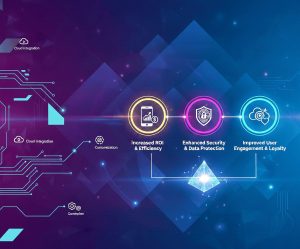
Quick ROI Model (Illustrative)
Estimate the impact using a simple formula:
Incremental monthly revenue = (monthly active users × conversion lift × AOV)
Example: 50,000 MAU × 2% conversion lift × $25 AOV = $25,000 incremental revenue/month. Compare that to the phased development cost to estimate payback period and prioritize features with fastest payback (e.g., checkout, onboarding, or personalized offers).
Short, Anonymized Examples
Retail: Barcode scanning + saved payment reduced cart abandonment and improved shipment accuracy; results included +30% faster fulfillment and a measurable uplift in checkout conversion.
Fintech: Native biometric login and secure key management reduced login friction and support calls, increasing daily active usage and passing strict store privacy reviews on first submission.
Want a focused ROI assessment for your product? Get a Free ROI Assessment to see prioritized features, an estimated timeline, and the projected business impact for your mobile app development plan.
Types of Mobile Apps We Build
Choosing the right technical route shapes performance, cost, and time to market for every product.
Native iOS Engineering For The App Store
We build native iOS apps when performance, security, and deep Apple integration matter. These apps use Swift (or Objective‑C where required) and call native apis for smooth offline behavior, precise background tasks, and rich UI interactions. Pros: maximum performance, access to the latest Apple frameworks (HealthKit, CoreML, ARKit), and a predictable device matrix for QA. Cons: higher per‑platform development cost and separate codebases per platform.
Best for: Apps requiring fine‑grained sensor access (camera, GPS), tight OS integration, or premium user experiences. Example decision: if you need Bluetooth LE pairing + secure biometric payments on iPhones, choose native iOS.
Native Android Delivery For Google Play
For broad reach across diverse devices, we deliver native Android solutions using Kotlin or Java and Android SDKs. We follow Material Design principles and mitigate fragmentation through targeted device testing and performance budgets. Pros: access to a large global market, flexible distribution options, and broad hardware support. Cons: more device variants to test and optimize.
Best for: Use cases that prioritize market reach, varied hardware access, or Android‑specific integrations. Example decision: if your product targets price‑sensitive markets with diverse device models and needs camera/barcode scanning at scale, choose native Android.
Cross‑Platform For Shared Codebases
When time to market and cost efficiency are priorities, we use cross‑platform frameworks such as Flutter or React Native to share code across iOS and Android while preserving native feel. Pros: faster parity across platforms, lower maintenance overhead, and accelerated MVP delivery. Cons: some platform‑specific APIs or performance‑critical features may require native modules.
Best for: MVPs, content apps, and business tools where feature parity and speed matter. Example decision: if you need an e‑commerce app with native‑grade UX but a compressed timeline, cross‑platform is often the optimal route.
Custom PWAs And Hybrid Solutions
Progressive Web Apps (PWAs) and hybrid approaches combine web technologies with installable experiences. PWAs give rapid distribution, SEO benefits, and offline caching; hybrids combine web views with native shells to access limited device features. Pros: lowest initial cost and strong discovery potential; Cons: limited access to some native apis and inconsistent PWA support across iOS browsers.
Best for: Discovery‑first products, content platforms, or internal tools where deep hardware access is unnecessary. Example decision: if SEO and quick adoption across desktop and mobile are critical, consider a PWA.
- We map languages, frameworks, and toolchains to your roadmap and compliance needs, weighing development speed, TCO, and long‑term maintenance.
- We weigh tradeoffs: native apps for top performance and native apis; cross‑platform for speed; PWAs for reach and discoverability.
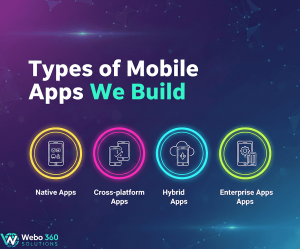
| Approach | Strength | Typical use |
| iOS (native) | Max performance, deep native apis | Secure, high‑retention markets; App Store distribution |
| Android (native) | Wide reach, flexible policies | Google Play releases, varied devices |
| Cross‑platform | Shared codebase, faster releases | MVPs and unified feature sets |
| PWA / Hybrid | Cost‑effective, web reach | Browser installable, limited hardware access |
For a recommendation tailored to your product, see our How We Build and Choosing Platforms sections, or Request a Platform Assessment to get a prioritized technical plan and timeline.
How We Build Your App: A Step‑by‑Step Process
Before we write a single line of code, we validate the opportunity with focused research and rapid prototypes so your app delivers measurable value.
1. Idea Validation And Market Research
We start with a short discovery engagement to validate product‑market fit, define measurable goals, and document must‑have requirements. Deliverables include a one‑page opportunity brief, competitor map, prioritized feature backlog, and success metrics (activation, retention, conversion). Acceptance criteria: validated persona(s), top three value propositions, and at least one testable hypothesis for the MVP.
2. UX/UI Design And MVP Planning
Our design process moves quickly from low‑fidelity wireframes to clickable prototypes and usability testing. Deliverables user journey maps, wireframes, a clickable prototype, and an MVP scope with a prioritized backlog. We measure design success through time‑to‑task benchmarks and prototype test results. The right‑sized MVP focuses on the smallest set of features that prove the business case and shorten time to first value.
3. Architecture, Code, And Integrations
During technical design we select front‑end and back‑end patterns that balance scalability, security, and cost. Deliverables include an architecture diagram, API contracts, data model, and CI/CD plan. We write modular, testable code with peer review standards, automated unit tests, and documented interfaces for third‑party integrations (payment providers, identity, analytics). This stage produces a deployable build pipeline and an initial release candidate.
4. Testing On Real Devices And Networks
Testing is continuous: automated suites (unit, integration) run on each commit, while manual and exploratory QA runs on a device matrix that reflects your target user base. We test across OS versions, screen sizes, and real network conditions (3G/4G/5G, offline). We also use platform beta channels—TestFlight for iOS and Google Play’s internal/test tracks—to gather early user feedback. Deliverables: test reports, a prioritized defect list, and performance baselines (cold start, time‑to‑interactive, memory use).
5. Store Preparation, Submission, And Compliance
Store readiness includes writing metadata, designing icons and screenshots, producing privacy disclosures, and preparing any legal or compliance documentation. We optimize listings for discoverability on the App Store and Google Play and manage the submission process and review responses. Deliverables: store assets package, submission checklist, and a post‑submission plan to handle any review items quickly.
6. Deployment, Analytics, And Continuous Improvement
We instrument analytics and define an event taxonomy that aligns with business KPIs. Deliverables: dashboards, conversion funnels, retention cohorts, and A/B test frameworks. We use staged rollouts and feature flags to safely release changes, monitor telemetry for regressions, and iterate on prioritized improvements. A living roadmap and release cadence keep stakeholders aligned and reduce long‑term maintenance costs.
- Roles & ownership: product owner, UX designer, iOS/Android developers, backend/API engineers, QA, DevOps — each with clear acceptance criteria and sprint‑level ownership.
- Typical timelines (scoped example): Discovery & prototype: 2–4 weeks; MVP build: 8–16 weeks; Enterprise integrations and compliance work extend timelines based on scope.
- 30/60/90 sample milestones (example):30 days — discovery complete, validated prototype, prioritized MVP backlog, and architecture plan.
- 60 days — core features implemented, automated tests in CI, first internal beta, analytics instrumentation in place.
- 90 days — public beta on TestFlight/Google Play internal track, store submission readiness, KPI dashboard operational.
- SLA & support outline: post‑launch support tiers include 30‑day hypercare (bug fixes and hotfixes), standard support (response SLA within 24–72 hours), and continuous delivery options for routine releases and experiments.
Our process is designed for predictable velocity and risk reduction: short iterations, measurable acceptance criteria, and a focus on outcomes. If you want a specific 30/60/90 plan for your product, Request a Tailored Roadmap and we’ll provide a scoped timeline, deliverables list, and an estimated cost range based on your target platforms and integrations.
Quality, Security, Performance, and Scalability by Design
We design systems that protect data, boost speed, and let features scale as your audience grows.
Security‑first coding and compliance readiness
Security is built into our development lifecycle. We apply least‑privilege access, strong encryption for data at rest and in transit, and centralized key management. Our pipelines include automated dependency scanning, static analysis, and input‑validation patterns to reduce attack surface. Deliverables include threat models, audit‑ready logging, and mitigation plans so your app meets regulatory and store requirements (e.g., privacy disclosures required by the App Store and Google Play).
Performance Optimization And Efficient Resource Use
Mobile devices operate with tighter CPU, memory, and battery budgets than desktop environments. We optimize performance through asset compression, lazy loading, efficient diffing/render strategies, and minimized JS/bitmap work. Typical KPIs we track: cold start time, time‑to‑interactive, memory usage, and frame‑rate stability. Improving these metrics leads to better user experience and retention—small improvements in start time often correlate to measurable drops in churn.
Cloud Offloading, APIs, And Extended Capabilities
We move heavy compute and storage to cloud services behind well‑designed apis to keep the app responsive.
Example: instead of processing images on the device, we send uploads to a serverless pipeline that runs image transforms and returns optimized assets — this reduces battery use, shortens render times, and simplifies versioned logic on the client. Cloud offload also enables advanced capabilities like push notifications orchestration, ML inference, and aggregate analytics without overloading devices.
Scalable Architectures And Rigorous QA
We design modular back‑end services with caching, queues, and autoscaling so features can grow without large rewrites. On the client we use feature flags, progressive delivery, and staged rollouts to limit blast radius. Continuous QA covers functional, performance, and accessibility tests across a representative device matrix and OS versions so users on older devices still have a reliable experience.
- Defense in depth: secure auth, token rotation, runtime protections, and role‑based access.
- Observability: integrated crash analytics, performance tracing, and real‑time monitoring (key KPIs: crash rate, error rate, time‑to‑first‑byte, and retention cohorts).
- Resilience: offline strategies, retry policies, exponential backoff, and graceful degradation for limited or lost connectivity.
| Focus | Goal | Outcome |
| Security | Least privilege & encrypted transport | Compliance and lower breach risk |
| Performance | Lightweight UI and cloud offload | Faster launches and improved user experience |
| Scalability | Modular services and caching | Handles growth with minimal rework |
Security checklist (procurement ready)
- Dependency & vulnerability scan results available for review
- Data‑flow diagram and encryption policy documented
- Incident response plan and SLAs for critical production issues
- Accessibility and privacy compliance checkpoints in QA
Our approach balances fast, delightful app experiences with enterprise‑grade system controls so your app performs well on varied devices and OS versions while protecting users and data. If you’d like a targeted review, Request a Security & Performance Assessment and we’ll provide prioritized remediation steps and KPI targets for your app.
Choosing Platforms: Android, iOS, Cross‑Platform, or PWA
Platform selection should be deliberate: pick where your audience is and what the product must do.
Effective platform choice is a core part of mobile app development strategy. We map reach, retention, and technical tradeoffs to recommend the best path for your product. Global Android share is dominant in many markets, while iOS often delivers higher retention and monetization in premium segments — and each store (App Store vs Google Play) has distinct review and distribution policies that affect release cadence and compliance work.
Beyond reach, consider time, budget, and required integrations. Deep native features (Bluetooth, background processing, secure biometrics) generally favor native app development. Shared codebases accelerate delivery and reduce maintenance overhead for many feature sets. PWAs prioritize rapid web reach and SEO but limit access to some native APIs, especially on certain iOS browsers.
Audience, Market Share, And Retention Considerations
- Start where your analytics point: if existing user data shows a majority on Android, begin there; if iOS users drive higher spend and retention, prioritize iOS.
- Match features to platforms: choose native when you need advanced native apis and sensor fidelity; choose cross‑platform when you need parity quickly.
- Regional market differences: some countries skew heavily to Android; others (e.g., U.S., parts of Western Europe) have stronger iOS presence — factor that into platform choice.
Time, Budget, And Feature Requirements
- Sequence releases to reduce risk: ship an MVP on one platform to validate product‑market fit, then expand to additional platforms.
- Evaluate TCO: an initial cross‑platform build may save cost up front, while native apps can reduce support costs and deliver better performance for complex features.
- Talent availability: choose technologies that align to available development skills to avoid long hiring cycles.
Store Policies, Review Timelines, And Distribution Strategy
- Plan for App Store review cycles and Google Play policies to avoid release delays — include time for metadata, privacy disclosures, and possible review feedback.
- Consider alternative distribution channels (enterprise stores, direct APKs, web first) where appropriate for internal or regulated deployments.
| Choice | When to choose | Key tradeoffs |
| Android | Wide reach, cost‑sensitive markets | Large device matrix; great for broad market entry via Google Play |
| iOS | High retention, premium users | Smaller device matrix; stricter App Store review but often higher monetization |
| Cross‑platform | Fast time to market and parity | Shared code; may need native modules for special APIs |
| PWA | SEO and rapid web distribution | Low cost; limited native access on some platforms |
A Concise 5‑Step Decision Checklist
- Who are your users and which devices do they use most?
- Which features require native apis or background processing?
- What is your budget and acceptable time to first release?
- Do you need app store presence or is web discovery sufficient?
- Can you launch an MVP on one platform and iterate based on analytics?
Sample TCO Example (Illustrative)
Estimate ranges for a typical commerce MVP:
- Single‑platform native MVP (iOS or Android): higher up‑front dev cost, better performance for complex flows; approximate dev & QA: 8–14 weeks.
- Cross‑platform MVP (Flutter/React Native): lower initial cost and faster parity across platforms; approximate dev & QA: 6–12 weeks.
- Multi‑platform launch (native both): increases development and QA time and cost but maximizes device‑specific optimization and long‑term supportability.
Not sure which platform to choose? Request a Platform Selection Session and we’ll provide a short, actionable recommendation — the best platform to start on, estimated MVP timeline, and a prioritized feature roadmap tailored to your users and market.
Modern Tools, Frameworks, and Native APIs
We pick pragmatic technologies that let teams ship high‑value features quickly and reliably.
Using Leading Frameworks And Languages To Accelerate Delivery
Our stack blends cross‑platform frameworks with native languages so we deliver speed without sacrificing quality. We typically use Flutter or React Native for shared codebases and Kotlin/Java (Android) or Swift (iOS) for platform‑critical modules. This hybrid approach gives you the best of both worlds: faster parity across apps with the ability to call native code where performance or platform APIs demand precision.
Selection criteria we apply for frameworks and languages include performance needs, developer availability, long‑term maintenance, ecosystem maturity, and the specific native apis required by your product. We also assess third‑party SDK maturity and privacy footprint before adding dependencies to the codebase.
Leveraging Native APIs For GPS, Camera, Bluetooth, & Notifications
Where user experience depends on device capabilities, we call native apis for precise location, camera capture, Bluetooth connectivity, microphone input, secure biometric auth, and push notifications. These integrations enable richer journeys — for example, location‑aware offers that increase conversion at the point of sale, or push notifications that re‑engage users based on in‑app behavior.
We design APIs and client modules so native functionality is encapsulated and testable, minimizing platform‑specific code spread and simplifying future updates.
- Choose Flutter when you need near‑native performance, expressive UI, and rapid iteration across platforms.
- Choose React Native for teams with strong JS expertise and a need for large ecosystem support and web parity.
- Choose native SDKs when you require the absolute best performance, the latest platform features (ARKit, CoreML), or strict security controls.
Code Quality, Governance, & CI/CD
We enforce coding standards, linters, and minimum unit/integration test coverage targets. A typical pipeline includes automated builds, static analysis, unit tests, UI tests on device farms, and staged rollouts. Recommended CI/CD tools include GitHub Actions, CircleCI, Bitrise, and Fastlane for automated signing and store submissions.
- Architect reusable modules with clear interfaces to minimize duplication across platforms.
- Integrate third‑party SDKs with privacy and footprint in mind — prefer modular, consent‑aware SDKs.
- Include accessibility and internationalization from design through implementation so your app serves broader audiences.
By combining the right frameworks, disciplined code quality practices, and reliable tools, we reduce development risk and improve the speed of delivering high‑impact features. Contact us to discuss which frameworks and languages best match your product goals and timeline.
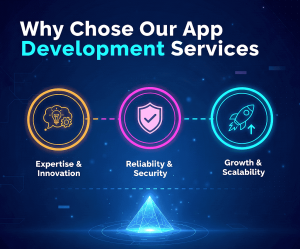
Why Choose Our App Development Services?
We combine senior product leadership, U.S.-based teams, and a disciplined process to deliver reliable app development, fast feedback loops, and measurable business outcomes.
Expert, U.S.-Focused Team With Transparent Communication
We assign a senior product owner and a local points-of-contact so decisions happen quickly and communication stays aligned with your business priorities. Each engagement includes a named developer and a small, cross‑functional roster (UX, iOS/Android engineers, backend, QA) to provide clear ownership from discovery through launch.
Accountability and rhythm: weekly sprint reviews, a product backlog you control, and clear acceptance criteria ensure predictable progress and fewer surprises. This structure reduces rework and improves time to market for your mobile app development initiatives.
Modern Tech Stack, Robust Process, & Agile Delivery
We use proven frameworks and modern languages (Flutter, React Native, Swift, Kotlin) combined with CI/CD pipelines and automated testing to keep scope predictable and velocity high. Our toolchain supports automated builds, device farm testing, and Fastlane or equivalent flows for streamlined store submissions.
Cloud services power push notifications, analytics, and scalable APIs so the client app remains lightweight while platform services handle heavy compute and data. That balance improves performance across devices and reduces long‑term development and maintenance cost.
Post‑Launch Support, Updates, & Measurable Outcomes
We instrument analytics to tie user behavior to business KPIs. Post‑launch offerings are tiered to match your needs: hypercare and hotfix response immediately after launch, ongoing support with SLAs for maintenance, and product teams for roadmap delivery and experiments.
- Performance and reliability backed by QA, observability, and crash analytics.
- Store strategy guidance and submission support to meet App Store and Google Play requirements and avoid rework.
- Documentation, training, and handover so your internal teams can extend the product confidently.
Engagement Models & Pricing Guidance
We offer flexible engagement models to match risk and clarity of requirements:
| Model | When to Choose | Benefit |
| Fixed‑scope | Clear requirements | Predictable budget and deliverables |
| Time & Materials | Evolving scope | Flexible resourcing and faster iteration |
| Milestone‑based | Hybrid needs | Risk sharing with staged approvals |
Typical engagements include an initial discovery and estimate, followed by a phased MVP build and optional post‑launch support. We’ll present a clear cost range and recommended model in the proposal so you can choose the approach that matches your budget and timeline.
Proof & Next Steps
Our team has delivered measurable gains across retail, healthcare, and enterprise workflows with outcomes such as increased engagement, faster checkout flows, and reduced support costs. To see what this could look like for your business, Request a Quote or Book a Discovery Call — we’ll provide a short proposal, an estimated timeline, and a tailored onboarding plan.
Client Success Highlights
Our case studies demonstrate measurable gains across retail, healthcare, and enterprise workflows—real examples of how mobile app development drives business outcomes.
Retail: Faster Checkout & Higher Engagement
Problem: A national retailer had high cart abandonment and manual fulfillment errors that increased costs.
Solution: We delivered a native iOS and Android app with barcode scanning, saved payment flows, and personalized, location‑aware offers. The team instrumented analytics and A/B tested onboarding and checkout flows.
Outcome: Engagement doubled within three months of launch and checkout conversion rose meaningfully (anonymized client data). Fulfillment errors dropped and average checkout time decreased ~18%, improving both customer experience and operational efficiency.
Healthcare: High Usability & Compliance‑Ready Delivery
Problem: A healthcare provider needed secure, fast mobile tools for clinicians and patients while meeting strict privacy requirements.
Solution: We built native apps with optimized UI for common devices, secure biometric authentication, audited logging, and HIPAA‑aware data flows. Performance tuning and QA across device versions reduced friction for critical tasks.
Outcome: Users rated the apps 4.8 for speed and usability in post‑launch surveys; support tickets for common workflows declined and clinical task completion times shortened. The release also passed store privacy reviews on first submission.
Enterprise & Cross‑Platform: Lower Cost, Faster Releases
Problem: An enterprise client needed feature parity across markets but faced high engineering overhead and slow release cadence.
Solution: We executed a cross‑platform rebuild with feature flags, CI/CD automation, and staged rollouts to maintain parity while reducing duplication of effort.
Outcome: Engineering costs fell by ~30% and release frequency increased, enabling faster market responsiveness and consistent user experiences across regions.
- Logistics Example: Camera barcode scanning cut errors and sped fulfillment in operational pilots.
- Media Example: Targeted push notifications and personalized content increased session frequency without raising opt‑out rates.
- Education Example: Offline lessons and sync improved completion rates in low‑connectivity regions.
- Fintech Example: Secure data handling and guided privacy flows passed strict store privacy reviews on first submission.
| Sector | Key metric | Result |
| Retail | Engagement | 2x in 3 months |
| Healthcare | Rating | 4.8 across devices |
| Enterprise | Cost | 30% reduction |
Want similar outcomes? we’ll map examples from your market to prioritized features and an estimated impact model for your app development roadmap.
Ready to Build? Contact Us for a Tailored App Strategy
Kick off a focused effort that reduces risk and speeds time to first value.
Our team provides expert guidance to shape your product vision, timeline, and measurable targets. We handle publishing readiness end‑to‑end — from developer program enrollment and compliant metadata to store review support and post‑launch analytics. While Google Play often allows faster review cycles, Apple’s App Store requires stricter checks; we manage both to minimize friction.
Start Your Project, Request A Quote, OR Schedule A Discovery Call Today!
Get a fast estimate and an onboarding guide that outlines phases, deliverables, and how we reduce time to first value. We’ll set targets for activation, engagement, and conversion and align the roadmap to your business goals.
Request a Quote — 24h Estimate | Book a 30‑min Discovery Call
What To Expect In The Discovery
- We learn your users, constraints, and target metrics (activation, retention, revenue).
- We surface integration needs, regulatory requirements, and required native apis.
- We provide a prioritized MVP scope, a phased timeline, and a rough development cost range.
- We outline post‑launch support options and recommended KPIs and dashboards.
Quick Contact Form (Suggested Fields)
To speed responses, include these in your initial message:
- Project name & short description
- Target platforms (iOS / Android / Web / PWA)
- Estimated timeline and preferred launch window
- Budget band (helpful ranges)
- Key integrations or compliance needs (e.g., payment, HIPAA)
| Action | Typical time | Notes |
| Developer enrollment | 1–7 days | Required for store publishing; we can assist with setup. |
| Store review | Hours–2 weeks | Google Play usually faster; prepare metadata and privacy details to reduce rejections. |
| Post‑launch support | Ongoing | Choose from hypercare, SLA‑based support, or continuous product teams. |
Budget Guidance (Illustrative Ranges)
- Simple MVP (single platform, core flows): Lower range — shorter timeline; typically suitable for validation and early user feedback.
- Cross‑platform MVP (feature parity across iOS & Android): Mid range — faster parity and lower ongoing maintenance per platform.
- Enterprise / Regulated builds (integrations, compliance, high security): Higher range — additional time for integrations, audits, and QA.
Trust markers: our teams have shipped mobile app development projects across retail, healthcare, fintech, and education — delivering results like doubled engagement, 4.8+ ratings, and measurable cost reductions. Request a tailored proposal and we’ll include anonymized case references relevant to your market.
Ready to start? Send a Note, Request a Quote, or Book a Discovery Call and we’ll move quickly to a clear plan, a prioritized roadmap, and responsive support for your app development and post‑launch needs.
How Webo 360 Solutions Helps You Build Powerful Mobile Apps

At Webo 360 Solutions, we specialize in designing and building high-performance mobile applications tailored to your unique goals. Whether you need a custom iOS app, an Android platform solution, or a cross-platform experience, our expert developers guide you through every step of the process.
-
✔Strategic Planning & UX Design: We begin with deep discovery and user-centered design to ensure your app resonates with its target audience.
-
✔Technical Development & Integration: Our team builds scalable, secure, and responsive applications that integrate seamlessly with your backend systems and third-party APIs.
-
✔Testing & Quality Assurance: Rigorous testing ensures your mobile app delivers reliable performance across devices and platforms.
-
✔Launch Support & Optimization: From app store submission to analytics tracking and post-launch growth support, we help your app get discovered and thrive.
With our full-lifecycle approach, you’ll get a mobile solution that not only looks great but also boosts engagement, retention, and revenue—giving your business a competitive edge in the mobile-first world.
Conclusion
A well‑crafted product blends research, clear design, and disciplined engineering to win user attention and loyalty.
Investing in expert mobile app development unlocks durable business gains across acquisition, engagement, and retention. By following a repeatable process—research, design, build, test, publish—we reduce launch risk, accelerate time to impact, and create a foundation for continuous growth. Whether you pursue native apps, cross‑platform builds, or PWAs, the right technical choices and disciplined delivery matter to long‑term success.
Top benefits we deliver:
- Faster user activation: optimized onboarding and UX that increase early conversion and reduce churn.
- Higher engagement & monetization: native features and personalized journeys that drive session depth and repeat value across App Store and Google Play audiences.
- Lower operational costs: scalable architectures, observability, and automated releases that reduce support overhead and speed experiments.
We prioritize user experience, secure architectures, efficient performance on constrained devices, and cloud APIs that extend capability without overloading the client. Our team aligns platform choice and feature prioritization to your business goals—targeting the combinations of native apis, performance optimizations, and analytics that produce measurable returns.
Special offer: Start with a complimentary 30‑minute roadmap review (limited availability). In the session we’ll evaluate your goals, recommend the best platform approach, and outline a focused MVP with an estimated timeline and impact model.
Ready to move forward? Contact our Developers to Request a Quote, Book Your Free 30‑minute Strategy Session, or get a tailored onboarding guide. We’ll provide concrete next steps and a prioritized plan so you can start building mobile apps your users will value.
FAQ
What do you mean by app development services and why do businesses need them today?
App development services cover the full lifecycle of a product: product discovery, UX/UI design, front‑end and back‑end engineering, API integration, testing on real devices, store publishing, and post‑launch support. Professional partners speed time to market, ensure secure and maintainable code, and align features to measurable business outcomes so your mobile app development investment delivers value to users and the business.
How do custom mobile solutions drive business growth?
Custom apps let you use native apis and device capabilities—GPS, camera, Bluetooth, biometrics—to create differentiated features and personalized journeys. That differentiation typically improves activation, retention, and lifetime value compared with generic web or off‑the‑shelf solutions. We tie features to KPIs (activation, conversion, retention) and run experiments to validate which product changes move the metrics that matter.
Which types of native and cross‑platform solutions do you build?
We build native iOS apps for the App Store, native Android apps for Google Play, cross‑platform apps (Flutter, React Native) where shared code makes sense, PWAs for web‑first discovery, and enterprise hybrids that integrate with existing systems and apis. We recommend the approach that best balances performance, time to market, and total cost of ownership for your product.
What is your step‑by‑step process for building a reliable product?
We validate ideas with market research and prototypes, design UX and an MVP, define architecture and API contracts, implement with testable code and CI/CD, run automated and manual testing across a representative device matrix, and manage store submission and staged rollouts. Post‑launch we measure with analytics, run A/B tests, and iterate against business KPIs.
- Deliverables: opportunity brief, prototype, architecture docs, CI/CD pipeline, analytics dashboards.
- Acceptance criteria: validated personas, testable MVP, performance baselines, and successful beta on TestFlight / Google Play internal tracks.
How do you ensure security, performance, and scalability?
We embed security and performance practices across the development lifecycle: threat modeling, least‑privilege, encryption, dependency scanning, performance budgets, and cloud offload via secure apis. Scalable back‑ends use modular services, caching, and queues; client apps use feature flags and staged rollouts. We track KPIs like crash rate, time‑to‑interactive, and retention cohorts to validate improvements.
How do you choose between Android, iOS, cross‑platform, or a PWA?
We assess your users, market share, retention goals, budget, and timeline. If native device features, background work, or highest possible performance are required, we prefer native app development; for faster parity and lower initial cost, cross‑platform is often right; PWAs work well for discovery and SEO. Store policies and review timelines (App Store vs Google Play) also factor into the recommendation.
Which tools, frameworks, and languages do you use to accelerate delivery?
We use proven frameworks (Flutter, React Native) alongside native languages (Swift, Kotlin/Java) when platform APIs demand it. CI/CD tooling (GitHub Actions, Bitrise, Fastlane), device labs for automated UI testing, and observability stacks for crash and performance monitoring are standard. We evaluate third‑party SDKs for privacy footprint and modularity before integrating them.
What kind of post‑launch support and measurement do you offer?
Support options include hypercare immediately after launch, SLA‑based maintenance, and dedicated product teams for ongoing feature delivery and experimentation. We provide analytics integration, A/B testing frameworks, and dashboards to measure engagement and iterate on features that move KPIs.
How long does it typically take to build a first release?
Timelines depend on scope. A focused MVP (single platform, core flows) can be delivered in a few months (commonly 8–14 weeks). Cross‑platform MVPs may be faster; enterprise or regulated projects that require integrations, audits, or complex workflows will take longer. We define milestones and deliverables up front to keep schedules predictable.
What industries have you supported and can you share outcomes?
We’ve delivered app development across retail, healthcare, finance, logistics, media, and education. Outcomes include doubled engagement for retail clients, 4.8+ user ratings in healthcare, and 20–30% cost reductions from cross‑platform rebuilds. Case studies and anonymized metrics are available on request.
How do you handle app store submission and compliance?
We prepare store assets (icons, screenshots, metadata), privacy policies, and any necessary compliance documentation. We manage submissions and respond to review feedback for both the App Store and Google Play, and maintain a policy watch so your releases avoid common causes of rejection.
How do you price projects and what engagement models are available?
We offer fixed‑scope engagements for well‑defined projects, time‑and‑materials for evolving scopes, and milestone‑based models for staged delivery. Pricing reflects targeted platforms, feature complexity, integrations, and ongoing support needs. We present a clear cost range in the proposal to help you choose the right model.
How do I start a project with your team and how should I prepare for the discovery call?
Start by scheduling a discovery call. To make the session productive, bring:
- A short product description and primary business goal
- Target platforms (iOS, Android, Web/PWA) and any required native apis
- Rough timeline and budget range
- Key integrations or compliance requirements (payments, HIPAA, SSO)
- Available analytics or user data (if any)
After the call we’ll propose a tailored roadmap, an estimated cost range, and recommended next steps to move from concept to a measurable product.