

You Don’t Need a Tech Co-Founder – You Need a Software Development Company Team
“What if giving up equity isn’t the only path to technical leadership?”

📌 Highlights
-
✔Why hiring a software development company often outperforms searching for a single tech co‑founder.
-
✔How a delivery partner provides predictable costs, full-team access, and enterprise-grade security without equity dilution.
-
✔Real outcomes faster MVPs, lower delivery risk, and continuous releases across web, mobile, e‑commerce, and AI-enabled solutions.
-
✔How to evaluate a partner and what a partner-as-technical-cofounder engagement really looks like.
You can buy delivery certainty by partnering with a ready-to-deploy team that covers strategy, architecture, build, QA, security, deployment, and support. A trusted software development company brings not just engineers but structured processes, project management, and measurable outcomes so your business can move from idea to shipped product without giving away equity.
Instead of weeks spent negotiating ownership, vesting, or founder clauses, you can fund development on predictable terms and retain IP and control. For many startups, the choice comes down to a tradeoff equity and long hiring cycles versus predictable costs, a full team of specialists, and a partner who treats your product like a living asset.
Marketing claims like “Since 1989, 4,200+ success stories and 1,400+ satisfied clients” and references to ISO-aligned quality and ISO 27001-based security controls should be verified for each partner. When they’re accurate, these credentials signal mature management practices and enterprise-ready security—important when you plan to scale, sell to regulated customers, or protect sensitive data.
What this means in practice: A documented scope, a clear project plan, measurable acceptance criteria, and a repeatable delivery rhythm. That structured approach reduces surprises, preserves runway, and keeps development focused on validated business goals rather than engineering perfection.
We’ll show how a partner model delivers MVP speed, lower delivery risk, predictable budgets, and continuous releases across websites, mobile apps, e-commerce, and AI/data solutions while keeping IP, control, and security clear. Expect concrete examples of timelines (MVPs from weeks to a few months), engagement models (fixed-price phases, dedicated squads, or time-and-materials), and sample milestones you can request in your contract.
Key Takeaways
Schedule A Free Consultation — take the first step towards transforming your ideas into reality. Our expert team is ready to discuss your project, understand your goals, and provide insights that will help you navigate the complexities of software development.
When a Technical Co-Founder Isn’t The Best Path For Your Product
Choosing a co-founder can feel romantic, but it often slows down the work that actually proves your idea.
The real cost of equity conversations: Equity negotiations — ownership splits, vesting schedules, and decision rights — can consume weeks or months of founder time. That delay reduces your runway for product validation and diverts attention from the core business problem: finding product‑market fit.
Hiring timelines and risk: Hiring a senior technical leader who fits your domain, pace, and culture commonly takes 8–16 weeks or longer, depending on market conditions and role specificity. During that time, your competitors keep shipping, and early user feedback goes uncollected. Even after hiring, a single hire can become a single‑point‑of‑failure for discovery, architecture, UX, backend, frontend, QA, DevOps, security, and analytics.
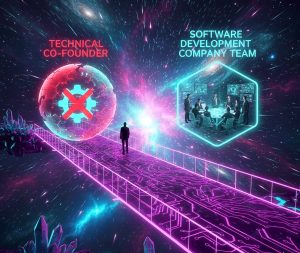
Single‑person Risk Vs. Repeatable Delivery Processes
One person rarely covers discovery, architecture, UX, backend, frontend, QA, DevOps, security, and analytics well enough to ship reliably. At the MVP stage, you need pragmatic technical leadership that chooses scope, manages tradeoffs, and sets simple engineering standards — not an open‑ended rebuild.
Think in terms of a repeatable process: Clear roadmap items, measurable acceptance criteria, risk checks, quality gates, and fast feedback loops. The goal is to prove demand and iterate rapidly, not to build a perfect final system on day one.
Evidence And Practical Data
Industry surveys and hiring studies consistently show hiring senior engineers is time-consuming median time-to-hire for senior technical roles often ranges from 6 to 12 weeks in normal markets and can extend further during talent shortages. Founders who delay product validation for hiring or equity negotiations frequently miss early learning opportunities—an avoidable cause of slower growth.
How To Decide: Co-Founder Or Partner?
Mini case (anonymized): A marketplace founder paused co-founder recruitment after six weeks without a viable candidate and engaged a development company instead. The partner delivered an MVP in 9 weeks, enabling first transactions and validating core assumptions. The founder preserved equity, secured early revenue, and later hired a product lead to work with the delivery team.
Mini counterexample (anonymized): A health‑tech startup spent five months negotiating equity with a prospective technical co‑founder. During negotiations, integration work stalled, investors grew impatient, and regulatory readiness was delayed—pushing the roadmap out six months and increasing burn.
These examples show how an external development company can act as a pragmatic alternative; it provides immediate development capacity, cross-functional expertise, and the operational processes needed to ship MVPs and iterate from real user data.
Contact Our Expert Team Today to discover how we can support your development objectives with efficiency and effectiveness.
Why A Software Development Company Beats Hiring A Technical Co-Founder
A full delivery partner gives you accountable outcomes fast, without equity talks or long hiring cycles.
Ownership And Accountability Without Equity Negotiations
With a reputable Software Development Company, you fund the build and retain ownership of IP and code. That preserves founder equity and keeps incentives aligned for future fundraising and exits. Contracts replace equity negotiations; they specify milestones, acceptance criteria, delivery artifacts, and payment terms—so outcomes are accountable and measurable from day one.
Sample milestone-based contract pattern (what to ask for in your SOW):
Each milestone should include measurable acceptance criteria (e.g., error rate < 1% under test load, 100% of critical paths covered by automated tests, or security scan results with no high severity findings). These details turn promises into enforceable deliverables.
Instant Access To Senior Specialists Instead Of A Single Point Of Failure
A development company supplies architects, frontend and backend engineers, QA, DevOps/cloud specialists, security experts, and product managers on demand. Instead of depending on one generalist, you get redundancy, handover buffers, and role-specific expertise—so staffing gaps don’t derail releases.
Typical onboarding time for an external team is measured in days to a couple of weeks for ramp-up, not months to recruit and hire. That faster ramp drives earlier user testing and revenue signals.
A Partner Built For Delivery, Not Just Ideas
Rather than buying an individual’s time, you buy a repeatable delivery engine: scoping, estimation, change control, quality gates, CI/CD pipelines, and release management. Good partners provide transparency through shared roadmaps, demo schedules, and sprint reviews so you remain a collaborator, not a spectator.
How Pricing Models Work (Quick Guide)
Understanding pricing helps you choose the engagement that best preserves runway and predictability:
Proof Points & Short Vignettes
Vignette 1 (anonymized): A fintech client preserved 100% founder equity by engaging a delivery partner to build their MVP payments. The partner delivered a production-ready integration and compliance checklist in 12 weeks; the product reached pilot customers and secured a seed round based on traction, not equity concessions.
Vignette 2 (anonymized): A B2B marketplace avoided a costly rewrite after launch because the development company used scalable architecture patterns and staged performance testing; uptime and transaction latency met SLA targets under early load.
| Aspect | Co-founder | Delivery Partner |
|---|---|---|
| Ownership | Shared equity, negotiation overhead | You fund the build and retain full IP |
| Accountability | Depends on individual incentives | Contractual milestones and SLAs |
| Team access | Often one or two people | Specialists on demand across roles |
| Risk | Single-point-of-failure | Redundancy and management coverage |
| Delivery maturity | Varies by person | Proven process for shipping software |
| Cost predictability | Variable salary + equity impact | Fixed phases, T&M, or managed squads |
| Onboarding time | Weeks to months | Days to weeks |
| Security & compliance | Depends on personal experience | Dedicated security practices and audits |
| Long-term support | Role-dependent availability | SLA-backed support and elastic staffing |
Want to see a real example milestone contract or pricing scenario? Request A Sample Milestone Contract, and we’ll send an annotated SOW and pricing models for MVPs, scaling phases, and long-term managed squads.
What You Gain: Speed, Predictability, And Lower Delivery Risk
You can reach market fit sooner by swapping single‑person risk for a proven delivery engine.
Faster time‑to‑market: A focused MVP can be delivered in measured phases—experiments in 2–4 weeks, a production MVP in 6–12 weeks for a well‑scoped feature set, and broader platforms with integrations in 3–4 months. After launch, a delivery partner supports continuous releases every 2–6 weeks so you can iterate on real user data and keep momentum.
Concrete example (anonymized): A marketplace client shipped an initial transaction flow in 9 weeks and reached the first 1,000 users within three months after launch. That early traction unlocked follow‑on investment without diluting founder equity.
Why this is faster: External teams provision cross‑functional specialists immediately—product managers, designers, frontend and backend engineers, QA, DevOps, and security—so you avoid the multi‑month recruiting cycle and get a coordinated team working to validate business goals.
Predictable costs: Partners use structured scoping, clear acceptance criteria, and transparent estimates to tie budget to features, platforms, and nonfunctional requirements. Typical pricing approaches:
These ranges vary by scope, compliance needs, and third‑party costs (payments, SMS, hosting). Use milestone-based contracts to lock in acceptance criteria and reduce surprises.
Reduced delivery risk: Mature development companies run risk registers, enforce change control, and include quality gates to surface issues early and prevent scope creep. They also provide auditable decision trails so stakeholders can see tradeoffs and rationale at each milestone.

Quality Built In
Shift‑left testing puts QA into discovery and every sprint, so defects are found early and fixed cheaply. A seasoned partner applies ISO‑aligned quality management practices (coding standards, peer reviews, CI/CD, and release readiness) to ensure consistent delivery quality across releases.
Enterprise‑Grade Security And Data Protection
Security practices include threat modeling, secure coding standards, SAST/DAST scans, periodic penetration testing, and a documented incident response plan. For regulated buyers, partners can provide audit artifacts and compliance checklists tied to ISO 27001 practices—helping you scale without exposing sensitive customer or enterprise data.
Equity Preservation & Founder Upside
By funding development rather than trading equity, founders keep upside for future rounds or exits. Investors often prefer teams that demonstrate traction and metrics—early revenue and KPIs matter more than small equity concessions for initial builds. A partner helps you show those metrics faster.
Partner With A Trusted Software Development Company to effectively build and scale your digital product. Start your journey towards success today!
Your Built-in Team For End-to-End Software Development
“Your startup gains a ready-made technical wing that acts as an extension of your leadership team”.
Engaging a software development company gives you an assembled, cross-functional team aligned to business goals rather than a single hire juggling multiple responsibilities. That means clearer management, faster validation cycles, and development services designed to reduce founder workload while preserving equity.
Consultants & Analysts
In week one, a consultant or business analyst runs rapid discovery: stakeholder interviews, user-story mapping, and prioritization workshops that turn business goals into a prioritized roadmap with clear acceptance criteria. Deliverables include a one-page product hypothesis, a prioritized backlog, and measurable success metrics (e.g., activation rate, conversion uplift targets).
Consulting helps you avoid feature bloat by focusing on the smallest valuable testable slice of the product. Analysts keep the scope tight so development resources concentrate on validated learning instead of speculative features.
Solution Architects & Engineers
Architects produce an initial technical design document and a technology recommendation that balances speed, cost, and long-term maintainability. Typical deliverables: component diagrams, API contracts, data models, and a deployment topology that supports scalability and observability.
Engineers translate the architecture into working software front-end interfaces, backend APIs, and integrations with payment, identity, or analytics platforms. Their approach reduces rework later by using proven patterns and a modular design that accommodates growth.
QA & Testing Specialists
Shift‑left testing embeds QA into discovery and all sprints. QA specialists create test plans, automated test suites, and acceptance criteria to catch defects early and protect ROI. Deliverables include regression suites, end-to-end test coverage reports, and a defect triage workflow that prioritizes fixes by business impact.
Testing practices accelerate delivery by preventing expensive post‑launch bugs and maintaining user trust, especially critical for customer-facing applications and e‑commerce platforms.
DevOps & Cloud Engineers
DevOps engineers build automated CI/CD pipelines, infrastructure as code, and monitoring/alerting to make deployments predictable and recoverable. Initial deliverables typically include deployment scripts, environment configuration, and a runbook for failover and rollback procedures.
Consistent environments reduce environment-specific bugs, shorten lead time for changes, and enable frequent releases key for continuous delivery and analytics-driven product improvement.
Security Experts
Security specialists run threat modeling, secure code reviews, and vulnerability scans (SAST/DAST), and coordinate penetration tests. For regulated projects, they produce compliance checklists, audit-ready documentation, and remediation plans tied to acceptance criteria.
These practices let you pursue enterprise customers with confidence by demonstrating defined controls for data protection and operational security.
How Teams Are Staffed And Scaled
Delivery partners offer flexible staffing models to match your roadmap:
Sample team compositions (typical for MVPs):
| Size | Roles | Duration |
|---|---|---|
| Small MVP | PM (0.5), 1 Frontend, 1 Backend, 1 QA | 4–8 weeks |
| Standard MVP | PM, Designer, 2 Frontend, 2 Backend, 1 QA, DevOps (part-time) | 8–12 weeks |
| Platform / Scale | PM, PO, UX, 3–5 Engineers, QA, DevOps, Security | 3+ months (phased) |
These sample compositions are guidelines; a partner will tailor team size to your risk profile, integrations, and regulatory needs.
Why A Multi-Disciplinary Team Preserves Equity And Reduces Founder Workload
A cross-functional partner supplies product management, design, engineering, QA, DevOps, and security so founders don’t have to trade equity for technical labor. The team becomes the operating engine: it executes roadmap items, runs demos, manages releases, and produces artifacts (roadmaps, runbooks, test suites) that accelerate investor conversations without diluting ownership.
Discover the ideal team compositions tailored for your project needs
Capabilities That Cover Website Development, App Development, And Beyond
To scale confidently, you need integrated services that cover marketing sites, apps, and backend platforms. That means a partner who delivers the full product surface area—front end, back end, and the integrations that keep your business running.

When you engage a software development company, you buy outcomes across the entire stack: conversion‑focused websites, production‑ready mobile applications, custom software for operations, e‑commerce engines, and enterprise integrations. Each capability includes design, engineering, testing, and deployment artifacts so your product is usable, measurable, and supportable from day one.
Website Development — Conversion And Retention
Website development focuses on getting users to take the action that matters: sign up, subscribe, or buy.
Deliverables: Typically include an information architecture, conversion‑optimized marketing pages, frictionless onboarding flows, A/B test frameworks, and secure customer portals.
Typical time‑to‑first‑release: 2–6 weeks for a marketing site or landing‑page MVP; 6–12 weeks for a portal with authentication and content management.
Technology Choices: headless CMS (for flexible content APIs and omnichannel delivery) vs. traditional CMS (for quick launches with builtin tooling). Choose headless when you need multi‑channel content and API-first integrations choose monolithic CMS for straightforward marketing sites that prioritize speed over extensibility.
Ready to elevate your online presence? Whether you’re looking to launch a new marketing site or enhance your existing platform, our expert team is here to help you navigate the complexities of web development.
Don’t wait— Get in Touch Today To Start Your Project and see results in just weeks!
App Development For Mobile And Cross‑platform Products
App development covers native iOS/Android builds and cross‑platform frameworks (React Native, Flutter) for faster reach. Each app engagement includes backend services for authentication, payments, messaging, push notifications, and analytics so the application is production‑ready from day one.
Typical timelines: 6–12 weeks for an initial native or cross‑platform MVP with core flows.
Decision framework: Choose native when platform‑specific performance or UX is a differentiator (e.g., advanced media processing). Choose cross‑platform when you need rapid market coverage and shared business logic across platforms.
Ready to elevate your business with a cutting-edge mobile app? Our team is here to help you turn your ideas into reality. Contact us today to get started!
Custom Software For Operations And Digital Transformation
Custom software unifies data, automates manual tasks, and modernizes workflows across finance, healthcare, logistics, and other industries.
Typical Deliverables: Workflow automation modules, integration adapters, data models, reporting dashboards, and APIs for downstream systems. Time to first internal release often ranges from 6–12 weeks for focused automations, with phased rollouts for larger transformations.
Business Impact: well‑designed custom software can reduce operational costs (for example, automating manual reconciliation may cut processing time by 50% or more), improve data accuracy, and speed decision‑making through unified analytics.
Unlock the potential of your business with our tailored software solutions.
Contact Us Today to discuss how we can help streamline your operations and drive digital transformation!
E‑commerce Solutions And Marketplace Engines
E‑commerce capabilities include catalog design, inventory and order management, payment processing, subscription billing, and third‑party integrations (fulfillment, tax, shipping). For marketplaces, partners design liquidity mechanics, matching logic, and fraud controls.
Typical MVP timelines: 8–16 weeks, depending on payment and fulfillment integrations.
Deliverables: checkout flows, merchant portals, order lifecycle management, analytics for conversion and LTV, and performance testing to ensure reliability under load.
Ready to elevate your online business?
Talk To Our Development Team to explore how our e-commerce solutions can enhance your operations and boost your sales!
Enterprise API Integration And Data Platforms
Enterprise integration connects CRMs, ERPs, billing systems, support tools, and data warehouses into a single ecosystem—reducing manual work, minimizing errors, and accelerating reporting.
Deliverables Include: ETL/ELT pipelines, real‑time sync adapters, master data models, and consolidated dashboards. Typical engagements range from a few weeks (point integrations) to several months (data platform builds).
For analytics and decision support, partners build data pipelines and analytics layers that unify real‑time and historical data, enabling product and ops teams to measure success metrics, iterate on features, and prove ROI for each release.
Ready to elevate your enterprise capabilities? Discover how our API Integration Solutions can streamline your operations and enhance your data connectivity.
Platform Fit Matters — Choose Tools That Scale
Platform decisions should prioritize initial delivery speed and long‑term extensibility rather than a single developer’s preference. A measured approach considers maintainability, ecosystem, hosting model, and total cost of ownership. Partners evaluate tradeoffs and recommend stacks that meet short‑term time‑to‑market goals and long‑term extensibility.
Engagement types: tailored solutions can be delivered via fixed‑price phases (good for well-scoped MVPs), time‑and‑materials (for evolving scopes), or dedicated development services / managed squads (for continuous product evolution).
Which Capability Should You Start With?
Unlock Your Potential Today By Exploring Our Detailed Capability Briefs! for website development, app development, custom software, e‑commerce, and enterprise integration with sample timelines, tech stacks, and expected deliverables.
| Capability | What it delivers | Business impact |
|---|---|---|
| Website development | Marketing sites, portals, onboarding, analytics | Higher conversions; lower support load |
| Mobile App Development | Native & cross-platform apps, backend services, telemetry | Faster user acquisition; reliable engagement |
| Software Development | Workflow automation, data unification, APIs | Lower ops cost; smoother scaling |
| E-commerce solutions | Catalogs, orders, payments, fulfillment | Revenue growth; fewer fulfillment errors |
| API Integration | CRM, ERP, billing, data warehouse, dashboards | Improved accuracy; faster decisions |
Building With Artificial Intelligence And Modern Data Capabilities
Practical AI and modern data pipelines turn routine tasks into measurable business advantages.
Start from outcome, not novelty. Choose Use Cases that show clear impact time saved, cost reduced, conversion lift, or fewer errors. That focus prevents wasted effort on “AI for AI’s sake.”
AI And Machine Learning To Automate Workflows And Improve Decision-Making
Machine learning and automation are best applied where measurable operational improvements are clear. Typical early wins include automated document triage, routing of customer requests, fraud scoring, and prioritized alerts that reduce manual handling and speed approvals.
Example (anonymized): A B2B client used an ML‑driven triage model to reduce manual review time by 60% and speed SLA responses by 40%, enabling the support team to focus on high‑value issues. That kind of result converts directly to lower operating costs and higher customer satisfaction.
Practical ML Engagements Follow a Pattern:
This keeps development focused on business outcomes rather than model novelty.
Data Analytics That Turns Real-Time And Historical Data Into Actionable Insights
Good analytics pipelines unify streaming and batch data into a single source of truth for product, marketing, and operations teams.
Deliverables: Typically include instrumented events, ETL/ELT pipelines, a metrics catalog, dashboards, and anomaly detection alerts.
Example deliverables and impacts: Conversion funnel dashboards that identify top drop‑off points, cohort analyses that inform retention experiments, and release-attribution reports that quantify feature ROI. Teams that ship with integrated analytics iterate faster because they can tie behavior changes directly to product decisions.
Computer Vision And Intelligent Ux For Differentiated Digital Products
Computer vision creates defensible product differentiation in domains like automated inspection, barcode and label verification, anomaly detection, and intelligent imaging workflows (e.g., auto-cropping or background removal). When combined with UX improvements, vision features can remove friction (faster scanning, fewer manual corrections) and increase lifetime value.
Example use case: automated visual inspection reduced manual QA checks by 70% in a logistics workflow, cutting turnaround time and reducing human error. Vision-based features require careful data collection, labeling, and performance monitoring to sustain reliability in production.
Mlops, Model Governance, And Delivery Implications
Productionizing AI requires more than models. MLOps and data engineering form the backbone of reliable delivery data pipelines, feature stores, model registries, drift detection, and automated retraining pipelines. Typical staffing includes data engineers, ML engineers, and SRE/DevOps to maintain production reliability.
Key operational controls to request in a contract or SOW:
AI Readiness Checklist For Founders
Sample Architectures: Mvp Vs. Enterprise
Lightweight MVP pipeline (weeks): Event instrumentation → data ingestion (stream/batch) → simple feature engineering jobs → a hosted model endpoint → basic dashboards. This approach is fast to validate and keeps costs low.
Enterprise pipeline (months): Robust data lake/warehouse, feature store, model registry, CI/CD for models, automated retraining, drift detection, observability, and fine‑grained access controls. This supports regulated environments and high-availability applications.
Delivery guidance: Pick cases by measurable impact, build data pipelines first and models second, and use MLOps tools for repeatable releases and governance. Integrate analytics tooling so product teams can measure ROI from each release and tie model improvements to business KPIs.
Security And Privacy For AI And Data
Security must be integrated from design. That includes threat modeling for data flows, secure storage and transmission, role‑based access, encryption at rest and in transit, and regular security scans. For models, avoid leaking PII in training data and include explainability or audit logs where regulatory scrutiny is expected.
Request An AI & Data Capability Brief — get a one‑page roadmap that maps your business goals to a validated AI use case, required data, estimated timeline, and staffing plan.
Business outcome: Smarter UX, faster service, lower manual cost, and defensible differentiation that boosts credibility and retention—when AI and data are applied with a product-first, measured approach.
Use Cases: Companies That Succeeded Without A Tech Co-Founder
Numerous startups and businesses have proven that you can reach scale quickly by hiring a full delivery team instead of searching for a single technical co-founder.
Below are anonymized, concrete use cases that show how a software development company providing consulting, engineering, testing, security, and product management helped teams ship MVPs, win customers, and scale without diluting founder equity. Each case includes the initial challenge, the partner’s role and team composition, timeline, and measurable outcomes you can expect from similar engagements.

Case Study 1 — Startup Mvp → Scalable Product (Saas Marketplace)
Challenge: A founder with domain expertise had product-market fit hypotheses but no technical leadership. Time was critical: early customers were available to test a transaction flow, but the founder lacked delivery capacity.
Partner role & team: Dedicated delivery squad (product manager, UX designer, 2 frontend engineers, 2 backend engineers, QA, DevOps). The partner provided product consulting, architecture, and execution.
Timeline & delivery: Discovery and prioritized roadmap in 2 weeks; MVP (core listing, search, checkout, basic merchant onboarding) delivered in 9 weeks; post‑launch hardening and analytics in the following 6 weeks.
Outcomes: First 1,000 users in 3 months; initial GMV sufficient to secure seed funding; zero equity given to the delivery partner. The partner later scaled performance and data pipelines with the same team, avoiding rewrites and preserving continuity.
Why it worked: Cross‑functional delivery, milestone-based acceptance criteria, and integrated analytics let the founder test hypotheses fast and show traction to investors.
Case Study 2 — Online Marketplace Launch (Two‑sided Liquidity Problem)
Challenge: A marketplace idea suffered from feature bloat in early builds and a lack of clear prioritization. The team needed product and platform consulting to find the smallest set of features that would create liquidity.
Partner role & team: Product consultants, UX strategist, backend engineers, and a product owner from the partner worked with the founder to map buyer and seller journeys and to instrument value metrics.
Timeline & Delivery: Two‑week discovery to define liquidity metrics and the minimum viable matching flow; 6–10 weeks to build and launch the initial marketplace with prioritized onboarding and friction‑reduction features.
Outcomes: Faster buyer/seller matching, increased first‑week retention by double digits, and quicker path to liquidity—leading to earlier monetization. The partner prevented feature bloat and kept roadmap decisions tied to measurable marketplace metrics.
Case Study 3 — Regulated Healthcare Platform (Dicom Backends & Compliance)
Challenge: A healthcare startup needed a compliance‑ready backend for medical imaging (DICOM) and strict traceability for audits. Hiring domain experts in-house would be slow and expensive.
Partner role & team: Domain experts (healthcare architects), security specialists, QA engineers with compliance testing experience, and DevOps for secure deployments. The partner provided end-to-end engineering plus regulated delivery practices (traceable documentation, test artifacts).
Timeline & Delivery: Discovery and requirements (including regulatory mapping) in 3 weeks; secure MVP with DICOM ingestion and storage, audit logs, and testable traceability delivered in 12–16 weeks with staged compliance evidence.
Outcomes: Audit-ready releases that satisfied procurement and clinical buyers; shortened procurement cycles and increased confidence among enterprise customers. The partner’s documentation and testing reduced the time-to‑market for regulated sales compared to a single hire trying to gain compliance expertise.
Case Study 4 — Consumer App Overhaul & Performance/Ux Improvements (Retrieve Example)
Challenge: A consumer app suffered from slow performance, poor onboarding, and stagnating retention. The founders wanted UX and performance upgrades but needed operational support to preserve core data and integrations.
Partner role & team: UX designers, frontend and backend engineers, QA, and a product manager. The partner ran discovery, produced measurable UX hypotheses, and executed performance optimization.
Timeline & delivery: 3‑week discovery; phased releases over 8–10 weeks implementing onboarding improvements, performance tuning, and analytics instrumentation.
Outcomes: 25–40% reduction in load times, improved onboarding conversion by double digits, and higher Day‑7 retention. Regular demos and daily contact kept stakeholders aligned while preserving integrations and core data integrity.
Public Examples & Industry References
There are public examples of companies that scaled without an original technical co-founder by engaging outside development teams or agencies.
For example, many early e‑commerce and marketplace startups used agencies to build initial platforms rapidly and then hired product or engineering leads later to run the product. When citing specific public examples, verify permissions and sources; use these stories as pattern references rather than direct endorsements.
How To Pick A Partner For Your Use Case
Selection Checklist (Quick)
Result: These examples show that companies reach success by partnering for execution and expertise—not by waiting for a single co‑founder to appear. A development company offers cross‑functional teams, predictable processes, and the ability to scale engineering and operations as your business grows.
Detailed narratives (anonymized) showing timelines, team composition, and KPI improvements; or Schedule A Tailored Use‑case Assessment to evaluate how a delivery partner can accelerate your product without giving up equity.
How Your Software Development Company Becomes A Long-Term Technical Partner
A true technical partner stays past launch and treats your product like a living asset. You get continuity from MVP build into post-release support, roadmap execution, and platform optimization — not a one-off handoff.
“Software product engineering from MVP to post-release support”
Good partners plan for the entire product lifecycle. The engagement begins with discovery and ends only when your business no longer needs external support—or you choose to internalize some roles. That lifecycle includes discovery, MVP delivery, launch & hardening, and an ongoing sustain/scale program that evolves your product through data-driven releases and operational maturity.
Typical Engagement Phases (How The Partner Acts As Your Technical Co‑founder)
Preserving Equity, Ip, And Transition Plans
A long‑term partner preserves founder equity by operating under clear contractual terms that define IP ownership (typically assigning IP to the paying client). Ask for the following contract clauses and artifacts:
Sla Template Summary (Recommended Baseline)
Use this as a starting point for operational SLAs when the partner provides post‑launch support:
| Metric | Target | Notes |
|---|---|---|
| Uptime | 99.9% (monthly) | Adjust by product criticality |
| L1 Response | < 1 hour | Acknowledgement of incidents |
| L2 Resolution | < 8 business hours (non-architectural) | Depends on complexity |
| L3 Escalation | Next business day senior engagement | Architecture, security, performance issues |
| Security patching | Critical: 24–72h; High: 5 business days | Aligned to CVSS scores |
Scaling The Team Up Or Down
Elastic staffing lets you scale resourcing for major pushes (feature launches, integrations, marketing campaigns) and trim to a steady‑state squad during stabilization.
Typical patterns:
Operational Integration — Partner As An Extension Of Management And Ops
In operational terms, a partner supplies people, processes, and gated releases while you retain priority control and IP. The partner becomes the execution arm of your management team running retrospectives, tracking KPIs, owning CI/CD health, and delivering measurable improvements to operational goals such as acquisition cost, retention, and uptime.
Pricing & Example Ongoing Support Models
Common models for long‑term engagements:
Example: A managed squad (PM, 3 engineers, QA, DevOps) might range from $25k–$60k/month depending on seniority, geographic mix, and SLAs.
Book A 30‑minute Technical Co‑founder Planning Session — get a tailored blueprint showing how a software development company can operate as your long‑term technical partner, including a sample governance plan, SOW outline, and suggested team composition.
Addressing Common Concerns: Ip Ownership, Control, Security, And Transparency
“Clear rules about ownership, access, and reporting stop surprises before they start”.
Ip Ownership & Source Code Access — What To Ask For
Founders should make IP and code access contractual priorities. Typical language assigns ownership of code and deliverables funded by the client to the client, while the partner retains rights only to pre-existing tools or libraries. Ask your legal team to include explicit clauses for:
Sample Handover Pack (Deliverables You Should Require)
A robust handover pack minimizes operational risk. Require the partner to deliver, at a minimum:
Project Control And Change Management
Shared roadmaps, acceptance criteria, and a formal change control process keep priorities aligned.
Insist on:
Communication Cadence & Transparency
Clear, predictable communication reduces surprises. Typical cadences that improve control:
How we ensure transparency: Partners should provide access to task boards (Jira/Trello), automated reports (velocity, lead time), and a shared analytics dashboard so leadership and investors can verify progress independently.
Security & Testing Practices — What To Expect
Security must be part of the development process, not an afterthought. Ask for and contract the following practices and artifacts:
Testing & Quality Assurance
Quality is enforced through shift‑left testing, automated test suites, and performance/regression testing. Expect:
Reporting & Measurable Kpis
Require regular reports that measure outcomes, not just activity. Useful KPIs include:
These KPIs let you course‑correct with data and make vendor performance objectively measurable.
Recommended Contractual Checklist (Quick)
Get Your Essential Vendor Contracts Checklist Now! Take the first step towards securing your business partnerships effectively or Request A Security Posture Review to get a prioritized map of gaps and a remediation plan.
How Webo 360 Solutions Acts As Your Technical Co‑founder Team
Webo 360 Solutions (as an example of a full‑service software development company model) embeds technical leadership, execution capability, and governance to operate like a non‑equity technical co-founder. Practically, this means supplying a cross‑functional squad plus fractional technical leadership (a fractional CTO or principal architect) who partners with your executive team to make the tradeoffs founders expect from a co‑founder, without asking for equity.
Here’s the blueprint Webo 360 Solutions follows when acting as a long‑term technical partner:
-
✔Shared Governance: A lightweight steering committee with your CEO/PM and the partner’s delivery lead meets weekly to set priorities, approve change requests, and remove blockers. Biweekly demos provide visible progress and maintain alignment.
-
✔Fractional CTO / Technical Leadership: A senior technical leader (fractional CTO) defines architecture, reviews security, and advises on hiring or vendor choices. They participate in key investor or technical discussions and ensure engineering decisions reflect long‑term product goals.
-
✔Dedicated Squad: Product manager, UX designer, architects, frontend/back-end engineers, QA, DevOps/cloud engineer, and a security expert. The team is stable across phases to preserve institutional knowledge, reducing onboarding overhead and preventing the “reset” effect seen in short engagements.
-
✔Outcome-Based Sow And Milestone Governance: The SOW specifies milestones, acceptance criteria, and deliverables (code, tests, runbooks, and analytics). This contractual clarity preserves your IP, provides predictable costs, and creates accountability equivalent to having a co‑founder responsible for delivery metrics rather than equity.
-
✔Transparency & Reporting: Real‑time dashboards showing velocity, burn, quality (defect rates), uptime, and security posture; these reports form a single source of truth for stakeholders and investors.
By combining fractional technical leadership with a stable delivery team and a clear governance model, a software development company can act like a technical co-founder making pragmatic architecture decisions, prioritizing product outcomes, and owning execution without taking equity.
Conclusion
Practical momentum comes from an accountable delivery engine, not from waiting on a single hire.
If you care about shipping and learning fast, you don’t need to give away equity to get technical traction. A software development company delivers a full cross‑functional team and management processes so you can preserve the founder upside while accelerating product development, accessing design and engineering expertise, and maintaining enterprise‑grade security and data controls.
With a trusted development partner, you gain scalable capacity and ongoing services for websites, mobile apps, custom software, e‑commerce platforms, integrations, and AI/data solutions—all under one accountable engagement. That means repeatable delivery processes, measurable outcomes, and the ability to show traction to investors without equity dilution.
Next Step: A Low‑risk, Equity‑free Way To Validate Your Idea
Ready to move from idea to shipped product? Schedule a free 30‑minute MVP scoping call we’ll define your MVP scope, recommend a delivery plan with timelines and costs, and outline a recommended team composition.
You’ll receive a one‑page delivery plan within five business days to help you evaluate options (fixed‑price phase, T&M, or a managed squad).
Frequently Asked Questions
Why choose a dedicated development team instead of finding a technical co-founder?
You gain immediate access to senior engineers, architects, QA, product consultants, and management processes without equity negotiations. A delivery‑focused team reduces single‑point‑of‑failure risk and speeds time‑to‑market through proven software development processes, toolchains, and measurable SLAs.
When isn’t a technical co‑founder the best path?
If you need fast time‑to‑market, predictable costs, enterprise‑grade security, or compliance readiness, hiring a co‑founder can slow you down. Recruiting timelines, misaligned incentives, and skill gaps often delay MVPs and add legal complexity.
What does “technical leadership” really mean at the MVP stage?
At the MVP stage, technical leadership is pragmatic, choosing the right scope, managing tradeoffs, and ensuring reliable delivery. It’s about accountability, roadmap discipline, and execution speed—not equity ownership.
How does a development partner handle ownership and accountability without equity?
Partners operate on clear contracts with deliverables, SLAs, and acceptance criteria. You retain IP and code access while the team guarantees timelines, quality checks, and post‑release support making responsibility contractual and measurable.
How quickly can you expect an MVP using an external team?
Typical MVP timelines range from two weeks for very focused experiments to 3–4 months for polished minimal products with integrations and compliance needs. Structured scoping upfront delivers reliable estimates and milestone plans.
How do you predict and control project costs?
Options include fixed‑price phases for well‑scoped work, time‑and‑materials with transparent burn rates, or managed squads with predictable monthly fees. Regular milestone reviews and change control keep scope creep in check.
How are risk management and quality assured?
Mature partners use risk registers, iterative releases, automated testing (shift‑left), code reviews, and change control. ISO‑aligned processes and CI/CD pipelines help prevent delivery failures and ensure consistent quality.
What security measures protect my product and data?
Security combines secure coding practices, threat modeling, automated SAST/DAST scans, penetration testing, and ISO‑aligned controls where applicable. Partners also provide incident response planning and compliance artifacts for enterprise buyers.
How do you price equity‑free engagements?
Pricing varies by scope and model: small MVP experiments often fit fixed‑price phases, while ongoing product development benefits from a managed squad retainer. We provide example pricing scenarios during the scoping call so you can choose the best balance of predictability and flexibility.
What are the first steps to work with a delivery partner?
Start with a short discovery: share your business goals and constraints, confirm data and compliance needs, and define a prioritized hypothesis. From there, the partner drafts a one‑page delivery plan with recommended milestones, timelines, team composition, and cost options.
What risk management practices reduce delivery failure?
Mature teams use risk registers, iterative releases, automated testing, and change-control. Early technical reviews and regular demos surface issues quickly, so you can prioritize fixes before they compound.
How is quality assured during development?
Quality is built in through shift-left QA, automated test suites, code reviews, and compliance with ISO 9001-aligned processes. Continuous integration and end-to-end testing help prevent expensive post-launch defects.
What security measures protect your product and data?
Security combines secure coding practices, threat modeling, regular audits, and ISO 27001-based controls. Teams run penetration testing, vulnerability scanning, and incident response planning to meet enterprise requirements.
How often will you receive updates or releases?
Most teams ship continuous releases every 2–6 weeks. This cadence maintains product momentum, enables rapid feedback, and helps you iterate on features based on real user data.
What roles will support your project end-to-end?
Your built-in team typically includes business analysts, solution architects, engineers, QA specialists, DevOps/cloud engineers, and security experts. That mix aligns features with goals and ensures scalable, secure delivery.
Can the team handle web, mobile, and backend needs?
Yes, capabilities cover conversion-focused websites, native iOS/Android and cross-platform apps, and backend systems for internal operations, e-commerce, and enterprise integrations—all tailored to your platform strategy.
Do you offer AI, ML, and modern data capabilities?
Yes, Our teams provide AI and machine learning to automate workflows, predictive analytics, and computer vision when needed. Data engineering and analytics turn real-time and historical data into actionable insights for product and business decisions.
Are there real-world use cases showing success without a tech co-founder?
Examples include startups that launched MVPs and scaled with delivery teams, marketplaces built with product consulting, regulated healthcare systems developed with domain expertise, and consumer apps improved through UX and performance overhauls.
How does a partner support you long-term after launch?
Support includes product engineering from MVP to scale, L1–L3 maintenance, and the ability to scale teams up or down as your roadmap evolves. Ongoing monitoring and feature iterations keep the product competitive.
Who owns the IP and code you fund?
You retain IP and code access per contract terms. Reputable partners provide clear ownership clauses, escrow options, and handover processes so you control what you pay for.
How do you maintain project control and transparency?
Expect shared roadmaps, frequent demos, sprint reviews, KPIs, and reporting dashboards. Daily contact and regular steering meetings keep you informed and able to steer priorities.
How do you ensure compliance and audit readiness?
Compliance combines secure development lifecycles, documented processes, audit trails, and external assessments. Teams prepare evidence for regulatory reviews and align with industry standards as required.