7 Red Flags When Hiring a Development Partner (Before You Make a Costly Mistake)
“Are you sure your next vendor choice won’t cost you time and budget?”
Development partner warning signs matter because poor choices compound quickly; only 29% of IT projects meet scope, time, and budget (Standish Group CHAOS, 2023), and recent analyses suggest as many as 75% of projects miss objectives or overrun costs. That makes hiring a development partner one of the highest-stakes decisions for your business.
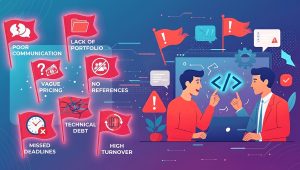
📌
Highlights
-
✔Vendor choice directly affects project cost, time, and long-term value.
-
✔You will get seven concrete warning signs to watch in vendor talks and proposals.
-
✔Each red flag includes practical checks you can run in sales calls or RFP reviews.
-
✔Use the list as a checklist during interviews, proposal comparisons, and reference calls.
-
✔Prioritize transparent pricing, clear requirements, QA standards, and measurable communication.
-
✔How to spot underquoting and demand transparent pricing line items.
-
✔Which development partner warning signs indicate delivery or quality risk?
-
✔What to ask on reference calls and a short scorecard to use.
-
✔Immediate steps: request discovery deliverables, PM ownership, a QA plan, and a shared project board.
After Reading, You Will Be Able To: Run a supplier checklist, conduct a focused reference call, compare vendor estimates on equal terms, and spot common mistakes when selecting dev team members or companies. If you’d like help applying these checks to your project, request a 30-Minute Feasibility Review With Webo 360 Solutions to validate requirements, pricing, and timeline assumptions.
In This Short Guide, You’ll get clear definitions and practical development partner warning signs for seven high-impact red flags. Each entry includes real-world examples (anonymized where needed), a concise “Why this matters” summary, and immediate actions you can take during vendor selection.
Use This List As A Decision Tool: You’re not just hiring coders—you are selecting a software vendor who influences timeline, code quality, ongoing maintenance costs, and long-term scalability. In 2026, AI-assisted builds and third-party dependencies introduce new hidden risks (for example, unexpected dependency upgrades breaking CI pipelines), while cloud complexity and tightening security requirements increase the cost of mistakes.
Trust Matters: This piece focuses on verifiable evidence — process, QA standards, and transparent estimates and positions Webo 360 Solutions as a benchmark for clear delivery practices without a hard sell. If you’re evaluating vendors now, consider a quick feasibility review to sanity-check scope and pricing assumptions with an experienced delivery partner.
Why Choosing The Right Development Partner Is A High-Stakes Decision In 2026
Selecting the correct delivery team is one of the highest-stakes choices your company makes today. Modern software development stitches together cloud infrastructure, third‑party APIs, and compliance obligations; when one link fails, the whole project can slow down or break. That interconnection means poor delivery discipline compounds quickly and raises project risk, technical debt, and ongoing maintenance costs.
Ground The Urgency In The Facts: The Standish Group CHAOS report (2023) shows only 29% of IT projects meet scope, time, and budget, and more recent industry analyses estimate up to 75% of projects miss objectives or overrun costs. The outsourcing market is large and growing — roughly $618.13B estimated in 2026— which makes your vendor choice decisive for results.
Consequences For Your Business Are Concrete: Budget overruns, missed launch windows, stakeholder churn, and systems that need costly rewrites all start with an unreliable supplier. For example, a seemingly minor third‑party API version bump can break authentication flows and pause integrations for weeks; an untested cloud migration can blow through expected hosting budgets in a single spike. Conversely, mature development companies with disciplined plans, clear communication, and proactive risk management make outcomes measurable and predictable.

Failure Rates You Can’t Ignore: Why Vendor Selection Affects Budget, Timelines, And Outcomes
Operationally, the high stakes look like delayed milestones, unclear ownership, and small misunderstandings that escalate into major rework. The goal of the rest of this guide is pragmatic learning to spot practical warning signs early before contracts and sunk costs accumulate so you can protect launch dates and product quality.
How This Affects You:
What a feasibility review covers: A focused sanity check on scope, assumptions, high‑level architecture, and pricing; a short risk register highlighting potential integration, security, and scaling concerns; and a recommended next step (discovery, fixed milestones, or further scoping).
To have an experienced delivery team validate your assumptions, highlight risks, and provide a transparent view of timeline and pricing so you can make a data-driven decision.
Development Partner Warning Signs: Pricing Traps That Indicate Delivery Risk
Low-ball pricing often hides skipped steps that later cost your company far more. A proposal that is dramatically cheaper than competitors can mask a weak process, missing QA, or an incomplete scope — a common software delivery partner risk. and a frequent cause of overruns in downstream project phases.

What This Looks Like In The Real World
Underquoting shows up as a near-zero discovery phase, minimal questions during scoping, and confident claims like “everything included.” Those are Development partner warning signs that often signal missing assumptions.
An Anonymized Case: A mid-market SaaS provider hired a low-cost dev team at roughly 50% of other bids. The vendor skipped a proper discovery, delivered an MVP on schedule, but key integrations failed at scale. Recovery required three additional sprints and a cloud reconfiguration that doubled the total project spend and delayed launch by six weeks, a textbook example of the hidden price of cheap proposals.
Practical Warning Signs To Watch (Red Flags)
Immediate Checklist — Pricing And Scope
Why This Matters
Low price often equals rushed builds, fragile code, and hidden technical debt. Those issues produce production incidents, long delays, and expensive rework that can surpass any initial savings. From a procurement perspective, the cheapest bid without documented assumptions is a significant risk factor in project delivery and long-term product quality.
| Warning Sign | What It Hides | Business Impact | What To Request Instead |
|---|---|---|---|
| No discovery line item | Unclear requirements | Scope drift, missed features | Discovery with deliverables and acceptance |
| No QA allocation | Skipped testing | Production incidents, hotfix costs | QA plan, environments, and test criteria |
| “Everything included” claims | Hidden exclusions | Surprise fees and delays | Explicit exclusions and change control |
How to compare bids: Normalize proposals by asking each vendor for the same discovery deliverables, milestone list, QA scope, and change-request terms. Score proposals on clarity of assumptions, completeness of requirements, and presence of measurable acceptance criteria — not just price.
Ask for transparent pricing: Request an estimate that documents assumptions, milestones, scope boundaries, and a clear change-request process. For a clean, comparable quote, Request A Transparent Estimate From Webo 360 Solutions that lists milestones, deliverables, and acceptance criteria so you can judge clarity — not just cost.
Software Delivery Partner Risks: Verifying Experience Matters
“A glossy portfolio means little unless you can trace real projects and measurable results back to the team.”

Define verifiable track record: Logos and screenshots are table stakes; you need comparable projects, measurable results (performance, conversion, uptime), and direct client conversations that confirm who actually did the work.
What Strong Experience Looks Like
Strong experience means demonstrable, relevant outcomes of similar scope, evidence of integrations handled cleanly, measurable performance improvements, and retained senior oversight during delivery and handover. In short, prove the team delivered the results, not just the marketing collateral.
Practical Warning Signs To Watch
How To Verify — A Simple 3-Step Process
Simple Reference-Call Script (And Scorecard Template)
| Check | What It Reduces | Business Impact |
|---|---|---|
| Direct client calls | Unverified claims | Lower delivery risk |
| Measurable outcomes | Scope guesswork | Fewer requirement misses |
| Proof of who did the work | Outsourced surprises | Shorter delays |
Buyer tip: Validate whether the company owned the project end-to-end and which team actually built the software. If you’re unsure how to run these checks, request our reference-check template and scorecard to streamline calls — a practical step when evaluating a software development company. This process is central to How to choose a software development partner: prioritize verifiable experience, measurable results, and direct client access before you sign.
Choosing A Software Vendor: Spotting Communication Pitfalls
If emails go unanswered and proposals arrive late, your project risk is already rising. Communication issues commonly appear during the sales stage and rarely improve after contract signing unless there’s a reproducible process in place. Treat early responsiveness as an indicator of how the vendor will behave during delivery.
Real-World Examples
Sales calls where follow-ups vanish, vague status updates, and shifting points of contact are frequent warning signs that a development partner will struggle to keep you informed. Typical failures include “We’re working on it” updates without documented blockers, decisions made without recorded tradeoffs or owners, and critical issues disclosed only after milestones slip.
For Example: A product team that received a weekly demo and live backlog access caught a misunderstood acceptance criterion in sprint 2; fixing it then cost one half-day of rework. By contrast, another team discovered the same issue only at release, which required two weeks of rework and delayed launch — a clear demonstration of how transparency saves time and money.
Practical Warning Signs To Watch
Communication scorecard (use in sales calls)
Questions To Ask In The Sales Call
Why This Matters
Low transparency creates misaligned expectations, scope confusion, and costly rework. When you can’t see progress or the backlog, small misunderstandings compound into late deliveries and higher costs. Good communication looks like weekly check-ins, asynchronous status notes, an open backlog you can view, and named owners for product, engineering, and QA.
| Warning Sign | What It Hides | Business Impact | Fix To Request |
|---|---|---|---|
| No shared project board | Hidden priorities | Misaligned work, rework | Live backlog access and read-only links |
| Slow sales responses | Poor follow-up culture | Late starts, unclear scope | Response SLA and demo of the handoff process |
| No escalation path | Undisclosed risks | Delayed fixes, missed launches | Defined owners and escalation matrix |
Decision tip: Treat sales-stage responsiveness and willingness to share artifacts as your baseline. If you want visible reporting and early risk escalation, ask to see a project board and SLA during the sales process before you commit.
Contact Webo 360 Solutions for a sample project board, a sales-stage SLA, and a short demo to see how transparent communication prevents costly rework.
Development Partner Warning Signs: Signs Of Weak Project Management In A Software Vendor
A solid delivery process turns guesses about scope and timelines into measurable outcomes. A mature delivery approach reduces ambiguity by producing artifacts and checkpoints; you can validate a discovery report, risk register, milestone plan, sprint cadence, and a defined change-control process.
What A Mature Process Looks Like
How To Evaluate Their Pm — Quick Checklist
Practical Warning Signs To Watch
Change-Control Microflow (Example)
Request → Vendor evaluates and returns a written estimate → Client approves or rejects → If approved, update milestones and acceptance criteria, and add entries to the risk register. This simple flow prevents surprise costs and preserves expectations.
| Warning | What It Hides | How To Fix |
|---|---|---|
| No PM ownership | Unclear accountability | Name a delivery owner and provide contact details |
| No milestones | Unmeasurable progress | Milestone-based plan in the contract with acceptance terms |
| No change control | Scope creep and surprise costs | Defined change-request process with estimates and approvals |
Pressure-test questions: Who owns delivery day-to-day? How are milestones defined and accepted? How will you estimate and approve changes, and who signs off on them? These questions help you assess whether a development company can realistically meet time, scope, and quality expectations.
This ties to “How to choose a software development partner”: Prioritize vendors that provide concrete artifacts (discovery report, milestone plan, risk register) and named owners. These items let you compare vendors on process and predictability rather than price alone.
Request A Delivery-Plan Audit From Webo 360 Solutions — we’ll review your vendor’s milestone plan, risk register, and change-control approach and provide a short remediation list or a milestone-based contract template you can use in negotiations.
Software Delivery Partner Risks: Unclear QA And Testing Practices
Unclear QA standards hide how a team validates, protects, and scales your product under real load.
You can’t see how features are validated, regressions prevented, or code reviewed. That gap leaves the product exposed to bugs, security issues, and performance slowdowns that increase long-term costs.
Real-World Examples
Teams that ship to meet a date without adequate testing often introduce repeat incidents. Skipping code reviews and CI/CD gates to “move faster” produces fragile code that breaks when new features are added. Some MVPs appear fine at launch but fail under real traffic, forcing costly rewrites or platform migrations.
Practical Warning Signs To Watch
QA evidence list — ask for these artifacts
Security & Performance Specifics To Request
Why This Matters
Poor QA leads to production incidents, security exposure, and rising maintenance costs. These issues slow time to market, erode customer trust, and increase the total cost of ownership. Asking for concrete QA artifacts during vendor selection reduces the risk of delivering brittle code and unexpected outages.
| Warning Sign | What It Hides | Business Impact | What To Ask |
|---|---|---|---|
| No CI/CD checks | Uncaught regressions | More hotfixes, slower releases | Which tests run on each commit? |
| No pen test plan | Unknown vulnerabilities | Security incidents, liability | When was the last pen test, and who owns fixes? |
| No performance targets | Brittle scaling | Re-platforming, outage risk | What load must the product sustain? |
Request Webo 360 Solutions’ QA Checklist and a short staging demo to validate test coverage, CI/CD gates, and performance expectations before you commit.
Why Webo 360 Solutions Stands Out As A Trusted Technology Provider
When you’re hiring a development partner, choose a company that proves delivery capacity with artifacts, references, and measurable QA — not just promises.

Webo 360 Solutions structures engagements to reduce risk early and keep projects predictable. We combine discovery-led scoping, milestone-based contracts, and transparent reporting so you — the client — retain control over scope, budget, and timeline.
-
✔End-to-end ownership: Named delivery owner, weekly sprint demos, and a continuity plan so your project keeps moving if resources shift.
-
✔Transparent pricing: Line-item estimates that list assumptions, discovery deliverables, QA scope, and change-control terms to avoid surprise costs.
-
✔Proven QA and automation: CI/CD gates, automated test coverage metrics, and quarterly vulnerability scans with documented remediation ownership.
-
✔Reference-first approach: Anonymized artifacts (architecture diagrams, sprint reports) and direct client references for comparable projects to validate results and team experience.
-
✔Scalability & security: Load-testing reports, observability dashboards, and cloud cost estimates to prevent runaway hosting bills and platform rework.
Ask any vendor for the discovery report, a milestone plan with acceptance criteria, a sample sprint report, the last pen-test summary, and a staging demo. If they can’t provide those, treat it as a red flag.
Measurable Differentiators:
- Average sprint demo cadence: Weekly; client access to backlog: read-only from day one.
- Standard QA deliverables: Test plan, CI pipeline summary, and automated coverage report with target thresholds.
- Reference process: Three verifiable client calls + anonymized artifacts for projects of similar scale.
Recommended Next Steps:
Conclusion
Treat the list below as a final checklist: If any one red flag exists, ask tougher questions; if several appear, pause the deal. These warning signs are not minor — they determine whether your project meets time, scope, and quality expectations.
Quick recap: Unclear pricing, unverifiable experience, poor communication, weak project process, and missing QA/security expose your projects to risk, delays, and surprise costs. When hiring a development partner, follow the checklist and pressure-test estimates and artifacts early.
Final Checklist
Request transparent estimates, run reference calls, insist on a shared project board, confirm PM ownership, and require a QA and performance plan with test environments. These steps show you how to choose a software development partner confidently and avoid common mistakes when selecting dev team members or companies.
If you want help, speak with an expert at Webo 360 Solutions to review requirements, validate scope, and pressure-test a delivery plan. A strong partner acts like an extension of your team and keeps you in control.
Next Steps: Schedule A 30-Minute Feasibility Review | Send Your Project Brief
FAQ
What pricing red flags indicate hidden delivery risks?
A trustworthy vendor will provide a clear estimate with contingency, deliverable dates, and acceptance criteria.
How to verify a software delivery partner’s track record?
If a company refuses reference calls or shares only generic portfolios, treat that as a warning sign.
What communication patterns indicate trouble early on?
How do you evaluate a development partner’s project management and delivery process?
If the answer is we’ll figure it out, expect missed deadlines and scope creep.
What QA criteria should be non-negotiable?
Confirm performance targets and rollback plans. Vendors that skip these items increase your long-term maintenance and security risk.
What are common real-world signs of underquoting or hidden costs?
Look for everything included language that lacks details. Insist on a contract with clear change-request pricing and scope boundaries.
Why does a verifiable track record matter for delivery risk?
Without that, you face a higher chance of missed requirements, avoidable delays, and costly rework.
What questions should you ask during sales to test transparency?
Request access to a current project board or anonymized artifacts. Transparent answers indicate mature delivery practices.
How should you verify security and scalability practices?
Vendors lacking these details often deliver brittle MVPs that fail under real traffic.
When should you consider walking away from a proposal?
Choosing the wrong team can cost far more than postponing a decision.
Schedule A 30-Minute Feasibility Review
with Webo 360 Solutions — we’ll validate assumptions, highlight risks, and provide next-step recommendations.