How to Evaluate a Business Idea Quickly (Before You Build It)

How do you know if your business idea is worth building—or just sounds good on paper?
Your Goal Is Simple: Learn how to evaluate a business idea fast and objectively so you don’t spend months building, hiring, or burning cash on the wrong opportunity. Ask yourself, is your idea worth building, and how do you know if the idea will succeed?
📌
Highlights
-
✔Write a 25-word business description that you’ll use on landing pages and tests.
-
✔Run a 90-minute problem-validation session with the included checklist.
-
✔Use the pre-sell landing page template to test willingness to pay within 24–72 hours.
-
✔Calculate simple unit economics (price − direct cost − CAC) with the provided spreadsheet.
-
✔Follow the decision rubric: proceed, pivot, or pause based on measurable proof.
-
✔Use a fast, checklist-driven framework to assess concepts before building.
-
✔Start by validating the problem and naming the paying customer.
-
✔Run early tests to reveal unit economics and scalability limits.
-
✔Real proof looks like deposits, repeat behavior, and willingness to switch—not just praise or clicks.
-
✔Decide: proceed, pivot, or pause based on consistent signals across interviews, surveys, and MVPs.
You’ll follow a step-by-step framework: Validate the problem, define buyers, confirm demand and market fit, map competitors and alternatives, craft a repeatable value proposition, run early validation tests, and check feasibility, unit economics, and scalability.
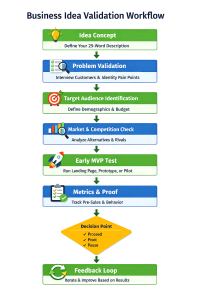
NFIB reporting has long shown that many small businesses struggle to reach profitability; roughly three in ten firms report clear profit, while a similar share breaks even. (Fact check confirms the NFIB dataset and the year before publishing.) That split underscores why a rapid evaluation loop matters if you want to save time and money instead of relying on excitement alone.
This guide is checklist-driven and practical. You’ll get clear outputs you can use immediately (a 25-word description, a problem statement, a customer profile, test templates, and basic unit-economics checks).
You’ll also see short examples—faster horses, the milkshake “jobs to be done” study, and public company lessons like Pets.com, and we work to illustrate common traps. “Quick” here means enough evidence to decide to proceed, pivot, or pause.
Start Validating Your Business Idea Today!
How To Use This Guide: Read once, then work through each section as a worksheet and capture evidence and decisions in the downloadable one-page validation worksheet. Use it to track tests, market research for idea validation, and the outputs you’ll use to evaluate whether your opportunity is worth deeper investment.
What a “Business Idea” Really Is (and What It Isn’t)
Pin down whether the concept can be priced, delivered, and repeated before anything else — that clarity separates a hobby from a viable new business.
Definition: A monetizable offer is a product, service, or product-service combination that returns profit after costs. If you cannot name who pays, what they buy, and what changes for them, the concept is not yet a business idea.
25-words-or-less test: Explain what you sell, who buys it, and why it matters in one short sentence. Save that sentence, use it as your headline on landing pages and test copy. If you struggle, refine the concept until it is repeatable and explainable.

Quick Quality Screen
Check |
Question |
Pass/Fail |
|---|---|---|
Customer |
Who paid? | Pass if a specific person/place/segment |
Offer |
What did they buy? | Pass if priced and deliverable |
Impact |
What changed for them? | Pass if clear, measurable value |
Do the 25-word test now — write your sentence and compare it to the examples in the downloadable workable business idea checklist (the worksheet will show you where to paste the sentence and how to use it in landing-page tests).
Common pitfall: Confusing a cool product with a viable business idea when pricing, delivery, or repeatability is unclear.
Go/no-go: If you cannot state the offer simply and link it to profit, pause and sharpen the concept. Next, validate the underlying problem with a jobs-to-be-done approach so your idea targets a real, repeatable pain.
How To Evaluate A Business Idea By Validating The Problem First
Jobs-to-be-done thinking makes validation practical and actionable. Instead of asking which features people want, identify the job they tried to complete, the context they were in, and what a successful outcome looked like. That shift reveals true needs and uncovers substitutes customers already accept as an essential step in the idea validation techniques you’ll use to see if the demand is real.
Broaden competition beyond direct rivals. Including substitutes, workarounds, and services people use to get the job done, these good enough options reveal real switching costs and the actual value you must deliver to win customers. Mapping these alternatives is a quick form of market research for idea validation and helps with recognizing real market demand.

One-afternoon Problem Validation Checklist (90 Minutes)
Interview Script (3–5 Core Prompts)
How To Synthesize Complaints Into Themes
Copy the 10 complaints into three columns: complaint | workaround | impact (and add tags: severity, frequency, quote). Then group similar complaints into 2–3 themes by frequency and severity.
Example: 10 complaints → “slow checkout” (4), “product availability” (3), “poor support” (3). Prioritize the theme with the highest frequency and a clear willingness to pay.
Quick Numeric Switching-Cost Method
Estimate switching cost as: minutes lost × hourly wage equivalent + out-of-pocket cost + friction score multiplier.
Example (illustrative): (15 minutes × $20/hr = $5) + $5 shipping + (friction score 3 × $2) = roughly $16 perceived cost. Use this number to judge whether your incremental value in time saved, money, or convenience can reasonably overcome resistance.
Practical Example And Common Mistake
Faster horses is the classic symptom-versus-job mistake. The milkshake jobs-to-be-done study (often cited in product and marketing literature) showed commuters bought milkshakes to make long drives less boring and avoid messy breakfasts, in context, not features, revealing the real job. If you target the symptom (faster product) rather than the job (comfortable, convenient in-car breakfast), you miss the opportunity. This is one of the core idea validation techniques: surface the job, not the requested feature.
Symptom |
Job |
Solution Clue |
|---|---|---|
| Faster horses | Faster, reliable transport | Consider engine, comfort, and cost |
| Sticky morning hands | Easy, tidy breakfast on commute | Thicker, longer-lasting shake |
Slow checkout |
Faster purchase flow | One-tap payments, saved carts |
Decision rule: If you can’t find a repeatable pain with measurable consequences and some customers are already paying or showing willingness to pay, revise the target job or pause the opportunity. Validate the problem first; only build after repeatable demand is evident.
Next: Use your validated job to name the specific customers who actually pay, then test reach and market size.
🚀“Run a 90-Minute Problem Validation Session Today.”
Target Audience Analysis; Find The People Who Actually Buy
Start by naming the specific people who will actually pay, not the broad crowd you wish would care. Narrowing your audience cuts research time, reduces validation cost, and improves your marketing match, so early tests give clearer signals about which segments are real customers.
Define basic signals:

Fast Places To Find Real Prospects
Look where actual customers talk: competitor comment sections, 3–4 star reviews, Reddit and Facebook groups (for example, r/commuting for transit issues), niche forums, LinkedIn posts, and local industry events. These sources give candidate feedback and reveal current workarounds and unmet needs, useful for market research for idea validation.
Customer Profile Mini-Checklist
Profile item |
What to capture |
Why it matters |
|---|---|---|
| Biggest need | Single-sentence pain (e.g., “I need reliable same-day inventory”) | Prioritizes product focus |
| Current workaround | Tool, hack, or competitor (and cost/time) | |
Budget & frequency |
Last purchase, price paid, how often they buy |
Worked Example Persona (Short)
Persona: “Urban commuter moms, age 28–40, combined household income $75k, value convenience, spend ~$50/month on ready‑to‑eat breakfast.” This profile helps you choose test channels (commuter Facebook groups, morning transit ads) and set realistic reachable-TAM assumptions.
Two Survey Question Templates
“In the past month, how many times did you use your current solution? Please describe the last time.”
“When you last bought X, how much did you pay? Would you have paid $Y for a faster or more reliable option?”
Outreach Script — Find 10 Real Prospects Now
Quick DM/email (copy/paste): “Hi — I’m testing a quick idea to help [persona]. Can I ask 3 short questions about how you currently solve [problem]? It’ll take 5 minutes, and I’ll share any useful findings.”
Example reply to expect: “I use X 3–4 times a week; last paid $Z.” Use this in groups, comments, or LinkedIn DMs to reach real buyers (not friends/family).
Segmentation And Reachable Tam
Focus on micro-markets you can reach cheaply (neighborhoods, verticals, or communities). Estimate reachable TAM with a quick calculation segment population (e.g., 50,000) × % with the problem (20%) × % likely to switch in tests (5%) = reachable customers (50,000 × 0.20 × 0.05 = 500). This gives a realistic opportunity rather than an inflated headline number.
Simple Survey Rules
Common mistake: Asking friends or family who aren’t true buyers and mistaking encouragement for market demand. Clear audience work sharpens market sizing, tightens competitor sets, and improves your value proposition.
🚀 “Identify Your Paying Customers Fast.”
Next step: Measure demand signals in these target segments so you know whether the people you identified will actually pay for the solution. For templates, paste your persona into the downloadable worksheet and use the built-in outreach scripts to speed validation.
Market Demand And Market Fit Signals You Can Verify Quickly
Small, measurable signals can tell you whether a market will buy before you build the full product.
Start by slicing the market into segments you can actually reach. For each segment, list the top demand drivers, price sensitivity, convenience, regulation, trends, and disposable income, and note which drivers have shifted recently. That gives a practical view of where to test first and helps with recognizing real market demand.
Estimate Demand By Segmenting And Listing Drivers
Segment |
Top driver |
Quick check |
|---|---|---|
| Urban commuters | Convenience | Trial sales on morning routes |
| Small retailers | Price sensitivity | Sample product run with margin test |
SaaS companies |
Regulation & uptime | Pilot with one company |
Worked Tam Example (Quick Math)
Pick one reachable segment and estimate reachable customers: population (e.g., 50,000 commuters) × % with the problem (20%) × % likely to switch or buy during tests (5%) = reachable customers (50,000 × 0.20 × 0.05 = 500). Multiply by your expected price to get a realistic near-term revenue number. This avoids inflated headline TAMs and focuses on the opportunity you can actually pursue.
Cycle, Tam Shortcut, And Light Testing
Classify the market as emerging, plateau, or declining. Emerging markets can offer strong upside but usually require more education and capital. Plateau markets often have predictable sales and clearer unit economics. Use this checklist to decide quickly:
Use a simple TAM-style shortcut to estimate potential customers in your reachable segments and multiply by the share that is underserved or lacks access. That gives a realistic, testable opportunity instead of an inflated headline number.
Lightweight MVPs And Expected Cost/Time Ranges
Test the waters with low-effort experiments that reveal willingness to pay. Choose the test that fits the segment and channel. Consumer offers often start with a landing-page pre-sell, while B2B opportunities usually begin with a pilot or concierge MVP.
Real demand shows repeat purchases, referrals, deposits, and willingness to wait, not just clicks. Avoid confusing broad interest (email signups or likes) with true market fit when paying segments are tiny or costly to acquire.
Try a quick TAM calculation using the downloadable template to get a realistic reachable-customer estimate for your idea and decide which minimum viable test (MVT) or MVP to run next.
Competitive Landscape: Direct, Indirect, and “Good Enough” Alternatives
Map the competitive landscape early; competitors show whether customers already pay and where the real opportunity sits.
Competition is a validation tool: active companies buying ads, ranking in directories, or repeatedly mentioned in reviews usually indicate paying customers and real demand. If you find no competitors, that can mean low pain or that buyers aren’t willing to pay, or it can be a nascent market that requires heavy education and capital. Treat “no competitors” as a hypothesis to test, not proof of a greenfield opportunity.
Fast Discovery Places
Step-By-Step Competitor Discovery (Mini Process)
Widen The List With The Job Lens
Think beyond rival products. List the substitutes customers use to get the job done (DIY hacks, adjacent services, spreadsheets, consultants). These “good enough” alternatives reveal switching costs and the minimal value you must exceed to win customers, a core part of competitor research that reveals real opportunity.
Judge Saturation Versus Healthy Competition
Look for margin pressure, dense ad auctions, and undifferentiated offers — signs of a crowded market where customer acquisition costs may be high. Healthy competition shows diverse positioning and room to claim a niche (for example, superior local service or simpler pricing).
Competitor Analysis Checklist
Area |
What to capture |
Why it matters |
|---|---|---|
| Positioning | Core claim and target segment | Shows where you can differentiate |
| Pricing | Price points, tiers, discounts | Sets customer expectations and margin limits |
| Logistics | Delivery, onboarding, and guarantees | Operational strengths you must match |
| Features | Core capabilities and missing functions | Product gaps become testable hypotheses |
Reviews |
3–4 star feedback and recurring complaints |
Provides practical improvement ideas |
Example — turn a review into a hypothesis (3-step experiment)
Action step: Document three gaps unmet by existing companies (pricing, delivery speed, support clarity) and turn each gap into a simple hypothesis you can test quickly. Expect this discovery work to take ~15–30 minutes per competitor if you use the provided template.
Download the competitor discovery template (columns: name, URL, ad presence, price, delivery, top complaints) to speed this work and capture the evidence you need to design focused minimum viable tests.
Your Value Proposition And Differentiation: Why You, Why Now
Your pitch must answer one simple question: why should a customer pick your offer over what they already use? That answer should be short, testable, and tied to proof from your problem validation and competitor research — the core inputs that show the value you claim is real.
Create a single-line “why choose you” statement that a buyer can repeat and a teammate can sell. Link that line to evidence: a validated problem, a reachable buyer, and a clear competitor gap you can exploit.
Two disruption lenses can help you spot opportunities: low-end disruption competes on price and simplified features for the least profitable customers; new‑market disruption serves overserved or excluded users with a “good enough” solution that opens demand. Use these lenses to decide whether to enter on cost, convenience, or a trust/quality gap.
Fill-In-The-Blank One-Line Pitch (Template)
Try: “We help [target customer] do [job] by [solution], so they can [main benefit].”
Practical Exercise: Map A Competitor Gap To An MVP
Choose one clear weakness from your competitor analysis, such as a slow returns process.
Build a focused 30-day pilot that directly addresses the gap — for example, instant refunds via live chat.
Track conversion lift (+5–15%), return rate, and repeat purchases within 60 days. Positive movement confirms real traction.
Item |
What you beat |
Proof to show |
|---|---|---|
Closest alternative |
Big retailer |
Faster delivery, local pickup |
What do you do better |
Customer care |
Response time, improved reviews |
Tradeoff |
Fewer SKUs |
Lower cost, simpler choice |
Caution: Pets.com is often cited as a cautionary example of heavy marketing spend, weak unit economics, and unclear differentiation contributing to its failure. Don’t confuse a long feature list with a real reason customers will switch and pay.
Outputs you should have after this step: One clear homepage headline (your 25‑word sentence), two short proof items ranked by strength (1. paid proof: pre-sale/deposit; 2. pilot result; 3. customer quote), and one concrete MVP experiment to run next.
🚀 “Craft Your Unique Value Proposition.”
Test your headline with a one-page landing page and an A/B test template to see which messaging converts your target audience best. Then use the winning line in surveys, ads, and early interviews to keep your positioning consistent as you validate. For a quick checklist, paste your headline into the Workable business idea checklist to confirm it meets the clarity and value criteria.
Early Validation Methods Before You Build The Full Product
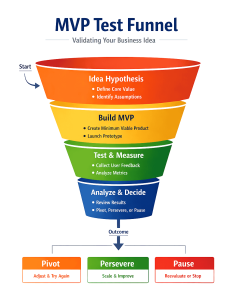
Early validation reduces risk by showing whether people will switch and pay before you build the full product. Run fast tests that focus on intent and real behavior, not vanity engagement. These tests inform product, marketing, and unit-economics decisions and form the core of your idea validation process.
User Interviews: Prompts That Reveal Willingness To Pay
Timestamp | Quote | Severity (1–5) | Frequency (mentions) | Willingness to pay (estimate).
This structure makes synthesis faster and helps quantify demand for pricing and messaging.
Surveys That Reduce Bias
(e.g., “How many times in the last month…?”), and avoid leading language.
Follow with an anchored test: “Would you have paid $Y for a faster or more reliable option?”
MVP Options, Step-By-Step And Expected Time/Cost
(MVTs) with typical time and cost ranges.
Use a one-line pitch, clear CTA, and two price options. Treat small tests as directional only.
and uncover operational friction. Low dev cost, higher human time.
and collect early buyer or enterprise interest.
Budget $200–$2,000 to capture retention and margin signals.
Metric |
Rule-of-thumb target |
Why it matters |
|---|---|---|
Traffic source |
Paid or organic (identify which works) |
Shows whether marketing channels can reach your target audience |
Pre-sell conversion |
5–15% (rule of thumb for well-targeted offers) |
Signals genuine purchase intent beyond clicks or likes |
Signup→interview |
30%+ |
Indicates lead quality for deeper validation |
Paid commitments |
Deposits, pre-orders, or LOIs |
Strongest signal—real money beats interest |
<3% pre-sell conversion → revise message or offer and rerun. 5–15%+ → proceed to concierge MVP or paid pilot. Treat thresholds as heuristics; adjust by channel and price.
Leading questions, vanity metrics, and overbuilding the MVP. The strongest signal is paid commitment — deposits, pre-orders, or paid pilots — not clicks.
Feasibility, Scalability, And Cost vs. Return
List startup costs, monthly burn, and a simple revenue path to decide whether to fund, proceed, or rethink.
Feasibility Checklist
Basic Unit Economics: Simple Cost Vs. Return Math You Can Do Quickly
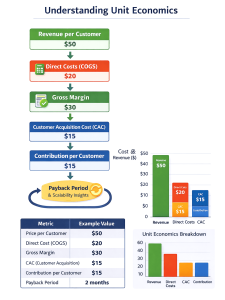
Compute revenue per sale minus direct costs (product or service delivery, shipping) to get gross margin, then subtract customer acquisition cost (CAC).
Example (copyable): Price $50 − Direct cost $20 = $30 gross margin; minus CAC $15 = $15 contribution per customer. If the contribution recovers the startup/customer onboarding cost within a few months, unit economics are plausible. These heuristics adjust thresholds to your industry and price point.
Worked Sensitivity Example (Quick)
Try two scenarios to see sensitivity to CAC:
Scenario A: Price $50 − Direct cost $20 = $30 gross margin; CAC $10 → contribution $20.
Scenario B: Same margin but CAC $25 → contribution $5. The payback period and scaling decisions differ dramatically; run the simple spreadsheet to model a range of CACs and volumes.
Simple Scalability Test: What Happens To Costs As Customers Grow?
Simulate 100, 1,000, and 10,000 customers and note whether costs rise linearly (labor, shipping, physical goods) or stay flat (software and digital products).
Quick spreadsheet structure: columns = customers | revenue | direct cost | CAC | contribution | cumulative payback months. This helps project margin shifts, staffing needs, and whether the model can support rapid growth.
Founder Fit: Skills, Limitations, And Consistent Execution
If any answer is no without a plan, build hiring or partnership steps into your roadmap. Founder fit matters as much as the numbers. Execution risk can kill a promising idea.
Funding Options (Neutral Overview)
If the revenue gap is large, consider options tailored to your stage bootstrap with pre-sales and concierge revenue, run a paid pilot or deposit-based pre-orders, pursue small business loans for inventory, or seek angel funding for higher upfront capital needs. Choose the least dilutive path that matches your time horizon and tolerance for risk.
Real-World Warning Sign: Unsustainable Models And The WeWork Lesson
Warning: Rapid growth funded by capital does not fix negative unit economics. WeWork’s expansion showed how scaling losses can create fragile business models; growth without a path to positive contribution inflates risk and investor exposure. Treat explosive growth claims skeptically unless unit economics and payback timelines are clear.
Decision rubric: Proceed only if unit economics look plausible, scalability is not structurally blocked, and you have the skills or a plan to hire resources to execute. Otherwise, pivot to a narrower opportunity, pause to gather more evidence, or fund a clear bridge with defined milestones. These are practical rules for how to evaluate startup ideas and prioritize limited resources.
Estimate your unit economics now — download the simple calculator to plug in price, direct cost, CAC, and projected volumes to see payback timelines and scalability impacts; use the sample inputs to compare best- and worst-case scenarios before you commit.
How Webo 360 Solutions Can Help
Webo 360 Solutions supports entrepreneurs and companies at each stage of this process in a practical, non‑salesy way. We offer short workshops and feasibility audits that help you validate the problem, identify target customers, and prioritize hypotheses. For teams that need technical clarity, we run technical feasibility reviews and architecture assessments to highlight implementation risk and scalability constraints.

What We Help You Do
Validate the real problem: Confirm demand before committing to development.
Identify high-value customers: Test willingness to pay early.
Prioritize the right hypotheses: Focus on what truly moves the business.
Reduce technical risk: Address scalability issues before they’re costly.
Validation & Feasibility Support
Idea validation workshops: Fast audits to test feasibility.
Technical feasibility reviews: Architecture and system assessments.
Risk identification: Scalability, cost, and delivery constraints.
MVP & Early Testing Execution
MVP sprints: Concierge or prototype-first execution.
Pre-sell landing pages: A/B testing and demand validation.
Unit economics & competitors: Proven templates and discovery frameworks.
Flexible Execution Support
Team augmentation: Designers, engineers, and product leaders.
Milestone-based engagements: Measurable outcomes only.
No long-term lock-ins: Only what your validation stage requires.
When you’re ready to move from tests to a product, Webo 360 Solutions can run focused MVP sprints (concierge or prototype‑first), help you set up pre-sell landing pages and A/B tests, and provide templates for unit‑economics and competitor discovery. If you need execution capacity, we can augment your team with designers, engineers, or product managers for short engagements—always framed around measurable milestones and learnings, not long-term commitments.
Want to move faster? Talk to an expert for a 30‑minute project scoping call to review your 25‑word description and validation plan; the call includes a quick gap analysis and suggested next experiment.
Start your 90‑minute validation session — Book a 30-Minute Idea Validation to Schedule Your Call. Walk through your key assumptions with an experienced reviewer.
If you still have questions, check the FAQ below or Contact Us to get tailored feedback.
Conclusion
Wrap the process with a simple decision rule; proceed, pivot, or pause based on proof from tests and numbers—not on enthusiasm alone. This is how to know if an idea will succeed in practice: evidence, not wishful thinking.
Define the business idea in one line, validate the problem, name your target buyer, check market demand and competitors, craft a clear value proposition, run rapid tests, and confirm feasibility and scalability.
Keep concrete output; you can act on a 25-word description, a clear problem statement, a customer profile, demand assumptions, a competitor grid, a value proposition, and basic unit economics. These are the artifacts you use to decide whether the opportunity is worth deeper investment and to evaluate startup ideas in an orderly way.
Final Checklist (Use To Decide: Proceed / Pivot / Pause)
Decision Guidance: Proceed if most checklist items are met and signals are consistent; pivot if one core assumption fails but others hold; pause if demand or the core problem is absent.
Frequently Asked Questions
What should you test first before building a product?
How do you know a concept is clear enough to explain quickly?
What quick signals show real customer demand?
How do you identify the right target customers fast?
What’s an easy problem-validation checklist you can run in an afternoon?
How should you map competitors without missing indirect alternatives?
What does a simple value-proposition statement look like?
When is a market considered attractive quickly?
What low-effort MVPs prove demand without building the full product?
How do you use negative reviews to improve your offering?
What basic unit-economics should you calculate early?
How do you check founder fit and execution risk quickly?
What are common validation mistakes to avoid?
How can you test pricing without launching fully?
What checklist helps decide whether to proceed after early validation?
How can a company like Webo 360 Solutions help with early validation?
Book A 30-minute
review to run your 25-word description and validation plan by an expert.